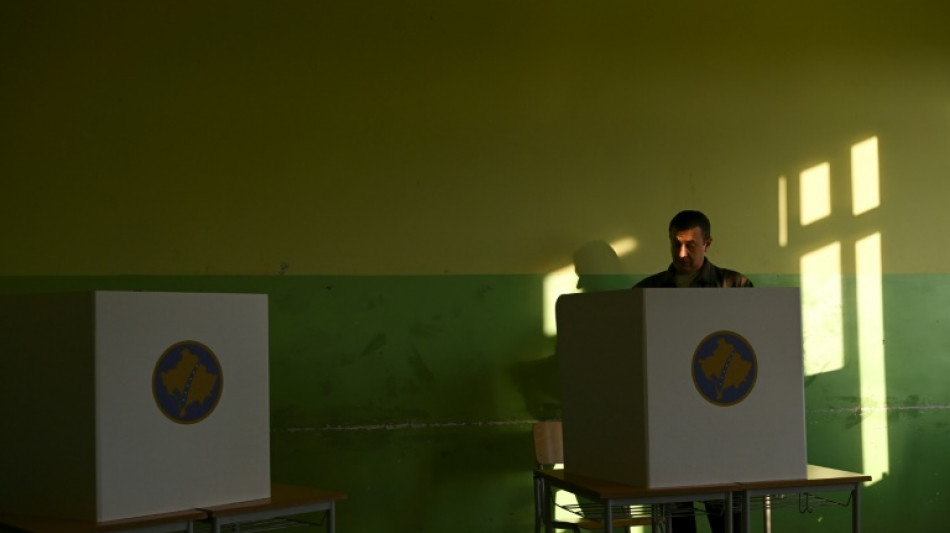
Uncertainty looms in Kosovo parliamentary polls / Photo: Armend NIMANI - AFP
Prime Minister Albin Kurti's ruling party appeared set to secure the most seats in Kosovo's parliamentary elections Sunday but it remained uncertain whether the incumbent stood a chance of forming a majority government.
Sunday's contest largely pitted Kurti's quest to stamp out Serbian influence on Kosovo's soil during his time as premier against the opposition's vow to boost the economy in one of the poorest pockets of Europe.
Without a party winning a clear majority in the 120-seat parliament, Kosovo would likely be headed for days if not weeks of coalition talks and political horse-trading.
Twenty seats are reserved for minority parties, including 10 for Kosovo's ethnic Serbs.
A projection published by leading Kosovo news outlet KOHA said Kurti's Vetevendosje ("Self-Determination") party (VV) was leading the race with an estimated 42 percent of votes.
The right-wing Democratic Party of Kosovo (PDK) trailed in second with 21 percent followed by the Democratic League of Kosovo (LDK) with 20 percent.
An online website set to publish official results as the vote was counted appeared to have crashed on Sunday evening.
The long-time rivals PDK and LDK have partnered to form coalition governments on multiple occasions since the independence war from Serbia in the late 1990s, following mediation and pressure from the international community.
In the run-up to Sunday's vote, Kurti hinted that he would prefer to enter opposition if his party was unable to form a majority government by itself.
Election officials said turnout for the vote hovered around 40 percent.
- Shadow state -
Animosity between Kosovo and Serbia has persisted since the war between Serbian forces and ethnic Albanian insurgents in the late 1990s.
Serbia has steadfastly refused to acknowledge Kosovo's declaration of independence in 2008.
To curb Belgrade's influence, Kurti's government effectively outlawed the use of the Serbian dinar currency, closed banks and shuttered the post offices where Serbian pension payments were cashed.
Belgrade-backed government and tax offices have also been closed and Serbian car number plates have been banned.
The moves have heightened the uneasy relations between Kosovo's ethnic Albanian majority and its Serb minority in the run-up to the polls.
Once known for antagonistic stunts such as letting off tear gas in parliament, the VV has grown from a street movement led by Kurti in the 2000s to Kosovo's dominant political party.
Kurti's government is the first to finish its full term in office since the breakaway Serbian province declared independence.
But Kurti's rule has been turbulent.
Tensions spiked after EU- and US-backed negotiations between Kosovo and Serbia all but collapsed in March 2023.
In the aftermath, NATO peacekeepers were assaulted by rioting Serbs while a deadly armed standoff in the north sent regional tensions soaring.
Throughout the unrest, Kurti has remained unwavering, even if it meant running afoul of Kosovo's vital allies in the United States and Europe.
But his supporters have praised his vision.
"You can see the things (Kurti) has done. He is irreplaceable," Zek Kurtaj, 40, told AFP after landing at the Pristina airport on Saturday ahead of the vote.
- 'Missing out' -
Others suggest Kurti's actions may have been overly disruptive.
Kurti "has been repeatedly accused by opposition parties of delivering little, defying the international community, and complaining about Serbia," wrote Jonathan Moore, an analyst from the Atlantic Council's Europe Center.
Several of Kurti's rivals have sought to focus on Kosovo's economic uncertainty.
Kosovo remains one of the poorest economies in Europe, with roughly 12 percent of its population emigrating since 2011.
Many voters said economic issues were at the top of their minds as they cast their ballots.
"We believe that change will come. I am thinking about employment, the economy, and all other sectors," Remzije Halimi, a teacher, told AFP.
Meanwhile, the LDK led by economist Lumir Abdixhiku has vowed to increase salaries and boost pensions.
In ethnic Serb areas, the Belgrade-backed Serb List party has campaigned on familiar vows to protect the rights of Kosovo's dwindling Serb minority.
Serb voters in the northern city of Mitrovica said they hoped elections would bring more prosperity in the future after years of tensions.
"The situation is now so bad that it can only be better," said Serb resident Dragisa, who only provided his first name.
S.Leysen--LCdB