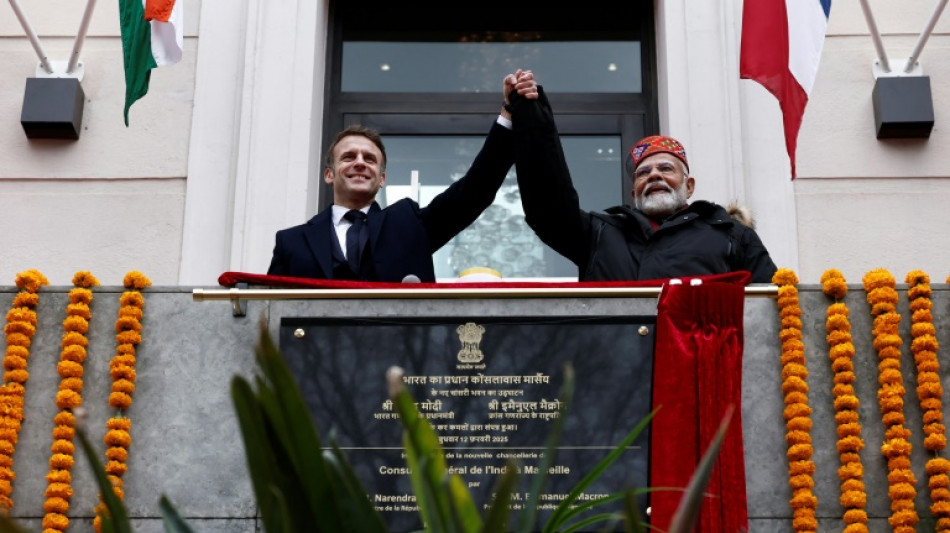
Macron courts Modi in quest for geopolitical 'independence' / Photo: Christian Hartmann - POOL/AFP
French President Emmanuel Macron and Indian Prime Minister Narendra Modi visited southern France with a packed schedule on Wednesday, fostering a relationship that Paris sees as an alternative to great power rivalries.
Macron took Modi for dinner in the picturesque southern town of Cassis on Tuesday, before Wednesday's visit to the Mediterranean coast and France's second-biggest city, Marseille.
They began the day with a homage to Indian soldiers who died in France during World War I, at the Mazargues military cemetery south of Marseille.
They then inaugurated India's new consulate general in Marseille, an event that drew a small crowd of cheering Indians.
Then it was time for business, with a visit to global sea freight company CMA CGM.
Both leaders have been discussing a project called India-Middle East-Europe Economic Corridor (IMEC), a railway and maritime corridor between India and Europe via the Middle East destined to rival China's Belt and Road Initiative.
"We see the relevance of IMEC projet," Macron said during the visit. "Marseille can be clearly the entry point for the whole Européen market."
At the end of a French-Indian business forum, Macron had already praised IMEC as a "fabulous catalyst" for "concrete projects and investment".
Paris also hopes to sell billions of dollars worth of Rafale fighter jets to India's navy, as well as submarines of the Scorpene class.
Macron is also aiming for increased cooperation with India in the nuclear energy sector, notably with the development of small modular reactors (SMRs).
- 'Acting as a bridge' -
Wednesday's schedule included a visit to the experimental nuclear fusion facility ITER, an international project aimed at next-level energy generation.
Modi has visited France during high-profile events before, including for the traditional Bastille Day parade in 2023 and this week's French-organised summit on artificial intelligence (AI).
Macron said at the weekend that the relationship with India's premier is part of France's strategy of seeking an alternative to the superpower rivalry between the United States and China.
"India and France are two great powers who are very closely aligned in our desire to work with the United States of America, and to work with China, but we don't want to be dependent on anybody," Macron said on French television. "We want to be independent."
A former French government minister, who asked not to be identified, told AFP that Macron had "the right intuition" because "Modi, who is leading an emerging power, has found a balanced position between the Americans, the Chinese and the Russians".
"The idea of acting as a bridge between the north and the south is a constant in France's rhetoric," observed Bertrand Badie, an international relations specialist at the Sciences-Po university.
"But this forces Macron to stay silent on the domestic policies" pursued by Modi, he said.
Modi is scheduled to fly to Washington later on Wednesday where he is to meet US President Donald Trump.
A.Peeters--LCdB