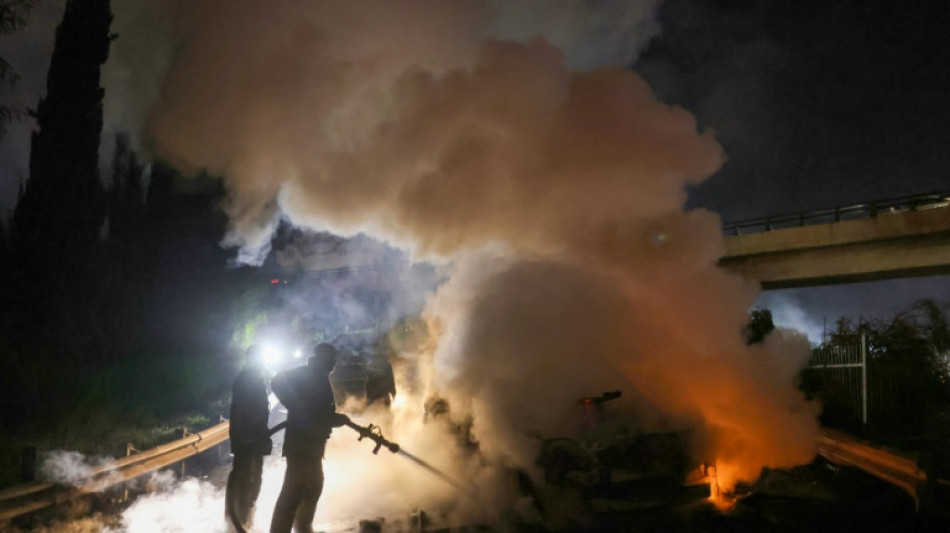
UN peacekeeping commander wounded as Hezbollah supporters protest near Beirut / Photo: IBRAHIM AMRO - AFP
Lebanese authorities are set to hold an emergency meeting on Saturday after a deputy commander with the UN peacekeeping force in the country was injured during an attack on a convoy taking him to the airport.
Hezbollah supporters have been blocking the road to the country's only airport for two consecutive nights over a decision barring two Iranian planes from landing in Beirut.
The UN Interim Force in Lebanon (UNIFIL) said one of its vehicles was set on fire during the Friday night incident, which injured outgoing deputy force commander Chok Bahadur Dhakal as he was returning home.
"We demand a full and immediate investigation by Lebanese authorities and for all perpetrators to be brought to justice," the peacekeeping force said in a statement.
An AFP journalist saw smoke billowing from the charred husk of a vehicle emblazoned with the UN peacekeeping logo, with the army deployed nearby.
The Lebanese army pledged to take firm action against those behind the attack, and the interior minister called an emergency meeting of the Central Internal Security Council on Saturday morning.
Interior Minister Ahmad Al-Hajjar said he visited two injured UNIFIL officers in hospital and emphasised "the Lebanese government's rejection of this attack".
UN Special Coordinator for Lebanon Jeanine Hennis-Plasschaert described the incident as "unacceptable".
"Such an act of violence threatens the safety of United Nations staff who work tirelessly to maintain stability in Lebanon, sometimes at great personal risk," she said in a statement.
In a conversation with Hennis-Plasschaert and UNIFIL Commander General Aroldo Lazaro, Lebanese Prime Minister Nawaf Salam strongly condemned the "criminal attack" and promised to arrest the perpetrators.
The army said on social media that several areas around the airport had seen "demonstrations marked by acts of vandalism and clashes, including assaults on members of the armed forces and attacks against vehicles".
- Ceasefire deadline -
It remains unclear who is responsible for the attack on the UNIFIL convoy.
Videos circulating on social media have shown demonstrators, some hooded and carrying Hezbollah flags, attacking a man in military garb and another in civilian clothes near the torched UNIFIL vehicle.
Hezbollah still has a sizeable power base in Lebanon, even after a year of war with Israel and the ousting in neighbouring Syria of its ally Bashar al-Assad left it massively weakened.
Israel has repeatedly accused Hezbollah of using Beirut airport to transfer weapons from Iran, claims Hezbollah and Lebanese officials have repeatedly denied.
Lebanon's Directorate General of Civil Aviation said Thursday it had "temporarily rescheduled" some flights, including from Iran, until February 18 as it was implementing "additional security measures".
The date coincides with the deadline for the full implementation of a ceasefire agreement between Israel and Hezbollah.
Violent protests are not uncommon in Lebanon, but there has been a major shift in the power balance in recent months.
Up until last year, Hezbollah played a dominant role in Lebanese politics and few in the security or political establishment would dare openly confront it.
Under the ceasefire that took effect November 27, Lebanon's military was to deploy in the south alongside United Nations peacekeepers as the Israeli army withdrew over a 60-day period, later extended until February 18.
The Israeli military is prepared to withdraw from Lebanese territory and hand over areas to the Lebanese army "within the timeline" set by the US- and French-mediated ceasefire agreement, a senior Israeli security official said.
Hezbollah was also expected to vacate its positions in the south, near the Israeli border, during the same period.
Z.Barbier--LCdB