Hamas transfers Israeli hostages to Red Cross in latest Gaza swap / Photo: Bashar TALEB - AFP
Gaza militants handed three Israeli hostages over to the Red Cross on Saturday in an exchange that is also set to see the release of 369 Palestinians from Israeli custody, the latest such swap under an ongoing truce deal.
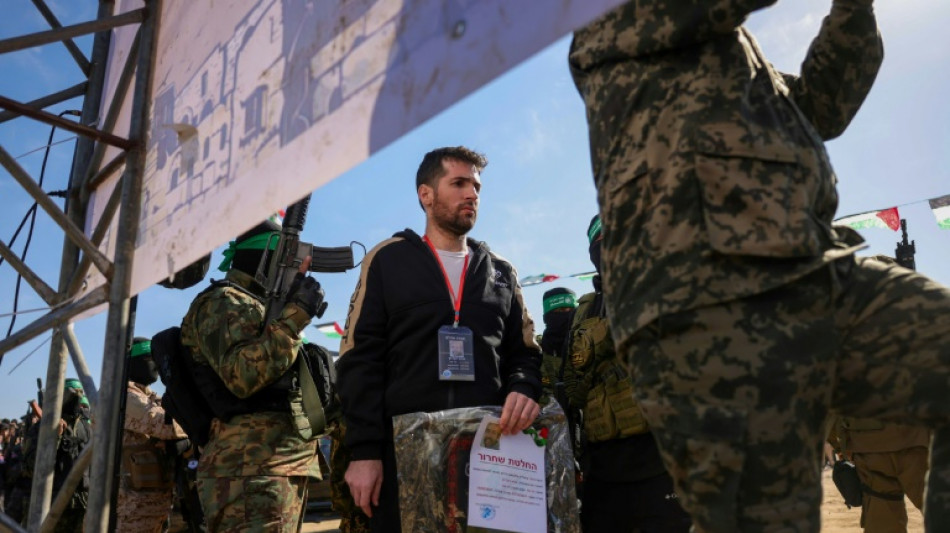
An AFP journalist saw masked Hamas militants parade the hostages onto a stage in Gaza's southern city of Khan Yunis, where they were told to address the crowd before their handover to the Red Cross.
Clutching gift bags given by their captors and a certificate to mark the end of their captivity, the three men, flanked by fighters, called for the completion of further hostage exchanges under the ceasefire deal.
The release, the sixth since the truce took effect on January 19, came after fears last week that the deal between Israel and Hamas was near collapse. But on Friday both sides signalled that Saturday's swap would go ahead.
Dozens of Hamas fighters lined up around the stage bearing the logo of the group's armed wing, the Ezzedine Al-Qassam Brigades, as Palestinian nationalist music played.
Sources from Hamas and Islamic Jihad said the groups had deployed about 200 militants for the handover ceremony.
A crowd also gathered in Tel Aviv's "Hostages Square" to watch the exchange, with many carrying Israeli flags and posters in support of the captives.
The office of Israeli Prime Minister Benjamin Netanyahu had named the hostages as Israeli-American Sagui Dekel-Chen, Israeli-Russian Sasha Trupanov and Israeli-Argentinian Yair Horn.
They had been held by Gaza militants since Hamas's October 7, 2023 attack on Israel that sparked the war 16 months ago.
The Palestinian Prisoners' Club advocacy group said Israel was to release 369 inmates in exchange, with 24 of them expected to be deported.
Almost all of the rest are "prisoners from the Gaza Strip who were arrested after October 7", the group said.
After the deal had appeared to be on the brink of collapse, a Hamas official on Friday said the group expected talks on a second phase of the ceasefire to begin early next week.
United States Secretary of State Marco Rubio, whose country is Israel's top backer and one of the truce mediators, is due to arrive in Israel late Saturday ahead of expected talks with Netanyahu on the Gaza truce.
Last week's release sparked anger in Israel and beyond after the freed hostages were paraded onstage, with their emaciated state sparking concern over conditions in captivity.
Israeli-American hostage Keith Siegel, released in a previous exchange, said he was "starved and... tortured, both physically and emotionally" during his captivity.
There were also fears for Palestinians in Israeli custody after some prisoners required medical treatment following their release in the last swap.
- Riyadh summit -
The ceasefire has been under massive strain since US President Donald Trump proposed a takeover of the Gaza Strip under which the territory's population of more than two million people would be moved to Egypt or Jordan.
For Palestinians, any forced displacement evokes memories of the "Nakba", or catastrophe -- the mass displacement of their ancestors during Israel's creation in 1948.
The stage set up for the release on Saturday bore an illustrated poster appearing to depict the final moments of Hamas's leader Yahya Sinwar, who was killed by Israeli forces in October. It showed the Al-Aqsa Mosque visible through a hole in the wall of a destroyed building along with the slogan: "No displacement except to Jerusalem".
Arab countries have come together to reject Trump's plan, and Saudi Arabia will host the leaders of Egypt, Jordan, Qatar and the United Arab Emirates on Thursday for a summit on the issue.
After the Riyadh summit, the Arab League will convene in Cairo on February 27 to discuss the same issue.
A joint statement from the heads of Christian churches in Jerusalem on Saturday also spoke out against any forced displacement, saying Gazans "who have lived for generations in the land of their ancestors, must not be forced into exile, stripped of... their right to remain in the land that forms the essence of their identity".
Trump had warned this week that "hell" would break loose if Hamas failed to release "all" remaining hostages by noon on Saturday.
Israel later insisted Hamas release "three living hostages" on Saturday or "the ceasefire will end".
- Second phase -
Under the terms of the 42-day first phase of the ceasefire agreement brokered by Qatar, Egypt and the United States, negotiations for a second phase were due to start on February 3.
Hamas official Taher al-Nunu told AFP on Friday that "we expect the second phase of the ceasefire negotiations to begin early next week".
Another source familiar with the talks told AFP that "mediators informed Hamas that they hope to start the second phase of negotiations next week in Doha".
The October 7, 2023 attack on Israel resulted in the deaths of 1,211 people, mostly civilians, according to an AFP tally of Israeli official figures.
Militants also took 251 hostages, of whom 73 remain in Gaza, including 35 the Israeli military says are dead.
Israel's retaliatory campaign has killed at least 48,239 people in Gaza, the majority of them civilians, according to figures from the health ministry in the Hamas-run territory that the United Nations considers reliable.
X.Thijs--LCdB