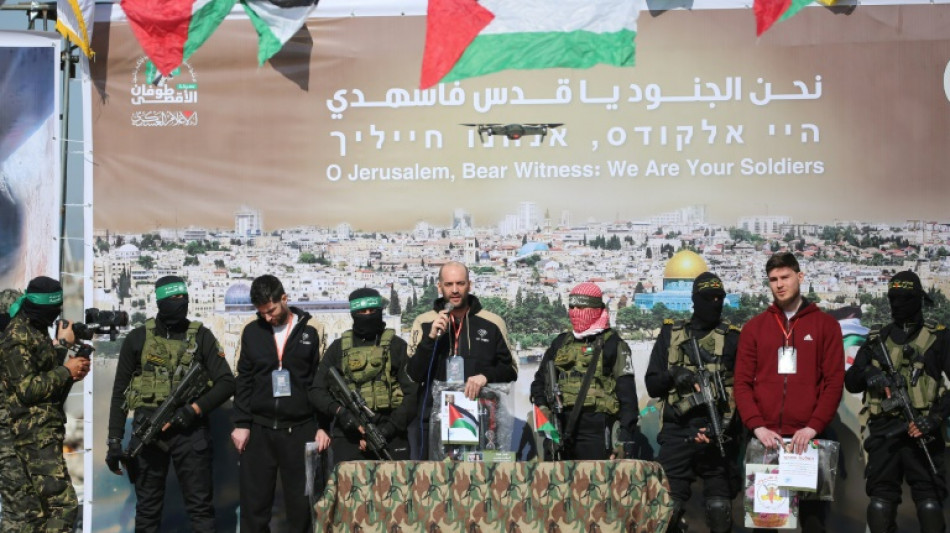
Flanked by masked gunmen, Israeli hostages address Gazans before release / Photo: Eyad BABA - AFP
Their voices monotone and their faces staring mostly ahead, three Israeli hostages spoke in Hebrew on a Gaza stage before walking to freedom on Saturday, after more than 16 months of captivity in the Palestinian territory.
The carefully choreographed handover to the Red Cross in Gaza came as part of an ongoing ceasefire deal with Israel.
Compared to three emaciated captives released last week, Israeli-American Sagui Dekel-Chen, Israeli-Russian Sasha Trupanov and Israeli-Argentine Yair Horn appeared in better health as they emerged from a white car.
They clutched gift bags and a certificate to mark the end of their captivity.
The three men -- flanked by five masked fighters brandishing assault rifles -- spoke on a microphone to the crowds, urging the completion of further hostage exchanges under the ongoing ceasefire deal.
The voice of Dekel-Chen, whose third daughter was born during his captivity, trembled slightly at the beginning of his address at the ceremony filmed by photographers in military fatigues.
Scenes a week earlier in Gaza's central city of Deir el-Balah, where pale and thin hostages were forced to speak on stage, provoked immediate outrage in Israel.
This week, one by one, the men dressed in tracksuits were led to Red Cross vehicles and driven away after a few minutes on stage.
Moments earlier a Red Cross official had filled out paperwork as part of the swaps, on a table where an hourglass had been placed.
"Time is running out" read an accompanying message in Hebrew, Arabic and English.
- Show of force -
Before the swap, fighters arrived to form a cordon around a cleared area in Khan Yunis in the southern Gaza strip.
Bunting in the colours of the Hamas and Palestinian flags was strung across the cleared area as strains of militant anthems blared out over loud speakers.
Hundreds of armed men were in attendance.
Some wore the green headbands of Hamas's Ezzedine Al-Qassam Brigades. Others, from Islamic Jihad's Al-Quds Brigades, wore black headbands for what has become a weekly show of force under the truce deal that began on January 19.
All wore black masks, leaving only their eyes visible.
Crowds of onlookers stood behind, waiting to catch a glimpse of the hostages. Some clustered on a mound of dirt, cleared by bulldozers during the war, to get a better view.
After five previous exchanges the militants had erected a larger and more elaborate backdrop to stage Saturday's handover ceremony.
- 'No displacement'-
But just metres behind lay a crumpled building, destroyed in the 15 months of war with Israel, its concrete floors spilling forward to the ground.
At the centre of the platform, a large image showing the Dome of the Rock in the Israeli-annexed Old City of Jerusalem showed fighters in the foreground moving towards the Muslim holy site.
"Oh Jerusalem, bear witness we are your soldiers," a slogan above the image read.
To one side, another poster showed what appeared to be former Hamas leader Yahya Sinwar seated on a red chair inside a destroyed building, a scene reminiscent of moments before his killing in October.
The mastermind of the October 7 2023 attack, which sparked the war in Gaza and who was killed by Israel on 16 October, was shown looking through a hole in the wall, again towards the Dome of the Rock, accompanied by a message in the three languages: "No displacement except to Jerusalem."
N.Lambert--LCdB