European allies seek united Ukraine front as US backing wavers / Photo: THOMAS KIENZLE - AFP
European leaders on Saturday scrambled to force their way to the table at any talks on the Ukraine war after US President Donald Trump moved to engage with Russia directly, increasing fears that Europe can no longer rely on Washington's backing for defence.
Trump upended the status quo this week when he announced he was likely to meet Russian counterpart Vladimir Putin soon to start talks to end the conflict.
The possibility of direct US-Russia talks left US allies in Europe reeling and worried that their interests would be sidelined in any deal on Ukraine.
NATO chief Mark Rutte said Europe had to come up with "good proposals" for securing peace in Ukraine if it wanted to be involved in US-led talks.
"If Europeans want to have a say, make yourself relevant," Rutte told journalists at a gathering of top policymakers in Munich.
Rutte also said he would head to Paris on Monday to take part in a meeting of European leaders convened by French President Emmanuel Macron.
The gathering would focus on defence spending and planning so that "when a deal is reached in Ukraine, that we have absolute clarity what Europe can contribute," he said.
A spokesman for Macron's office told AFP "discussions" were ongoing over a "possible informal meeting", without giving a date or an indication of the attendees.
As part of any eventual "security guarantees" for Ukraine, discussions have begun in Europe over a potential deployment of peacekeepers.
But those talks are only at an embryonic stage -- and others argue the focus now needs to be on building up Ukraine's own forces.
- Europe has 'input' -
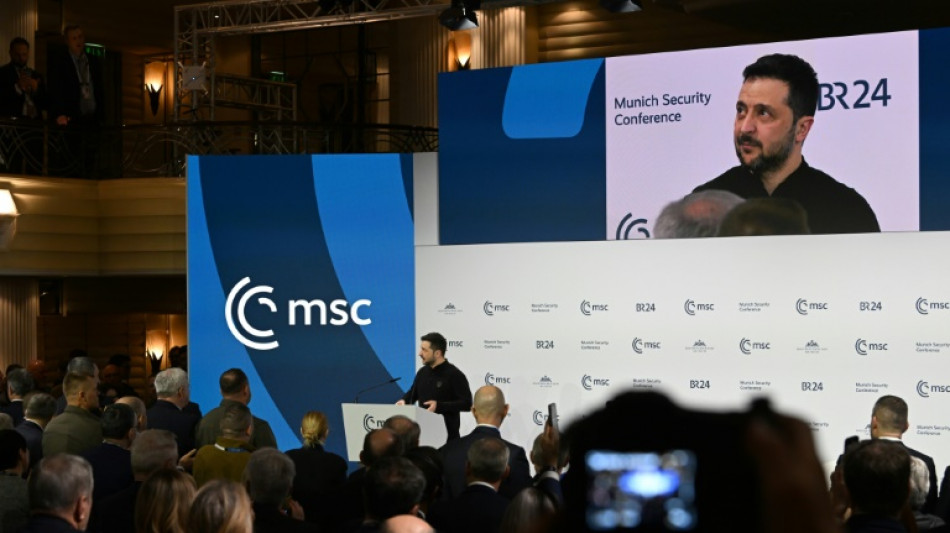
Speaking at the Munich Security Conference, Ukrainian President Volodymyr Zelensky called for the creation of a European army, arguing the continent could no longer count on Washington.
"Let's be honest –- now we can't rule out the possibility that America might say no to Europe on issues that threaten it," Zelensky said.
"I really believe that time has come. The Armed Forces of Europe must be created."
The push for a joint continental force has been mooted for years without gaining traction and Zelensky's intervention seems unlikely to shift the balance.
Zelensky's rallying cry came a day after he met US Vice President JD Vance as Kyiv scrambles to ensure it is not sidelined in Washington's push to wrap up the conflict.
"Ukraine will never accept deals made behind our backs without our involvement," Zelensky said in a speech.
"No decisions about Ukraine without Ukraine. No decisions about Europe without Europe."
European leaders backed up Zelensky's call to action and echoed the need for the continent to play a key role in talks.
Polish Prime Minister Donald Tusk said on X "Europe urgently needs its own plan of action concerning Ukraine and our security".
Trump's special envoy to Ukraine Keith Kellogg however gave Europeans reasons to doubt they would be heard in any negotiations.
Europe would not be directly involved in the talks but would still have an "input", Kellogg said in Munich.
- 'Lasting peace' -
US officials have sought to assure Ukraine that it will not be left in the cold after three years of battling Russia's invasion.
Vance said after his sit-down with Zelensky that the United States was looking for a "durable, lasting peace" that would not lead to further bloodshed in coming years.
But Washington has sent mixed messages to Kyiv, with Pentagon chief Pete Hegseth appearing to rule out Ukraine joining NATO or retaking all of its territory.
Trump has also pushed for access to Ukraine's stocks of rare earth minerals as compensation for the military aid provided by the United States.
Zelensky said Saturday he blocked a deal that would have given the US access to vast amounts of Ukrainian natural resources as it lacked "security guarantees" for Kyiv.
"In my opinion, it does not protect us. It is not ready to protect us, our interests," Zelensky told journalists on the sidelines of the Munich conference.
The situation for his forces on the ground, though, has continued to deteriorate.
Russia's army on Saturday claimed to have captured a village in Ukraine's eastern Donetsk region close to a road linking key towns as Moscow slowly eats up territory.
Despite suffering heavy battlefield losses, the Russian army has been creeping forwards in eastern Ukraine for more than a year.
"It's terrifying," said Ukraine-born protester Nataliya Galushka, 40, who left the country when she was a child.
"The fact that (Trump is) talking to Putin, a criminal, what kind of world is this?"
Z.Barbier--LCdB