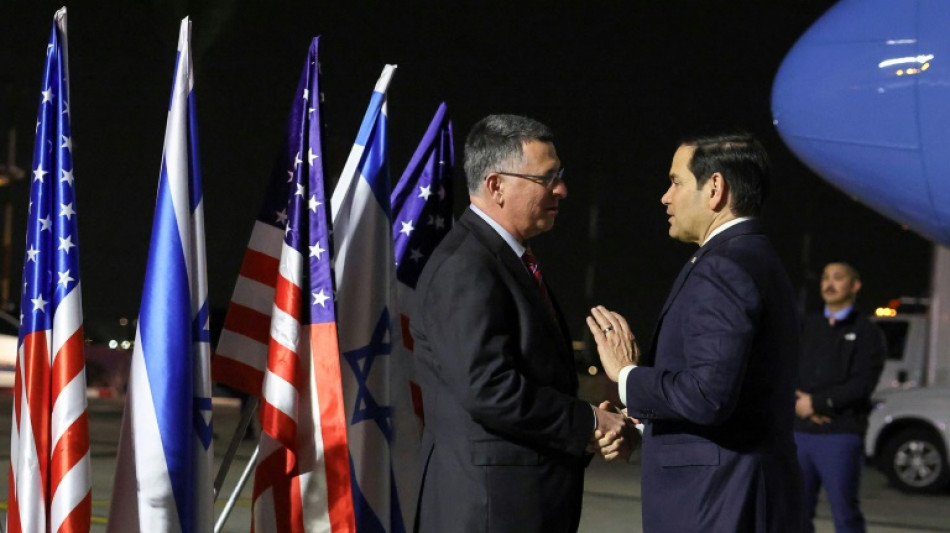
US top diplomat meets Netanyahu for Gaza ceasefire talks / Photo: Evelyn Hockstein - POOL/AFP
US Secretary of State Marco Rubio met with Israel's prime minister in Jerusalem on Sunday for talks on the Gaza ceasefire, launching a Middle East tour a day after the latest hostage-prisoner exchange.
On his first visit to the region as Washington's top diplomat, Rubio is expected to push US President Donald Trump's widely condemned proposal to take control of Gaza and relocate its more than two million residents.
The scheme that Trump outlined earlier this month, while Israeli Prime Minister Benjamin Netanyahu visited Washington, lacked details. Trump said Palestinians had "lived a miserable existence" in Gaza and suggested the coastal territory could become the "Riviera of the Middle East", following redevelopment after more than 15 months of war.
Netanyahu welcomed the idea but foreign leaders have largely rejected it.
Rubio arrived hours after Hamas freed three Israeli hostages in Gaza in exchange for 369 Palestinian prisoners -- the sixth swap under a fragile ceasefire which the United States helped mediate along with Qatar and Egypt.
"At any moment the fighting could resume. We hope that the calm will continue and that Egypt will pressure Israel to prevent them from restarting the war and displacing people," said Nasser al-Astal, 62, a retired teacher in southern Gaza's Khan Yunis.
Washington, Israel's top ally and weapons supplier, has said it is open to alternative proposals from Arab governments but insists that, for now, "the only plan is Trump's".
In January, then-US secretary of state Antony Blinken outlined a roadmap for post-war Gaza, warning it required Israel to accept a path to a Palestinian state –- something Netanyahu's government opposes.
Egyptian President Abdel Fattah al-Sisi said the establishment of a Palestinian state is "the only guarantee" of lasting Middle East peace.
Regional states including Saudi Arabia have repeatedly called for a Palestinian state, existing alongside Israel.
Rubio is due to also visit Saudi Arabia and the United Arab Emirates.
Overnight, Israel said it received a shipment of US-made bombs, after the previous Biden administration blocked a shipment of heavy 2,000-pound ordnance.
- Brink of collapse -
Hamas and Israel are implementing the first, 42-day phase of the ceasefire that began on January 19 but nearly collapsed last week.
Israel had warned Hamas it must free three living hostages by the weekend or face renewed fighting.
The freed hostages -- Israeli-American Sagui Dekel-Chen, 36, Israeli-Russian Sasha Trupanov, 29, and Israeli-Argentine Yair Horn, 46 -- returned to emotional family reunions.
Flanked by armed and masked Hamas fighters on a stage, they had to undergo a last-minute ordeal of speaking in front of the crowds.
Israel freed 369 Palestinian prisoners, mostly Gazans detained during the war, but also some serving life sentences for attacks on Israelis.
Footage aired by Israeli media showed Palestinian prisoners in sweatshirts bearing a Star of David and the slogan: "We will not forget and we will not forgive."
They tore them off upon reaching Gaza and burned them in a bonfire at the reception point in Khan Yunis.
Since the truce began last month, 19 Israeli hostages have been released in exchange for more than 1,000 Palestinian prisoners.
Out of 251 people seized in Hamas's October 7, 2023 attack on Israel that sparked the war, 70 remain in Gaza, including 35 the Israeli military says are dead.
- Heightened tensions -
Negotiations on a second phase of the truce, aimed at securing a more lasting end to the war, could begin this week in Doha, a Hamas official and another source familiar with the talks have said.
On Saturday, a former Israeli negotiator said his country missed two chances last year to reach a truce and hasten hostage releases, which Netanyahu's office denied.
Trump has warned of repercussions for neighbouring Egypt and Jordan unless they accept displaced Gazans under his plan.
Diplomats say Egypt is leading efforts to propose an alternative focused on training a new security force and appointing local Palestinian leaders.
Rubio said he believed Arab states were "working in good faith", but insisted Hamas must have no future role.
The October 7, 2023 attack on Israel resulted in the deaths of 1,211 people, mostly civilians, according to an AFP tally of Israeli official figures.
On Sunday, Hamas said an Israeli air strike killed three police officers near south Gaza's Rafah. Israel said it struck "several armed individuals" in south Gaza.
It is at least the second Israeli air strike in Gaza since the ceasefire began.
burs-lb/it/dv
C.Maes--LCdB