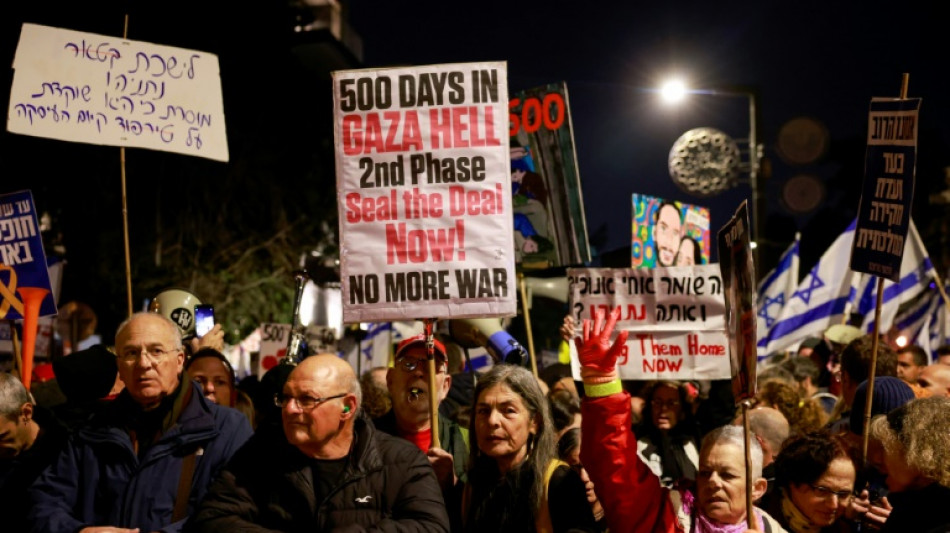
Hamas to free 6 Israeli Gaza hostages, hand over 4 bodies this week / Photo: Menahem Kahana - AFP
Hamas said Tuesday that it would hand over all six living Israeli hostages due for release under the first phase of the Gaza ceasefire this week, as well as the bodies of four dead captives.
The fragile Gaza truce took effect on January 19 after more than 15 months of fighting between Israel and Hamas, sparked by the Palestinian militant group's October 7, 2023 attack on Israel.
Thirty-three Israeli hostages were due to be released under the first phase, with 19 freed so far in exchange for more than 1,100 Palestinian prisoners. Of the remaining 14, Israel says eight are dead.
Five Thai nationals held in Gaza since the 2023 attack have also been released outside the scope of the truce deal.
Hamas "decided to release on Saturday, February 22, the remaining living (Israeli) prisoners whose release was agreed in the first phase, numbering six", the group's top negotiator Khalil al-Hayya said in a televised address.
The group had also "decided to hand over four bodies on Thursday... and the enemy will release the corresponding prisoners", Hayya said.
Israel subsequently confirmed the arrangements, with Prime Minister Benjamin Netanyahu's office saying that during indirect negotiations in Cairo, "agreements were reached" for the six living hostages to be released on Saturday.
It added that the bodies of four hostages would be returned on Thursday, ahead of four others next week.
These would be the first bodies returned by Hamas to Israel since the start of the war.
A Palestinian source close to the negotiations said mediators had presented the request for the new releases, adding they aimed "for this step to create a positive atmosphere, insisting on the continuation of the ceasefire".
The first phase of the truce is due to expire on March 1, and negotiations on the next stages, including a permanent end to the war, have not yet begun.
The truce deal has so far held despite both sides trading accusations of violations, and despite the strain placed on it by US President Donald Trump's widely condemned plan to take control of Gaza and relocate its population.
- Arab summits -
Saudi Arabia is set to host the leaders of Egypt, Jordan, Qatar and the United Arab Emirates on Friday to present their own plan for Gaza's reconstruction while ensuring that Palestinians remain on their land.
Egypt and Jordan have been floated by Trump as possible destinations for displaced Gazans, though both countries have rejected the idea.
After the Saudi meeting, Egypt will host an extraordinary Arab League meeting on Gaza, with participants expected to address Trump's plan.
Though initially set for next week, the summit has been postponed to March 4, Egypt said Tuesday.
For Palestinians, any forced displacement evokes memories of the "Nakba", or catastrophe -- the mass displacement of their ancestors during Israel's creation in 1948.
On Monday, Egypt hosted the latest meeting of the Global Alliance for the Implementation of the Two-State Solution, which initially gathered in Saudi Arabia last year.
Egypt's foreign ministry stressed Cairo's "full commitment to implementing the two-state solution" to the Israeli-Palestinian conflict, and "the necessity of establishing an independent Palestinian state".
- 'Demilitarisation' -
Saar also said Israel would begin negotiations "this week" on the second phase of the truce, which aims to lay out a more permanent end to the war.
A Hamas official and another source familiar with the talks have earlier said negotiations on a second phase could begin this week in Doha.
Qatar, a key mediator in the Gaza conflict, said on Tuesday that Palestinians must decide the territory's post-war future.
"From our perspective, this is a Palestinian question on what happens post this conflict," said Ansari when asked about Israel's stated objective to eliminate Hamas.
"It is a Palestinian question on who represents the Palestinians in an official capacity and also the political groups and parties in the political sphere," he said.
Ansari also said that humanitarian aid into Gaza "today is insufficient".
Hamas's 2023 attack on Israel resulted in the deaths of 1,211 people, mostly civilians, according to an AFP tally of Israeli official figures.
Israel's retaliatory campaign has killed at least 48,291 people in Gaza, the majority of them civilians, according to figures from the health ministry in the Hamas-run territory that the United Nations considers reliable.
P.Verhoeven--LCdB