Israel suspends prisoner release after six Gaza hostages freed: sources / Photo: Bashar TALEB - AFP
Israeli officials said the release of hundreds of Palestinian prisoners due Saturday has been delayed, after six hostages were freed under a fragile Gaza truce that is nearing the end of its first phase.
While Israel was meant to release Palestinians in its custody in exchange for the six Israelis taken back home, Israeli officials said it may only happen after Israeli Prime Minister Benjamin Netanyahu convenes a security consultation later on Saturday.
"Once the security consultation concludes, a decision will be made regarding the next steps" of the ceasefire agreement with Hamas, said one Israeli official, speaking on condition of anonymity.
The sources did not provide a clear reason for the delay, which comes after an emotional two days in Israel, where the remains of another hostage, Shiri Bibas, have been identified after the initial handover of a different body.
Bibas and her two young sons, among dozens taken captive during Hamas's October 7, 2023 attack on Israel that triggered the war, had become symbols of the ordeal suffered by the Israeli hostages.
Six Israelis, some of them dual nationals, were released earlier on Saturday, the last group of living hostages under the truce's first phase.
The Palestinian Prisoners' Club advocacy group said Israel would free 620 inmates, most of them Gazans taken into custody during the war, in exchange.
The first phase of the truce, which has largely halted more than 15 months of devastating fighting in the Gaza Strip and has enabled the release of 30 captives, is due to expire in early March.
Negotiations for a second phase, which is meant to lead to a permanent end to the war, have yet to begin.
- Well-practised ceremony -
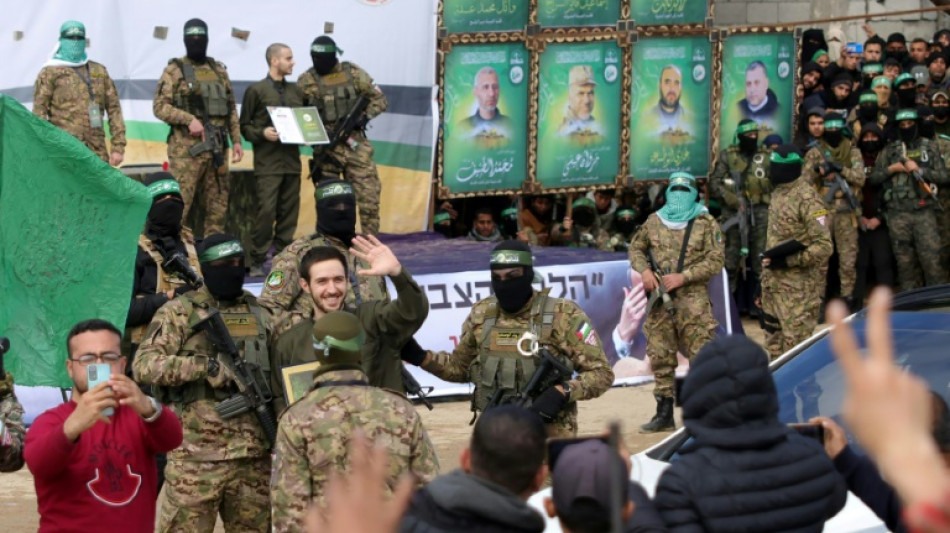
At a ceremony in Nuseirat, central Gaza, masked Hamas militants brought onto a stage Eliya Cohen, 27, Omer Shem Tov, 22, and Israeli-Argentine Omer Wenkert, 23.
An AFP correspondent said they waved while holding release certificates before their handover to the Red Cross and return to Israeli soil.
At a similar ceremony in Rafah, southern Gaza, militants handed over Tal Shoham, 40, and Avera Mengistu, 38, who both appeared dazed.
Shoham was made to address the gathering, flanked by masked gunmen dressed all in black.
In the Israeli city of Tel Aviv, hundreds who gathered at a site known as "Hostages Square" applauded and some weeped as they watched a live broadcast of the releases.
A sixth hostage, Hisham al-Sayed, 37, was later released and taken back to Israeli territory, the military said.
Sayed, a Bedouin Muslim, and Mengistu, an Ethiopian Jew, had been held in Gaza for about a decade after they entered the territory individually.
"Our family has endured 10 years and five months of unimaginable suffering", Mengistu's family said in a statement.
Sayed's family called it "a long-awaited moment".
Relatives of Shoham wept and embraced as they watched his handover, video released by Israel's government showed.
"Tal seems well considering the circumstances. An enormous weight is lifted from us," the family of the Austrian-Israeli dual national said in a statement.
Under a cold winter rain in Rafah, and in Nuseirat, Hamas staged a show of force after months of bombardment and strikes that killed the group's top leaders.
In what has become a well-practised ceremony since the truce began, stages were set up in front of large posters promoting the militants' cause or praising fallen fighters.
- Domestic pressure -
On Thursday the first transfer of hostages' bodies took place under the truce.
There was anger in Israel after analysis had concluded that Shiri Bibas's remains were not among the four bodies returned.
Hamas then admitted a possible "mix-up of bodies", which it attributed to Israeli bombing of the area.
Late Friday the Red Cross confirmed the transfer of more human remains, which the Bibas family said in a statement had been identified as Shiri's.
The family said she "was murdered in captivity and has now returned home... to rest."
Israel's military said that, after an analysis of the remains, Palestinian militants killed the Bibas boys, Ariel and Kfir, "with their bare hands" in November 2023.
Hamas has long maintained an Israeli air strike killed them and their mother early in the war, and on Saturday dismissed the military's account as "baseless lies and fabrications".
Out of 251 people taken hostage during the October 2023 attack, 62 are still in Gaza including 35 the Israeli military says are dead.
The Hamas attack resulted in the deaths of 1,215 people, mostly civilians, according to an AFP tally of Israeli official figures.
Israel's retaliatory campaign has killed at least 48,319 people in Gaza, the majority of them civilians, according to figures from the health ministry in the Hamas-run territory that the United Nations considers reliable.
D.Moerman--LCdB