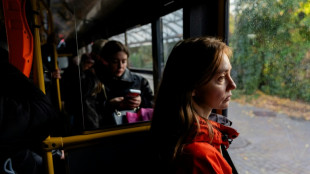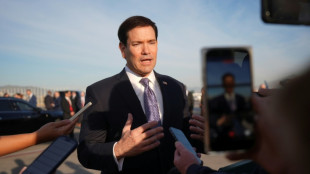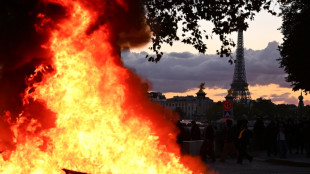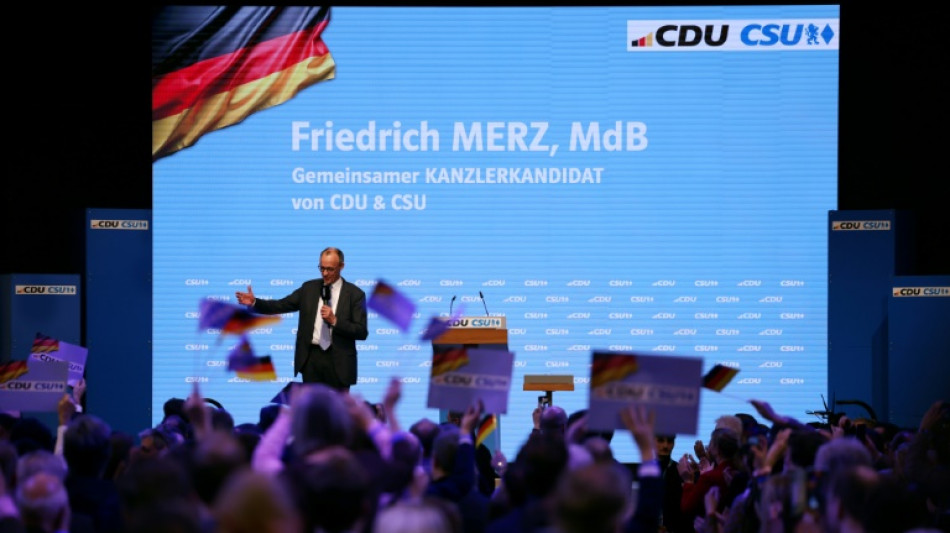
Germany on eve of vote expected to see far-right surge / Photo: Alexandra BEIER - AFP
German politicians made a final scramble for votes Saturday on the eve of crucial elections in which conservatives are favoured to win despite the dramatic rise of the far-right AfD.
Sunday's vote comes at a time of upheaval for Europe and its biggest economy as US President Donald Trump has ended a united Western stance on the Ukraine war by reaching out to Russia.
"Tomorrow we will win the elections and then the nightmare of this government will be over," conservative leader Friedrich Merz told a jubilant crowd in Munich.
He vowed to be a "strong voice" in Europe in turbulent times.
Trump's threats of a trade war spell more trouble ahead for Germany. The economy has shrunk for the past two years and the country faces bitter social polarisation on the flashpoint issues of immigration and security.
The mood has been inflamed by a series of bloody attacks, most recently Friday's stabbing that badly wounded a 30-year-old Spanish man at Berlin's Holocaust Memorial. The Syrian suspect is thought to have an anti-Semitic motive.
Sunday's vote is being held more than half a year early after Chancellor Olaf Scholz's three-way coalition with the Greens and the pro-business FDP collapsed in early November.
His Social Democrats are lingering on around 15 percent in the polls, while Merz's CDU/CSU bloc has held a stable lead in voter surveys with some 30 percent of support.
- Far-right rise -
The vote looks set to deliver a historic result for the far-right Alternative for Germany (AfD), which has been polling in second place on around 20 percent, boosted by anger over the spate of deadly attacks blamed on migrants.
Just 10 days before the election, an Afghan man was arrested for ploughing a car through a street rally in Munich, killing a two-year-old child and her mother and wounding dozens.
The AfD has had strong support from Trump's inner circle, including tech billionaire Elon Musk and Vice President JD Vance.
"I'm very confident and, no matter how it turns out, we still have room for improvement," AfD supporter Julian Adrat, 34, said at a rally of th anti-immigration party Berlin.
Protesters gathered elsewhere to send a signal against the far right, 40,000 people joining demonstrations in the northern city of Hamburg.
Educator Juan Miranda in Berlin said he hoped that "most people don't vote for the AfD but for the old parties", even if previous governments had gotten things wrong.
"There were a lot of issues they didn't address, and they focused on migration policy, but in the wrong way."
- Coalition complications -
Speaking in his Potsdam district near Berlin, Scholz spoke to voters' feelings of "uncertainty" and said halting the rise of the AfD was a "central task" of the election.
But Merz, appearing certain he would cruise to victory, told supporters that "the left is over", while also ruling out the possibility of forming a government with the AfD.
"There is no left majority and no left politics anymore in Germany," Merz told a raucous beer hall, sketching out a plan to curtail benefits, cut red tape and tighten immigration.
With the conservatives heading the next government, he said, Germany would have a "strong voice in the European Union" again at a crucial time for the continent.
"Europe must become stronger again and Germany must become more involved in the European Union," Merz said.
In the era of Trump, Europe needed to walk tall to be able to "sit at the main table and safeguard our interests vis-a-vis Russia and China".
Even after an election win on Sunday, Merz could face numerous obstacles on the path to power.
He would need the support of at least one other party to form a government -- most likely Scholz's Social Democrats or the Greens, based on polls.
"Nevertheless, it would be in Germany's interest to have people in place in Berlin who are capable of acting as quickly as possible."
F.Claes--LCdB