Islamic Jihad says Israeli tanks part of 'plans to annex West Bank by force' / Photo: JOHN WESSELS - AFP
Palestinian militants said on Monday that an unusual deployment of Israeli tanks in the occupied West Bank, part of a major offensive that has displaced tens of thousands, may be a step toward annexation.
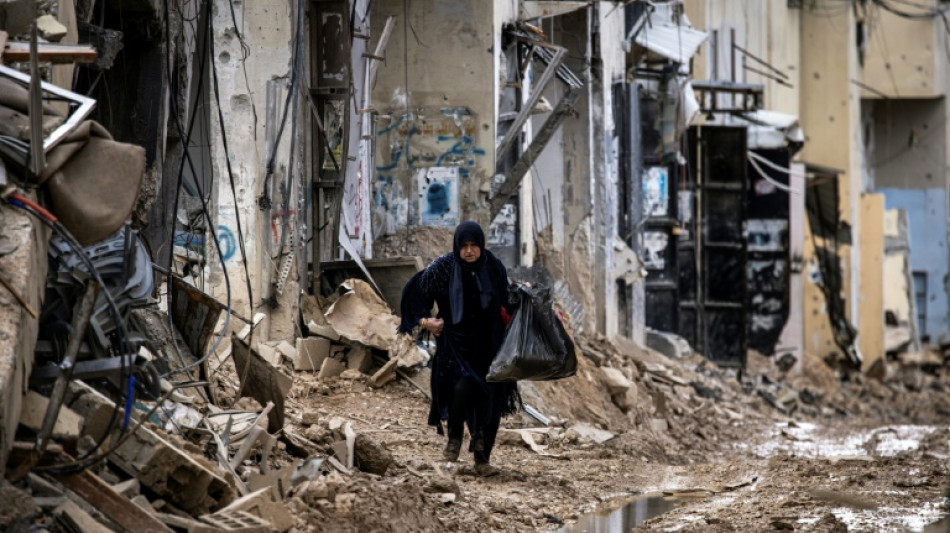
The torn-up streets surrounding the Jenin refugee camp in the territory's north were empty on Monday, an AFP journalist reported, as three Israeli Merkava tanks stationed at higher vantage points overlooked the area.
Displaced camp residents occasionally entered through a back alley to retrieve belongings from their homes.
"We go back in to get things, whatever we can. We take the risk because we have to," said 52-year-old Ahmad al-Qahrawi.
"We had nothing when we left, no clothes, nothing. We go back to get clothes because it's cold."
Israeli leaders have repeatedly pledged to annex at least parts of the West Bank, which has been occupied since 1967, but any such proposal has been met with strong opposition from Palestinians and much of the international community.
In a weeks-long military operation in the north of the territory, launched around the time a truce took hold in the Israel-Hamas war in the Gaza Strip, Israeli forces looking for militants have cleared three refugee camps and deployed tanks in Jenin.
Militant group Islamic Jihad said that the mass evacuations and first deployment of Israeli tanks in the territory since the early 2000s "confirms the occupation's plans to annex the West Bank by force".
The group, which has fought alongside Hamas in Gaza and has a strong presence in the northern West Bank, denounced "a new act of aggression" which it said was "aimed at uprooting our people from their land".
The International Committee of the Red Cross said many residents who fled have taken shelter in "crowded mosques and schools".
The damage has hampered displaced residents' "access to basic needs such as clean water, food, medical care and shelter", and the winter cold "has made it more difficult to survive", it added in a statement.
- UN, EU concerned -
The United Nations' humanitarian agency OCHA said the military offensive "appears to exceed law enforcement standards" and has had severe consequences.
"The continued use of lethal war-like tactics in residential areas is extremely concerning," OCHA said.
Throughout the Gaza war, violence in the West Bank -- a separate Palestinian territory -- has soared, as have calls to annex it, most notably by Israel's far-right Finance Minister Bezalel Smotrich.
Since the start of the war in October 2023, Israeli troops or settler attacks have killed at least 900 Palestinians, including many militants, according to the Palestinian health ministry.
Palestinian attacks and clashes during military raids have killed at least 32 Israelis over the same period, according to official figures.
UN chief Antonio Guterres on Monday rejected "calls for annexation" and said he was "gravely concerned by the rising violence".
EU foreign policy chief Kaja Kallas said that "we are closely watching developments, and cannot hide our concern when it comes to the West Bank."
Israel said on Sunday that its troops would remain for many months in the evacuated refugee camps in the northern West Bank -- Jenin, Tulkarem and Nur Shams -- aiming to "prevent the return of residents and the resurgence of terrorism", according to Defence Minister Israel Katz.
He put the number of displaced Palestinians at 40,000, the same figure provided by the United Nations which said the offensive has killed at least 51 Palestinians including seven children, and three Israeli soldiers.
Islamic Jihad accused Israel of attempting to consolidate "military domination by creating settler corridors that reinforce the separation of West Bank cities and their camps".
The West Bank, excluding Israeli-annexed east Jerusalem, is home to around three million Palestinian as well as nearly half a million Israelis who live in settlements that are illegal under international law.
Israeli tanks have not operated there since the end of the second Palestinian intifada, or "uprising", in 2005.
- Bus bombs -
Last week, Israeli Prime Minister Benjamin Netanyahu ordered the army to step up its operations in the West Bank, after bombs had exploded on several empty buses in Israel, causing no injuries.
Israeli officials said the explosives resembled those used by West Bank militants.
In both Tulkarem and Jenin, the army has demolished dozens of homes with explosives, opening up new access routes into the densely built camps.
Armoured bulldozers have wreaked havoc, upturning tarmac, cutting water pipes and tearing down roadside facades.
The military says the bulldozers are meant to clear roads of explosives.
bur-az-lba-jd/ami
W.Smets--LCdB