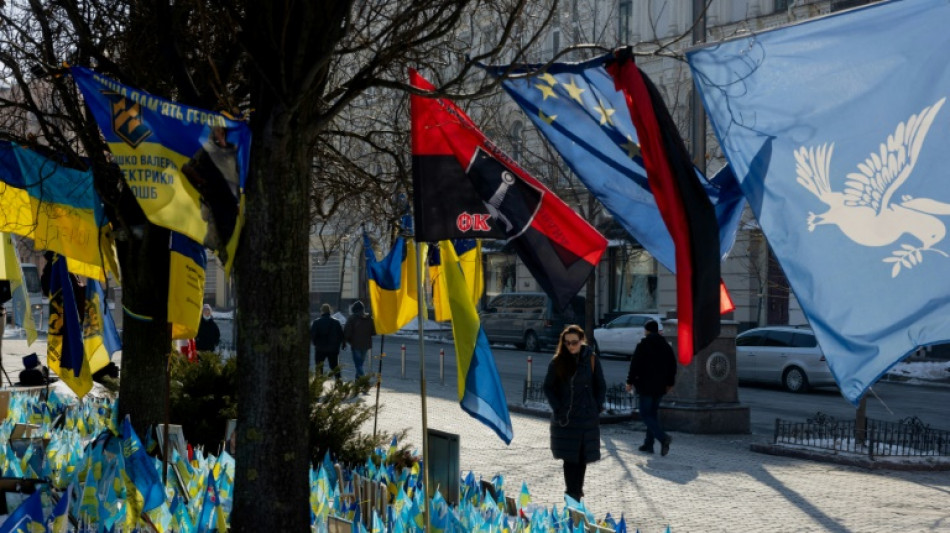
Russia says annexation of Ukrainian land is 'non-negotiable' / Photo: Tetiana DZHAFAROVA - AFP
The Kremlin on Thursday ruled out giving back Ukrainian regions it claims to have annexed as part of a future peace deal, setting out a major red line as Russian and US officials met in Istanbul for a new round of talks to normalise relations.
US President Donald Trump has pushed for a quick end to the three-year conflict since taking office last month, reaching out to Russian President Vladimir Putin in a stunning shift in US foreign policy.
The Istanbul talks come after a high-level meeting in Saudi Arabia earlier this month, and aim at restoring diplomatic ties after embassy staff on both sides were expelled under the Joe Biden administration.
Putin said Thursday that the contacts with the United States gave "some hope" of resolving the conflict, but his spokesman earlier cautioned that giving up any annexed Ukrainian land was "non-negotiable".
"The territories which have become subjects of the Russian Federation, which are inscribed in our country's constitution, are an inseparable part of our country," Kremlin spokesman Dmitry Peskov told reporters.
"This is undeniable and non-negotiable," he said in a phone briefing attended by AFP.
- 'Laughable' -
Months after launching its full-scale offensive in February 2022, Russia declared the annexation of four southern and eastern Ukrainian regions -- Donetsk, Lugansk, Zaporizhzhia and Kherson. It annexed the Crimean peninsula from Ukraine in 2014.
Ukraine and most international observers have dismissed the annexations as illegal, which Ukraine reiterated in answer to the Kremlin remarks.
"Ukraine has its internationally recognised borders," said Ukrainian foreign ministry spokesman Georgiy Tykhy.
"It's really laughable to see them referring to their constitution" to justify the annexation, he added.
Russian forces control most of the Donetsk and Lugansk region but only parts of Zaporizhzhia and Kherson. Moscow also occupies part of the Kharkiv region in northeast Ukraine.
Ukrainian President Volodymyr Zelensky has conceded his army lacks resources to reclaim those territories, but says some captured land could be returned through diplomacy.
Kyiv has seized hundreds of square kilometres of Russia's Kursk region and Zelensky has raised the possibility of an "exchange" of territory with Moscow -- a notion also ruled out by Russia.
Putin on Thursday said initial Russia-US talks gave "some hope" of resolving "problems" like the Ukraine conflict.
"The first contacts with the new US administration give some hope. There is a mutual desire to work on restoring relations," Putin said at a meeting of the FSB security agency.
- Zelensky in Washington -
Peskov told reporters earlier that restoring ruptured ties with the United States was a "process".
"No one expects decisions to be easy and quick. But with the political will of the two countries, with the willingness to listen and hear each other, we will be able to get through this working process," he said.
Putin's comments come as part of a flurry of diplomatic activity between Russia and the United States, and US and European leaders, as all sides tout their positions to Trump.
Zelensky is due to meet Trump on Friday, where he hopes to press Washington on aid.
British Prime Minister Keir Starmer will meet Trump on Thursday to appeal for a US backstop to any Ukraine ceasefire, insisting it would be the only way to stop Putin from attacking again.
Starmer arrived in Washington late Wednesday to build on a visit by French President Emmanuel Macron, amid growing concerns in Europe that the US leader is about to sell Kyiv short in negotiations with Putin.
The Russian defence ministry on Thursday said it had re-captured the village of Nikolsky near the Ukrainian-held town of Sudzha.
burs-brw/dt/gv
V.Nijs--LCdB