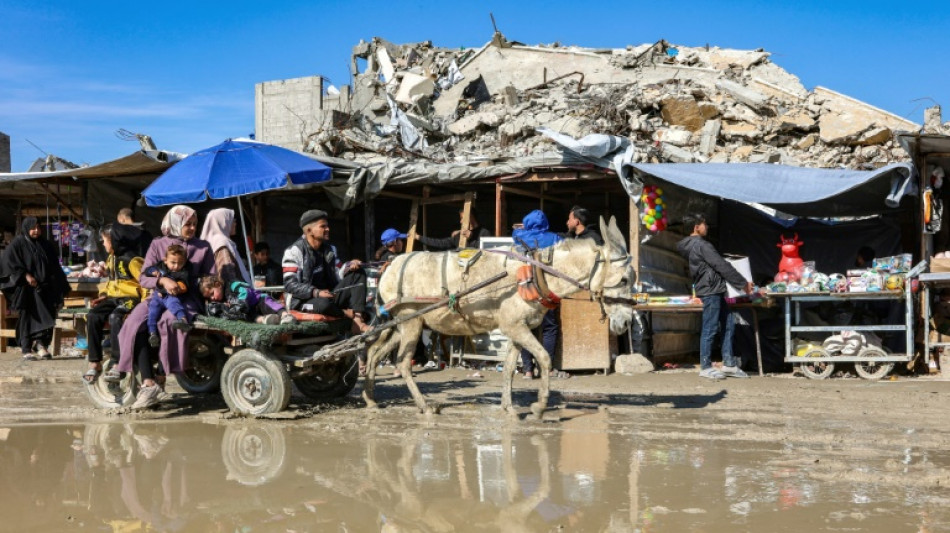
Hamas wants pressure on Israel to start next phase of Gaza truce / Photo: Omar AL-QATTAA - AFP
Palestinian militant group Hamas called on Friday for international pressure on Israel to enter the next phase of a ceasefire that has largely halted the war in Gaza, as negotiations were resuming in Cairo.
With hours to go before the first phase of the truce is due to expire, mediator Egypt said on Thursday that Israeli, Qatari and US delegations were in the capital Cairo for "intensive" talks on a second phase that should bring a permanent end to the war.
In Israel, a day after the military acknowledged its "complete failure" to prevent the 2023 Hamas attack that sparked the war, mourners gathered for the funeral of Tsachi Idan, a hostage whose remains have been returned from Gaza.
Hamas said in a statement that "with the end of the first phase of the ceasefire", the group "affirms its full commitment to implementing all the provisions of the agreement in all its stages and details".
"We call on the international community to pressure the Zionist occupation (Israel) to... immediately enter the second phase of the agreement without any delay," it said.
Prime Minister Benjamin Netanyahu on Thursday "instructed the negotiation delegation to depart for Cairo", his office said shortly after Hamas handed over the remains of Idan and three other hostages under the truce, in exchange for hundreds of Palestinians in Israeli custody.
The ceasefire, reached following months of gruelling negotiations, has largely halted the war that erupted with Hamas's October 7, 2023 attack on Israel.
Militants broke through Gaza's security barrier that day, launching a deadly attack on residential communities, army bases and other sites, and seizing dozens of hostages.
Israel has vowed to destroy Hamas and to bring home all the hostages after the attack that resulted in the deaths of 1,218 people, mostly civilians, according to an AFP tally of official figures.
The Israeli retaliation has killed more than 48,000 people in Gaza, according to the health ministry in the Hamas-run territory, figures the UN has deemed reliable.
- 'Too many civilians died' -
An internal Israeli army probe into the October 7 attack, released on Thursday, acknowledged the military's "complete failure" to prevent it, according to a military official who briefed reporters about the report's contents on condition of anonymity.
A senior military official said at the same briefing that the military acknowledges it was "overconfident" and had misconceptions about Hamas's military capabilities before the attack.
Following the scathing probe's release, Israel's military chief General Herzi Halevi said: "The responsibility is mine."
Halevi had already resigned last month citing the October 7 "failure".
On Friday a crowd gathered at a football stadium in Israel's commercial hub of Tel Aviv to bid a final farewell to former hostages Idan, 49, waving flags and holding scarves of the local team he supported.
After his body was repatriated, Israeli authorities said that he was "murdered while held hostage in Gaza".
Israel Berman, a businessman who lived in the Nahal Oz kibbutz community where Idan was abducted, has said that "until the very last moment, we were hoping that Tsachi would return to us alive".
- 'We were in hell' -
The hostage-prisoner swap early Thursday was the final one under the initial stage of the truce that took effect on January 19.
Israel's Prison Service said that 643 inmates were released after Hamas returned the bodies of four hostages.
Among those freed was the longest-serving Palestinian prisoner in an Israeli jail, Nael Barghouti, who spent more than four decades behind bars including for the murder of an Israeli officer.
AFP images showed some inmates, back in Gaza, awaiting treatment or being assessed at a hospital in Khan Yunis after their release. Several freed Palestinian prisoners were hospitalised following earlier swaps.
Yahya Shraideh, released on Thursday, said: "We were in hell and we came out of hell."
Over the past several weeks, Hamas freed in stages 25 living Israeli and dual-national hostages and returned the bodies of eight others.
Israel, in return, was expected to free around 1,900 Palestinian prisoners.
Gaza militants also released five Thai hostages outside the deal's terms.
D.Pauwels--LCdB