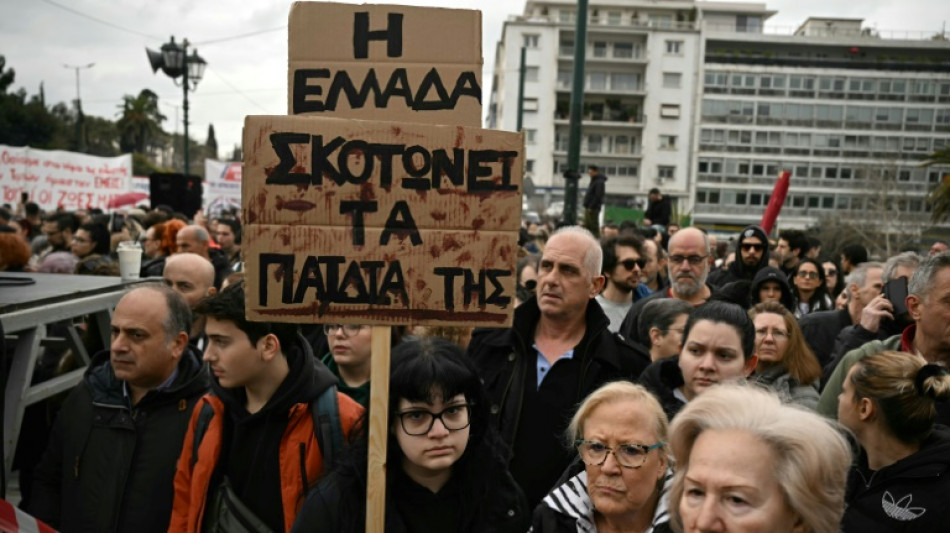
Violence mars huge Greece train crash demonstration / Photo: Angelos Tzortzinis - AFP
Violence on Friday marred a huge demonstration in Athens to mark the second anniversary of the country's worst rail tragedy, with firebomb-wielding youths clashing with riot police outside parliament.
The clashes erupted as nearly 200,000 people demonstrated to demand justice for the 57 victims of the accident, which occurred on February 28, 2023 when a train from Athens to Thessaloniki carrying more than 350 passengers collided with a freight train near the central city of Larissa.
Police said some 300,000 people turned out nationwide in demonstrations described by commentators as unprecedented in size.
In the capital, many walked several kilometres to join the demonstration as subway trains heading downtown were already jammed with passengers.
"Today we must send a strong message to punish those responsible for this tragedy," Nikos Lykomitros, a 20-year-old archaeology student, told AFP in Athens.
Babis Solakidis, a 44-year-old metalsmith, added: "This was not a simple accident, and there will be more if safety measures are not taken."
Friday's mobilisation -- likely to be the broadest in recent Greek history -- shut down schools, many shops, public services, trains, ferries and most flights.
Many shopowners put signs on their shuttered businesses that read "we demand justice."
Anti-government anger has grown, with opinion polls showing that most Greeks believe officials covered up vital evidence following the crash, slowing down an investigation that is still incomplete.
Over 40 people have been prosecuted, including the local station master responsible for routing the trains, but a trial into the tragedy is not expected before the end of the year.
The two trains had travelled towards each other on the same track for miles without triggering any alarms. The accident was blamed on faulty equipment and human error.
- 'Historic proportions' -
According to the victims' families, protests and gatherings were being held in over 200 cities and towns in Greece and other European countries, as well as in cities worldwide with large ethnic Greek populations, such as New York and Melbourne.
In a rare move, justice officials held a moment of silence and a one-hour stoppage before midday (1000 GMT) Friday in memory of the victims.
Several prominent artists joined the walkout, shutting down theatres and music clubs.
Leftist daily Efsyn said the mobilisation was of "historic proportions".
The government has rejected accusations by opposition parties that it was behind an "organised plan" to shield senior officials from responsibility.
"Society is angry because society has been misled," government spokesman Pavlos Marinakis said this week.
"One of the aims by a large part of the opposition is to lead to tension, to an explosion, through misinformation," he said.
Opposition parties will call a no-confidence vote against the government next week, in addition to a parliamentary inquiry into whether officials were too quick to bulldoze the disaster site and, as a result, destroyed vital evidence after the collision.
- 'Destabilisation' -
Prime Minister Kyriakos Mitsotakis, who has dismissed calls to resign, has accused critics of attempts to "destabilise" the country and "sink political life into a quagmire".
"In all my years in politics, I've never seen anything like this before," Mitsotakis told a business forum in Thessaloniki last week.
A survey for Alpha TV this month said 72 percent of respondents believed the government had tried to cover up the case, including more than 40 percent of the governing party's own voters.
More than two-thirds (67 percent) said they had little or no faith in the judicial investigation into the accident, while 81 percent said the government had not done enough to make train travel safer since the accident.
Mitsotakis has long been criticised for hastening to attribute the accident to human error just hours after the official investigation began.
An experts' report funded by the victims' families has claimed the freight train was carrying an illegal and unreported load of explosive chemicals, which contributed to the high death toll.
On Thursday, Greece's state aviation and railway safety investigation agency said there was a "possible presence" of an "unknown fuel" at the scene.
The train's operator, Hellenic Train, has denied knowledge of any illegal cargo.
Τhe Athens prosecutors' office has summoned Hellenic Train's former CEO Maurizio Capotorto on suspicion of giving "false testimony" to a parliamentary investigative commission last year.
Under privacy laws, surveillance videos are supposed to be automatically deleted within two weeks of filming.
P.Matthys--LCdB