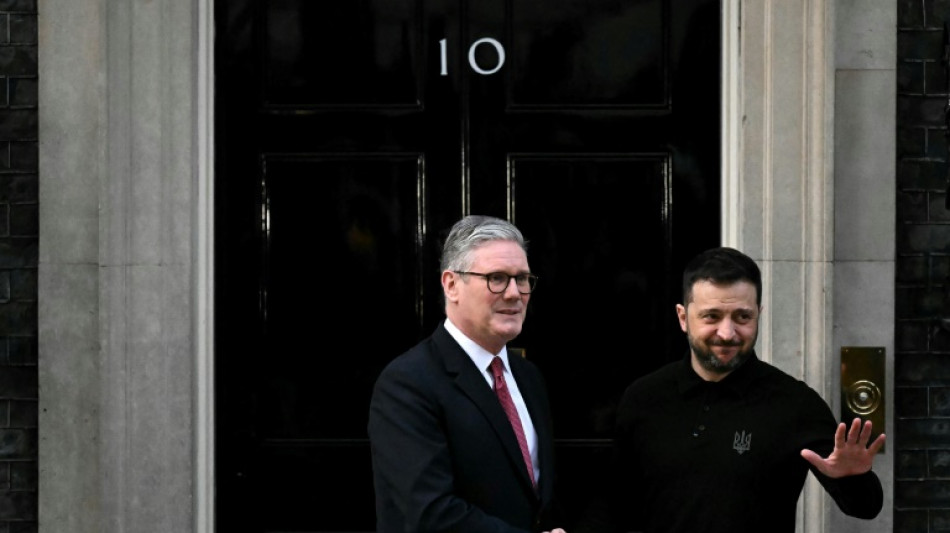
Ukraine's Zelensky gets warm welcome from UK's Starmer / Photo: Ben STANSALL - AFP
UK Prime Minister Keir Starmer on Saturday gave Volodymyr Zelensky a warm welcome in London, a day after the Ukrainian leader's clash with US President Donald Trump.
And the two countries unveiled a £2.26 billion ($2.84 billion) loan agreement to support Ukraine's defence capabilities, to be paid back with the profits of immobilised sovereign Russian assets.
Supporters cheered as Zelensky's convoy swept into Downing Street, where he was embraced by Starmer and posed for photographs before heading inside the UK leader's home.
"You're very, very welcome here in Downing Street," Starmer told Zelensky.
"And as you've heard from the cheers street outside, you have full backing across the United Kingdom, and we stand with you with Ukraine for as long as it may take."
"I want to thank you, the people of the United Kingdom, for such big support from the very beginning of this war," Zelensky responded.
He is due to meet King Charles III on Sunday.
The pair met behind closed doors for around 75 minutes, and embraced again as Starmer escorted Zelensky to his car.
- 'A new age of infamy' -
Earlier Saturday Zelensky had stressed that Trump's support was still "crucial" for Ukraine despite their row the previous day.
The clash was a further shock to Kyiv's European allies, still adjusting to Washington's new stance on the war.
On Friday, Trump berated Zelensky for not being "ready" for peace with Russia, triggering alarm across Europe.
"Yesterday evening underlined that a new age of infamy has begun," said Germany's Foreign Minister Annalena Baerbock.
Polish Prime Minister Donald Tusk and Starmer were among several other European leaders who reiterated their support for Kyiv after the row.
In an interview with the BBC, NATO chief Mark Rutte said that he had told Zelensky he had to "find a way" to restore his relationship with Trump.
Russian politicians were delighted, however.
Russia's former president Dmitry Medvedev called Zelensky an "insolent pig" who had received "a proper slap down in the Oval Office".
Although Zelensky left the White House without having signed the deal on Kyiv's rare minerals, he insisted he was still ready to sign it as "the first step toward security guarantees".
"It's crucial for us to have President Trump's support. He wants to end the war, but no one wants peace more than we do," Zelensky said in a post on social media platform X.
On Sunday, Zelensky will attend emergency talks with Kyiv's European backers, also attended by Canada's Prime Minister Justin Trudeau.
- Shouting match -
Trump stunned many in Europe when he reached out to Russian President Vladimir Putin to seek a deal on Ukraine, which Moscow invaded three years ago.
Those concerns were only exacerbated Friday by the shouting match in the White House Friday.
During the televised clash, Trump and Vice President JD Vance shouted at Zelensky, accusing him of not being "thankful" and refusing to accept their proposed truce terms.
"You're either going to make a deal or we're out, and if we're out, you'll fight it out and I don't think it's going to be pretty," Trump said.
- EU 'independence' from US -
Trump has alarmed Kyiv and European allies with his abrupt U-turn in US policy, casting himself as a mediator between Putin and Zelensky and refusing to condemn the Russian invasion.
He said in the Oval Office that he had "spoken on numerous occasions" to Putin -- more than has been publicly reported.
With fears growing over whether the United States will continue to support NATO, Sunday's gathering in the UK will also address the need for Europe to increase defence cooperation.
"We have a shield, they don't," he said in an interview with French newspapers appearing Sunday. "And they can no longer depend on the American nuclear deterrent."
Germany's likely next leader, Friedrich Merz, also stressed the need for the continent to move quickly to "achieve independence" from the United States on defence matters.
But Hungarian Prime Minister Viktor Orban -- the closest ally of Trump and the Kremlin in the European Union -- vowed to oppose any EU-wide agreement on the conflict.
"I am convinced that the European Union -- following the example of the United States -- should enter into direct discussions with Russia on a ceasefire and a sustainable peace in Ukraine," Orban wrote in a letter.
On Friday, Kyiv reported that Russian infantry had attacked the Ukrainian border from the Russian region of Kursk, near areas seized last summer by Ukrainian forces.
On Saturday, Moscow said it had seized two more villages in the south of the eastern Donetsk region.
burs-jj/sbk
E.Willems--LCdB