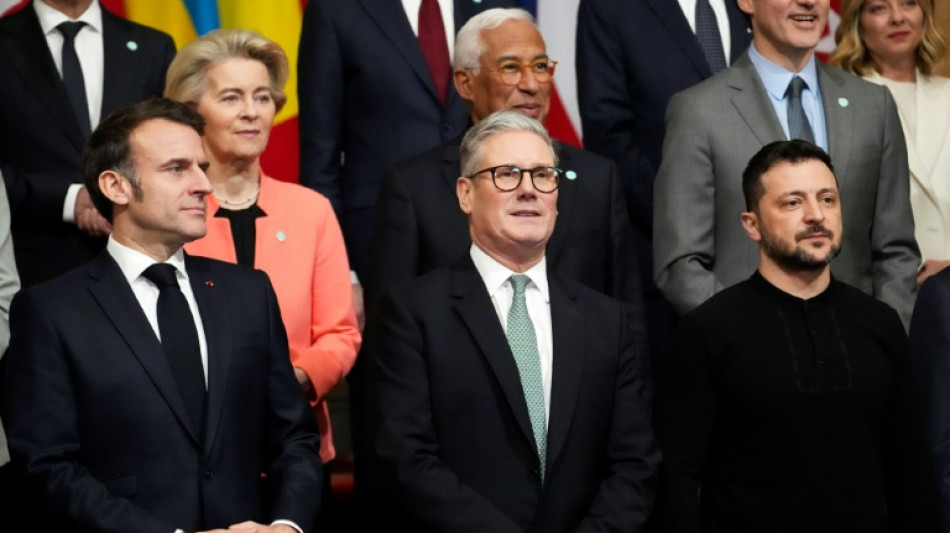
Europeans rally around Ukraine after Trump row / Photo: Christophe Ena - POOL/AFP
European leaders closed ranks Sunday in support of Kyiv at a London summit, where they pledged to spend more on security and assemble a coalition to defend any truce in Ukraine.
Bringing together 18 allies, the talks were devoted to the key questions of how to provide security guarantees for Ukraine and bolster Europe's future defences while keeping the United States under President Donald Trump onside.
Just days after a thunderous row between Trump and Ukraine's Volodymyr Zelensky raised fresh questions over the US leader's commitment to Ukraine and NATO, British Prime Minister Keir Starmer warned that Europe found itself "at a crossroads in history".
"This is not a moment for more talk -- it's time to act. It's time to step up and lead and unite around a new plan for a just and enduring peace," the premier added.
With no guarantee of US involvement, "Europe must do the heavy lifting" in securing peace in Ukraine, Starmer said, indicating that several countries were ready to help defend any truce.
Zelensky was warmly embraced by many of the summit's attendees, including Starmer, Canadian Prime Minister Justin Trudeau and NATO chief Mark Rutte, while protesters rallied outside the UK leader's home in support of Ukraine.
That welcome stood in stark contrast to Zelensky's treatment in the White House on Friday, where he was berated by Trump for not being grateful enough for US aid and not being "ready" for peace with Russia.
- Avoid dividing West -
Their argument, played out in front of the world's news cameras, raised fears that Trump wants to force Kyiv into a peace deal giving Russian President Vladimir Putin what he wants while leaving Ukraine broken and insecure.
After the leaders gathered on Sunday, European Commission chief Ursula von der Leyen warned that "we urgently have to rearm Europe" and "prepare for the worst" on the continent.
Polish Prime Minister Donald Tusk meanwhile called for the United States and Europe to "speak with one voice" in showing Putin "that the West has no intention of capitulating before his blackmail and aggression".
Starmer and France's President Emmanuel Macron have said they are prepared to deploy British and French troops to Ukraine to help preserve the peace in the event an agreement is signed to end the war.
Rutte pointed to promises from more European countries to "ramp up defence spending", while insisting the United States remained committed to the transatlantic alliance.
The London meeting brought together allies from around continental Europe, including France, Germany, Denmark and Italy as well as Turkey, NATO and the European Union.
In addition to attending the security summit, Zelensky also met King Charles III at his Sandringham estate in England.
- 'Very welcome' -
As Sunday's gathering got underway dozens of protesters draped in the yellow and sky-blue flag of Ukraine gathered outside Starmer's office, some holding signs bearing the legend "Putin's end is near" and "Stop vermin, Stop Putin".
That mirrored the hero's welcome Zelensky received on Saturday when his convoy swept into Downing Street to a cheering crowd.
The pair unveiled a £2.26-billion ($2.84 billion) loan agreement to support Ukraine's defence capabilities, to be paid back with the profits of immobilised sovereign Russian assets.
In scenes that blew up the years-long wartime alliance between pro-Western Ukraine and the United States, Trump and his Vice President JD Vance angrily accused Zelensky of not being "thankful" and refusing to accept their proposed truce terms.
- 'Complete failure' -
Trump has alarmed Kyiv and European allies with his pivoting of Washington's diplomacy on the conflict.
The Republican has cast himself as a mediator between Putin and Zelensky, and has sidelined Kyiv and Europe while pursuing rapprochement with Putin.
Though he refused to apologise after the White House clash, Zelensky indicated that he was still open to signing a deal on Ukraine's mineral wealth -- coveted by Trump.
Moscow branded Zelensky's Washington trip a "complete failure".
"The new administration is rapidly changing all foreign policy configurations. This largely coincides with our vision," Kremlin spokesman Dmitry Peskov said an interview with Russian state television recorded on Wednesday.
burs-sbk/jm
Q.Ceulemans--LCdB