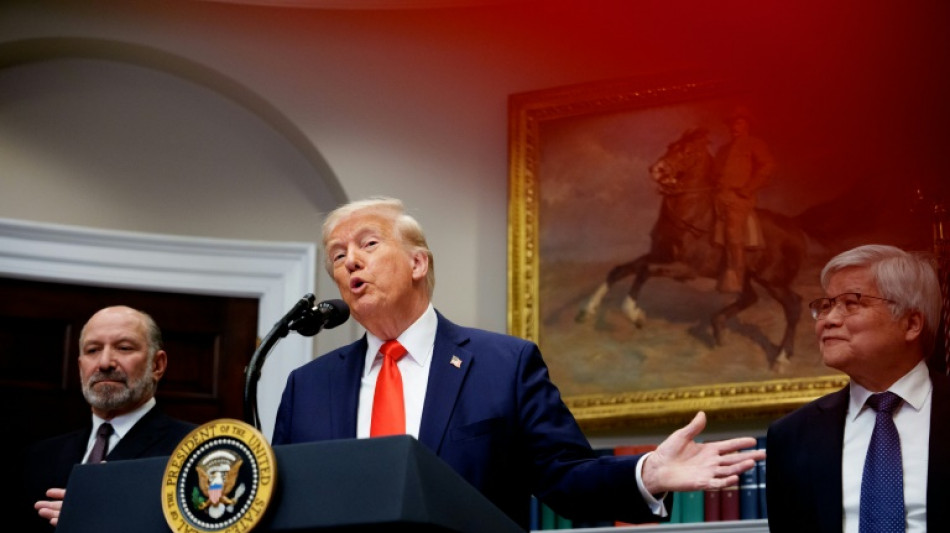
Trump warns will not 'put up with' Zelensky / Photo: Andrew Harnik - GETTY IMAGES NORTH AMERICA/AFP
US President Donald Trump warned Monday he would "not put up" much longer with Volodymyr Zelensky's stance on the war with Russia, as the Ukrainian leader countered he wanted to end it "as soon as possible."
In a new sign of frayed ties following their White House blow-up last week, Trump called Zelensky's assertion that an agreement to end the war remained distant "the worst statement that could have been made" by him.
"America will not put up with it for much longer," Trump said on social media.
The comment came after the Ukrainian president accused Russia -- which invaded Ukraine in 2014 and greatly expanded the conflict in 2022 -- of not being serious about peace.
Zelensky warned that tough security guarantees were the only way to end the conflict.
But Trump's attacks on Zelensky have upended US support for Ukraine, and Washington's allies more broadly, and stoked concern about the United States pivoting to Russia.
The US president stepped up his threats during an event at the White House later Monday, suggesting that Zelensky "won't be around very long" without a ceasefire deal with Moscow.
Trump said Zelensky should be "more appreciative" of the billions of dollars of military aid that Washington has contributed to Kyiv's fight against Russia.
But he offered hope that a minerals deal that fell through last week due to the row could be revived, and played down reports that he could halt military aid.
- European support -
"Now, maybe somebody doesn't want to make a deal, and if somebody doesn't want to make a deal, I think that person won't be around very long," Trump said.
After weekend crisis talks in London, Britain and France are investigating how to propose a one-month truce "in the air, at sea and on energy infrastructure" -- potentially backstopped by troops on the ground.
Zelensky said discussions were still focusing on the "first steps," adding: "An agreement on ending the war is very, very far away" -- a comment that angered Trump.
Zelensky added in a video statement Monday that "real, honest peace" would only come with security guarantees for Ukraine, which agreed to denuclearize in 1994 only in exchange for protection provided by the United States and Britain.
"It was the lack of security guarantees for Ukraine 11 years ago that allowed Russia to start with the occupation of Crimea and the war in Donbas, then the lack of security guarantees allowed Russia to launch a full-scale invasion," Zelensky said.
Russia dismissed his comments, accusing him of not wanting peace -- echoing US criticisms after he was shouted down in the Oval Office on Friday.
On the ground, Ukrainian officials reported fatalities from a Russian missile strike on a military training facility, some 130 kilometers (80 miles) from the front line.
A respected military blogger said between 30 and 40 soldiers were killed and 90 more wounded in the attack near Dnipro on Saturday.
- 'Deliberate escalation'? -
Trump has previously called Zelensky, president since 2019, a "dictator" for not holding elections, even though martial law precludes any vote because of the war.
Zelensky dismissed calls for him to resign, repeating his pledge to do so only if Ukraine were given NATO membership, which Russia -- and now the United States under Trump -- opposes.
In Moscow, Kremlin spokesman Dmitry Peskov blamed Zelensky for Friday's White House blow-up with Trump and Vice President JD Vance, saying he "demonstrated a complete lack of diplomatic abilities."
"He doesn't want peace," Peskov told reporters.
But Germany's likely next chancellor, Friedrich Merz, said the astonishing clash was a "deliberate escalation" by Trump.
US and Russian officials have held talks on ending the war, enraging Ukraine and Europe for being sidelined, and prompting fears in Kyiv and beyond that any deal could threaten the country's future.
French President Emmanuel Macron told daily newspaper Le Figaro that a truce would not, initially at least, cover ground fighting, as the size of the meandering front line would make it hard to enforce.
Macron met Trump in Washington last week, as did Britain's Prime Minister Keir Starmer, who insisted Sunday that the United States was "not an unreliable ally," despite Trump's overtures to Putin.
H.Goossens--LCdB