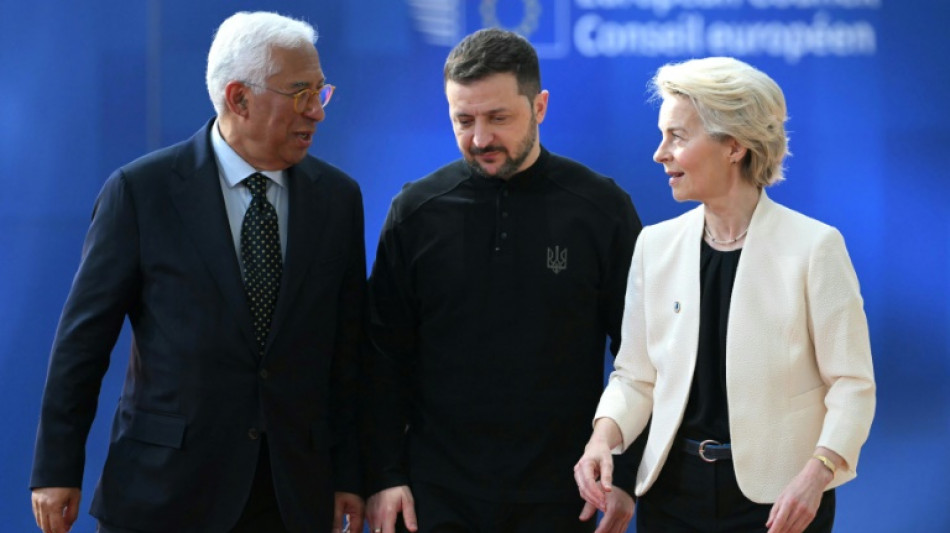
'We are not alone': Zelensky thanks Europe at crisis summit / Photo: NICOLAS TUCAT - AFP
Volodymyr Zelensky thanked EU leaders Thursday for standing by Ukraine's side, as the bloc kicked off crisis talks on confronting US President Donald Trump's pivot away from Kyiv and its transatlantic partners.
Thursday's summit brings all 27 EU leaders together for the first time since last week's explosive meeting between Trump and Zelensky. Since then, Washington has suspended the military aid and intelligence sharing that has helped Kyiv fight off Russia's invasion.
"We are very thankful that we are not alone. And these are not just words," the Ukrainian president told reporters as the talks kicked off, standing alongside EU chiefs Ursula von der Leyen and Antonio Costa.
"This is a watershed moment for Europe," said von der Leyen, who has laid out a plan aimed at mobilising 800 billion euros to "re-arm Europe" faced with the threat from Russia.
"Europe faces a clear and present danger, and therefore Europe has to be able to protect itself," the commission chief told reporters.
"It's also watershed moment for Ukraine," she added. "We have to put Ukraine in a position to protect itself and to push for lasting and just peace."
Leaders are expected to give a green light Thursday to the commission's defence plans, based largely on freeing states to spend much more -- something the bloc's two economic powerhouses look set to do.
In a sombre national address on the summit's eve, France's President Emmanuel Macron called for a defence spending surge to confront a "new era" and said he would discuss extending France's nuclear deterrent to European partners.
"Who can believe that this Russia of today will stop at Ukraine?" Macron asked. "I want to believe that the United States will stay by our side, but we have to be prepared for that not to be the case."
Germany's chancellor-in-waiting Friedrich Merz, who conferred with EU chiefs in Brussels ahead of the talks, has declared himself ready for "the worst-case scenario" and embraced radical reforms to pump up German defence spending.
- 'Coalition of the willing' -
Zelensky's visit to Brussels comes as he scrambles to reengage Washington after the White House blow-up -- declaring himself ready to work towards a peace deal under Trump's "strong leadership" and to finalise an accord on US access to Ukrainian mineral resources.
But Germany's outgoing leader Olaf Scholz reiterated European warnings against any "dictated peace" in Ukraine. A future settlement must guarantee Kyiv's "sovereignty and independence", he said.
Trump's outreach to Russian President Vladimir Putin to end the three-year war -- sidelining both Kyiv and its European partners -- has thrown Europe into crisis mode as it contemplates the possibility of a more lasting withdrawal of US security support.
It has also helped draw Britain back into the European fold, five years after leaving the EU. Now Prime Minister Keir Starmer is working in tandem with Macron to rebuild bridges between Trump and Zelensky.
Starmer and other European leaders made a show of embracing Zelensky at weekend talks in London that brought in NATO's secretary general and non-EU partners such as Turkey. EU chiefs will be briefing the British leader on the Brussels talks Friday.
France and Britain have pitched a one-month truce "in the air, at sea and on energy infrastructure" and are calling for a "coalition of the willing" to help secure a future ceasefire. Turkey indicated Thursday it could play a part in peacekeeping efforts.
Leaders in Brussels are to start thrashing out more broadly what "security guarantees" the bloc might provide for a peace deal. That could include the deployment of European troops, something several states support, but which Russia reiterated Thursday it would not accept.
Several states argue Europe currently has enough money committed to meet Kyiv's needs -- despite the US freeze on aid.
burs-ec/jj
M.Franck--LCdB