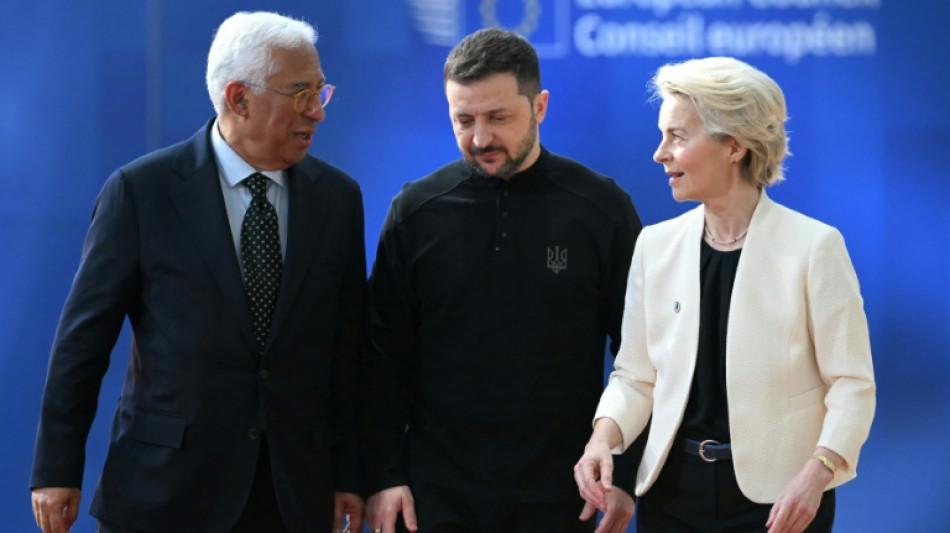
EU leaders agree defence boost as US announces new talks with Kyiv / Photo: NICOLAS TUCAT - AFP
EU leaders shaken by the prospect of US disengagement agreed to boost the bloc's defences at a crisis summit Thursday, as Washington said talks with Kyiv were back on track to secure a ceasefire with Moscow.
Rallying around Ukraine after Volodymyr Zelensky's White House blow-up with President Donald Trump, European countries greenlit a plan to "re-arm Europe" against the perceived threat from Russia.
"We are moving decisively towards a strong and more sovereign Europe of defence," Antonio Costa, who heads the Council of the EU's 27 states, told reporters after the talks.
"We are putting our money where our mouth is."
Leaders endorsed the European Commission's aim to mobilise about 800 billion euros ($860 billion) for defence spending, committing to examine "as a matter of urgency" its proposal to provide members with EU-backed loans of up to 150 billion euros.
The defence plan eases fiscal rules to allow states to spend much more -- at a time when Germany's chancellor-in-waiting Friedrich Merz is embracing radical reforms to fund the country's rearmament.
France's President Emmanuel Macron has likewise called for a defence spending surge and suggested extending France's nuclear deterrent to European partners.
European governments are under pressure to step up defence as Trump questions whether the United States -- the guarantor of Europe's security since World War II -- should continue its central role in NATO.
The US leader once again called that commitment into question on Thursday, complaining that its allies "should be paying more."
- 'Not alone' -
Trump's pivot away from the United States' transatlantic partners comes as he seeks a rapprochement with Russia to end the Ukraine war -- raising fears Kyiv could be forced into an unfavourable deal.
EU leaders welcomed President Zelensky in Brussels in a show of support, a week after his bust-up with Trump led to the United States cutting off military aid and intelligence sharing with Kyiv.
Declaring that Ukraine had to be in the "strongest possible position" to secure a "just and lasting peace" a leaders' statement repeated calls for "robust and credible security guarantees" to deter future Russian aggression.
The text -- backed by 26 of 27 states, given the expected opposition of Hungary's nationalist Prime Minister Viktor Orban, an ardent Trump supporter -- stressed that "there can be no negotiations on Ukraine without Ukraine".
"We are very thankful that we are not alone," Zelensky said.
The meeting brought no major new aid announcements, with several EU states arguing that Europe currently has enough money committed to meet Kyiv's needs, despite the US freeze on aid.
Norway, a non-EU member, announced, however, that it will more than double its aid for 2025 to bring the total to $7.8 billion.
- Saudi talks -
After last week's diplomatic incident, Zelensky has scrambled to mend fences with Trump, and the US envoy on the Russia-Ukraine conflict announced Thursday that new negotiations were planned.
Declaring himself pleased by Zelensky's "apology", US envoy Steve Witkoff said he intended to travel to Saudi Arabia to speak to Ukrainian negotiators about an "initial ceasefire" with Russia and a "framework" for a longer agreement.
In Kyiv, a senior official said Ukrainian and US delegations were expected to meet Tuesday in the Saudi capital Riyadh. Witkoff said the meeting would take place in Riyadh or Jeddah.
Zelensky said that Ukrainian and American negotiators had "resumed work".
"We hope that next week we will have a meaningful meeting," he said.
In his bid to salvage cooperation with Washington, Zelensky declared himself ready to work towards a peace deal under Trump's "strong leadership" and to finalise an accord on US access to Ukrainian mineral resources.
Trump's outreach to Russian President Vladimir Putin to end the three-year war -- sidelining both Kyiv and its European partners -- has thrown Europe into crisis mode.
It has also helped draw Britain closer to the EU, five years after leaving the bloc.
Britain's Prime Minister Keir Starmer is working with Macron to rebuild bridges between Trump and Zelensky and together they have pitched a one-month truce "in the air, at sea and on energy infrastructure".
They have called for a "coalition of the willing" to help secure a ceasefire, with a British official saying Thursday talks with around 20 countries were underway.
Russia reiterated, however, that it would not accept European forces in Ukraine, nor a merely temporary ceasefire, saying a "final settlement" was needed.
burs-ec-ub/ec/sco
C.Adam--LCdB