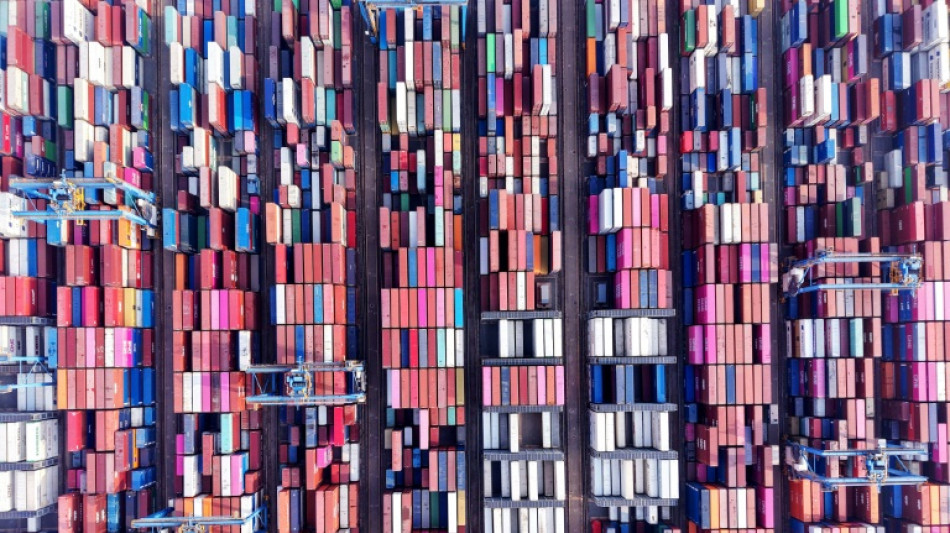
US trading partners hit back on steel, aluminum tariffs / Photo: STR - AFP/File
Major US trading partners announced countermeasures Wednesday to President Donald Trump's blanket steel and aluminum tariffs, hours after the levies took effect in a salvo that fueled trade tensions globally.
The steep 25-percent levies came into place after midnight with no exemptions despite countries' efforts to avert them, in an escalation of Trump's fresh duties already imposed on Canada, Mexico and China since he returned to the White House.
The European Commission swiftly unveiled retaliation starting in April, while Canada announced additional tariffs on US goods and China vowed "all necessary measures" in response -- as Washington edged toward an all-out trade war with allies and competitors alike.
The European Commission will implement a series of countermeasures from April 1 in response to Washington's "unjustified trade restrictions," with chief Ursula von der Leyen saying the retaliation was "strong but proportionate."
Canada, which is heavily exposed to the US steel and aluminum levies, announced additional tariffs of CAN$29.8 billion ($20.7 billion) on US goods, with the levies coming into force Thursday.
These will hit products that include computers and sports equipment, said Canadian finance minister Dominic LeBlanc.
His country supplied about half of US aluminum imports and 20 percent of its steel imports, according to a recent note by EY chief economist Gregory Daco.
Besides Canada, Brazil and Mexico are also key US suppliers of steel, while the United Arab Emirates and South Korea are among the major providers of aluminum.
Wednesday's levies stack atop earlier ones, meaning some Canadian and Mexico steel and aluminum products could face higher tariff rates unless they comply with the US-Mexico-Canada Agreement (USMCA), making them eligible for a temporary reprieve.
- 'Enough war' -
US Trade Representative (USTR) Jamieson Greer criticized the EU's promises of retaliation, calling the bloc's economic policies "out of step with reality" while blaming it for failing to help address global excess capacity.
"The EU's punitive action completely disregards the national security imperatives of the United States –- and indeed international security," Greer said in a statement.
This came shortly after European Council Chief Antonio Costa called on Washington to de-escalate the situation and enter dialogue.
"I think we have enough war in the world, we need to stop the wars we have and not create a trade war," Costa said.
German Chancellor Olaf Scholz, head of Europe's largest and heavily export-oriented economy, condemned Washington's moves as "wrong" and warned consumers could be hurt by increased inflation.
Beijing's foreign ministry said "there are no winners in trade wars."
China is the world's leading steel manufacturer, although not a major exporter of the product to the United States.
Trump's steel and aluminum tariffs will likely balloon costs of producing goods from home appliances to automobiles and cans used for drinks, threatening to raise consumer prices down the road, experts say.
Auto manufacturing and construction are among the biggest users of steel in the country, noted Cato Institute research fellow Clark Packard.
- 'Massive uncertainty' -
Markets in Asia, including Hong Kong and Shanghai, were down on Wednesday.
Even before the latest US tariffs took effect, manufacturers moved to find cost-effective domestic suppliers.
The mere threat of protectionism, said the Cato Institute's Packard, has allowed US steel and aluminum firms to raise their prices.
"It's creating massive amounts of uncertainty," he added.
Looking ahead, Trump has also promised fresh "reciprocal tariffs" from April 2 to tackle what Washington considers unfair behavior.
Washington has framed the tariff moves as a bid to protect US steel and workers as the sector declines and faces fierce overseas competition, especially from Asia.
It is not the first time Trump has slapped tariffs on the metals, having targeted both in his first presidency.
The lack of exemptions Wednesday came despite US partners, including Australia and Japan, pushing for exclusions.
Tokyo expressed regret it had not succeeded while Australian Prime Minister Anthony Albanese called the tariffs unjustified. But both Canberra and London stopped short of retaliation.
burs-jsk-bys/aha
M.Lenaerts--LCdB