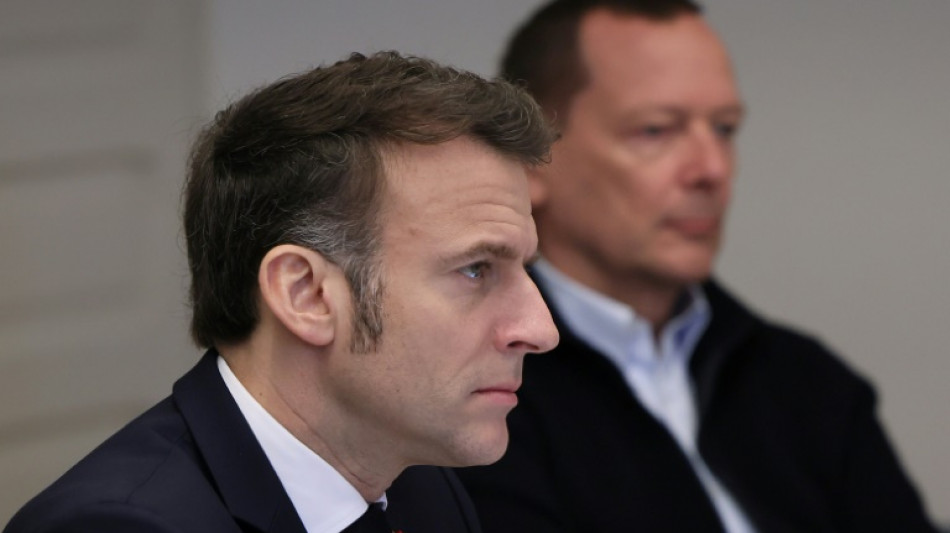
Macron wants 'clear pressure' on Moscow to accept ceasefire / Photo: Kiran RIDLEY - POOL/AFP
French President Emmanuel Macron said Saturday that Europe and the United States had to put pressure on Russia to accept a proposed ceasefire in Ukraine.
Russia "does not give the impression it sincerely wants peace," Macron said in a statement provided to AFP following a Saturday morning video conference of countries backing Ukraine organised by UK Prime Minister Keir Starmer.
On the contrary, Russian President Vladimir Putin is "escalating the fighting" and "wants to get everything, then negotiate," he said.
"Russia must respond clearly and the pressure must be clear, in conjunction with the United States, to obtain this ceasefire," he added.
In a statement released later Saturday, his office said Macron would Canada's new prime minister Mark Carney on Monday to discuss the war in Ukraine and "other international crises".
Since returning to the White House in January, US President Donald Trump has stressed his desire to end the three-year old conflict, and has made a spectacular rapprochement with Vladimir Putin.
After a very public falling out between Trump and Ukraine's President Volodymyr Zelensky at the White House last month, Kyiv has worked to restore relations. It has backed Washington's proposed a 30-day ceasefire, which Russia has not accepted.
- 'Moment of truth' -
"This is a moment of truth because if Russia does not sincerely commit to peace, President Trump will toughen sanctions and retaliation, and so that will completely change the dynamic," Macron said in a interview Friday with French regional papers that was posted late Saturday.
He said planning was accelerating among countries willing to provide security guarantees for Ukraine following any eventual ceasefire, such as France and Britain.
Military leaders from some 30 countries met in Paris on March 11 to discuss plans for a peacekeeping force in Ukraine, and will meet again Thursday in Britain.
"Several European countries, and indeed non-European ones, have expressed their willingness to join" a possible deployment to Ukraine to secure a future peace agreement with Russia, said Macron.
This would involve "a few thousand troops" per state, deployed at key points, to conduct training programmes and "show our long-term support", he told the regional papers.
Moscow has firmly opposed such a deployment.
But Macron said: "If Ukraine requests allied forces to be on its territory, it is not up to Russia to accept or reject them.
Macron will travel to Berlin Tuesday for talks with Chancellor Olaf Scholz for talks on Ukraine ahead of an EU summit, Berlin has announced.
Q.Martens--LCdB