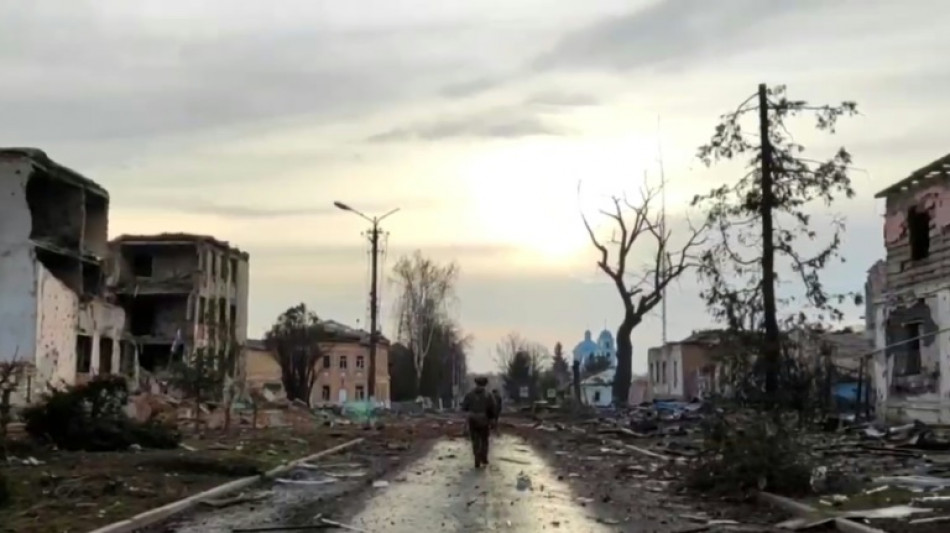
Top US and Russian diplomats discuss next steps on Ukraine / Photo: Handout - Russian Defence Ministry/AFP
The top US and Russian diplomats discussed Saturday the "next steps" to end the war in Ukraine, hours after Kyiv's allies agreed to exert pressure on Moscow.
Despite recent tensions between US President Donald Trump and his Ukrainian counterpart Volodymyr Zelensky, Kyiv has agreed in principle to a US-brokered 30-day unconditional ceasefire -- if Moscow halts its attacks in eastern Ukraine.
Russia's President Vladimir Putin has not, however, agreed to any truce, instead setting conditions that were beyond what was called for in the US agreement with Ukraine.
The ceasefire proposal by Trump's team comes as Russia has momentum in many areas of the front in Ukraine.
US Secretary of State Marco Rubio and Russia's Foreign Minister Sergei Lavrov, in a call on Saturday, "discussed next steps", State Department spokeswoman Tammy Bruce said.
Since returning to the White House in January, Trump has stressed his desire to end the three-year-old conflict, and has made a spectacular rapprochement with Putin.
The statement gave no details on when the next round of US-Russia talks hosted by Saudi Arabia would begin.
But Rubio and Lavrov also "agreed to continue working towards restoring communication between the United States and Russia," Bruce added.
- 'Moment of truth' -
The call came after a virtual summit hosted by London earlier on Saturday.
At those talks, British Prime Minister Keir Starmer told some 26 fellow leaders that they should focus on how to strengthen Ukraine, protect any ceasefire and keep up the pressure on Moscow.
Starmer said Putin would eventually have to "come to the table".
"Putin is trying to delay -- saying there must be a painstaking study before a ceasefire can take place," he added.
Military leaders from about 30 countries met in Paris on March 11 to discuss plans for a peacekeeping force in Ukraine, and will meet again Thursday in Britain.
French President Emmanuel Macron on Saturday called for unified action to ensure Russia accepts the proposed ceasefire.
"This is a moment of truth because if Russia does not sincerely commit to peace, President Trump will toughen sanctions and retaliation, and so that will completely change the dynamic," Macron told French regional papers in an interview posted late Saturday.
"Russia must respond clearly and the pressure must be clear, in conjunction with the United States, to obtain this ceasefire," he said in a statement to AFP.
European Commission President Ursula von der Leyen said that Russia had to show "it is willing to support a ceasefire leading to a just and lasting peace."
But Zelensky warned that Russia wanted to achieve a "stronger position" militarily ahead of any ceasefire, more than three years since it invaded Ukraine.
"They want to improve their situation on the battlefield," Zelensky told journalists in Kyiv.
- Troops -
Starmer and Macron have said they are willing to put British and French troops on the ground in Ukraine, but it is not clear if other countries are keen on doing the same.
Russia has rejected the idea of foreign soldiers acting as peacekeepers in Ukraine.
But Macron said Saturday: "If Ukraine asks allied forces to be on its territory, it is not up to Russia to accept or not."
Starmer has said he welcomes any offer of support for the coalition, raising the prospect that some countries could contribute logistics or surveillance.
Trump on Saturday appointed Keith Kellogg as special envoy to Ukraine.
A former national security advisor during Trump's first term, Kellogg had previously been described as a special envoy for both Ukraine and Russia.
But he was excluded from recent talks in Saudi Arabia on ending the war, with NBC News in the United States citing a senior Russian official who said that Putin considered him too pro-Ukraine.
Fighting continues, and Moscow has regained swathes of land this week in the Kursk border region.
In Russia, three civilians were injured on Saturday night when Ukrainian drones struck in the town of Gubkin and the village of Dolgoe in the Belgorod region, officials said on Telegram.
burs-pjm/sco
B.Hendrix--LCdB