Carney says Canada 'too reliant on US' on UK, France trip / Photo: Jordan Pettitt - POOL/AFP
Canadian Prime Minister Mark Carney on Monday warned his country must reduce its reliance on the United States and would turn towards its "reliable" European allies instead on his first trip abroad.
Carney's transatlantic visit to British leader Keir Starmer and France's Emmanuel Macron came after US President Donald Trump suggested his country could become part of the United States and threatened its economy.
After succeeding Justin Trudeau last week, Carney conspicuously chose key European powers France and the United Kingdom, rather than the United States, for his first trip abroad.
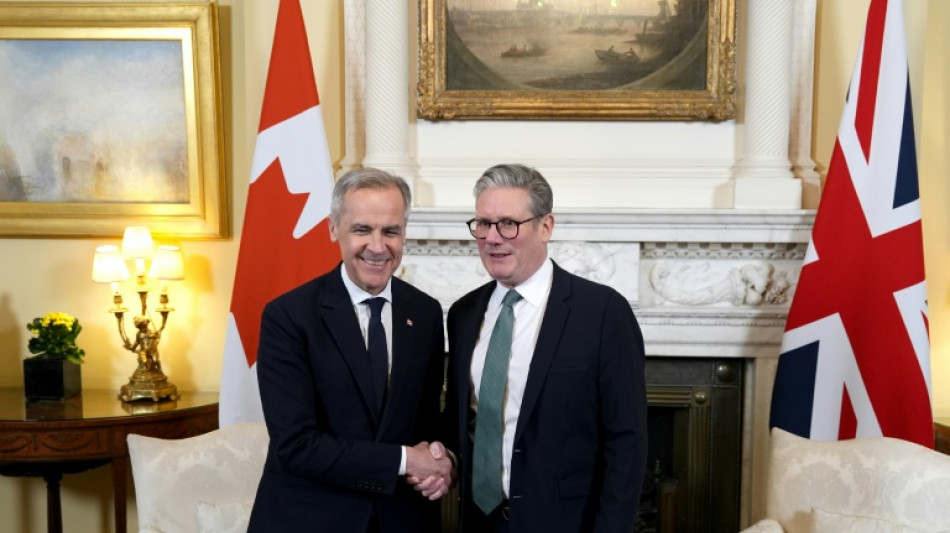
Following talks with UK Prime Minister Starmer in London, Carney told journalists his country "must diversify" its trade and security ties.
"What is clear is that our trade and our security relations are too reliant on the United States. We must diversify," the former Bank of England governor said.
Underlining their "shared values" and "shared king", Starmer thanked Carney for his "approach to Ukraine", two days after the Canadian leader took part in a video conference on shoring up support for Kyiv hosted by his UK counterpart.
Britain's King Charles -- who is also head of state in Canada -- earlier welcomed Carney for talks at Buckingham Palace.
Carney had travelled to the British capital after meeting France's President Macron at the Elysee Palace in Paris.
Describing Canada as the "most European of non-European countries", Carney said his nation needed to boost ties with European allies like France while trying to retain positive relations with Washington.
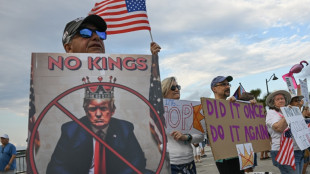
Carney faces threats on three fronts: a trade war with Washington, Trump's threats to annex his country and looming elections at home.
Trump's imposition of an escalating raft of import tariffs on Canadian goods has threatened to trigger a recession, and his scorn for Canadian sovereignty sent jitters through the former ally.
Opinion polls show a large majority of Canadian voters reject Trump's argument that their country would be better off as the "51st state of the United States".
But the trade war is a threat to the economy of the vast country of 41 million people, which has long enjoyed a close US partnership.
- 'Security and sovereignty' -
Canada, France and Britain are among the NATO members that have maintained strong support for Ukraine's beleaguered government and military since Russia's all-out invasion in February 2022, even as Trump's US administration has pushed Kyiv to make concessions to Moscow.
London and Paris are putting together plans for a coalition security force in Ukraine and looking for allies.
Canada and France want a "solid and lasting peace, accompanied by robust guarantees that will protect Ukraine against any further Russian aggression," Macron said alongside Carney.
"It is in this spirit that we will... continue to demand clear commitments from Russia," he added.
Carney told Macron, who also took part in Saturday's call hosted by Starmer on Ukraine, that both nations stood for "sovereignty".
Britain is Canada's third-largest trading partner and France its eleventh at a time when Trump's tariffs and Canadian retaliatory measures are threatening trade with its huge southern neighbour -- destination of three-quarters of Canada's exports.
But Canada also has a "Comprehensive Economic and Trade Agreement" with the European Union, which includes France.
It is also a member of the Comprehensive and Progressive Trans-Pacific Partnership (CPTPP), which now likewise includes Britain.
In his first speech as prime minister, Carney said: "Security is a priority for this government... as is diversifying our trading and commercial relationships, of course, with both Europe and the United Kingdom."
On his return leg, Carney will touch down in Iqaluit in Nunavut, the Canadian territory closest to the Danish autonomous country of Greenland -- another Trump target for annexation -- to "reaffirm Canada's Arctic security and sovereignty".
R.Michiels--LCdB