Hamas fires at Tel Aviv in first riposte to deadly Israel assault / Photo: BASHAR TALEB - AFP
Hamas said it fired rockets at Israeli commercial hub Tel Aviv on Thursday in its first military response to the growing civilian death toll from Israel's resumption of air and ground operations in Gaza.
Israel said it had closed off the territory's main north-south route as troops expanded the ground operations they resumed on Wednesday.
Gaza's civil defence agency said 504 people had been killed so far in the Israeli assault, including more than 190 children.
The armed wing of Hamas, the Ezzedine al-Qassam Brigades, said it fired rockets at Tel Aviv in response to Israel's "massacres" of Gaza civilians.
The Israeli army said it intercepted one projectile fired from Gaza and that two others struck an uninhabited area.
After weeks of stalemate, Israel resumed its air campaign early Tuesday with a wave of deadly strikes that drew widespread condemnation.
The offensive shattered a relative calm that had pervaded in the war-ravaged Palestinan territory since a ceasefire took hold on January 19.
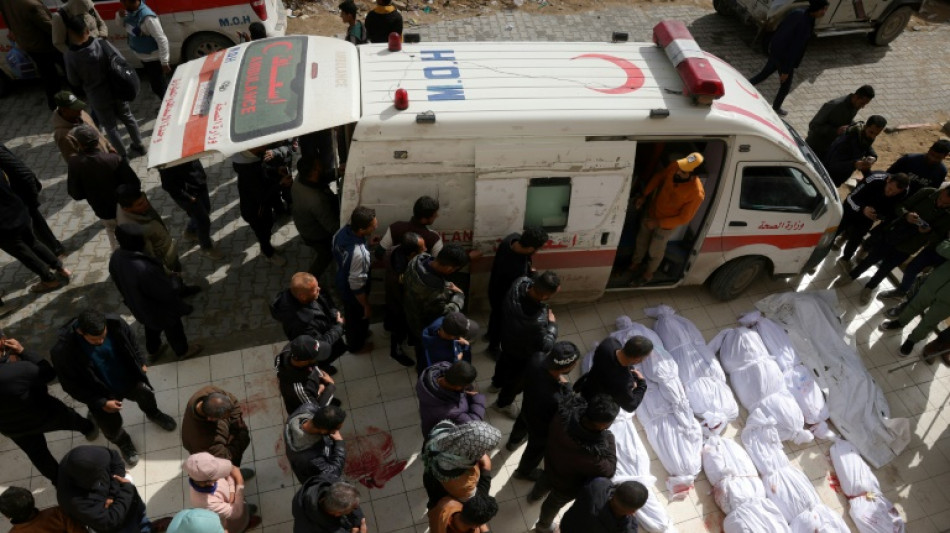
At the Indonesian Hospital in northern Gaza, grieving families knelt by the bodies of their loved ones enveloped in blood-stained white shrouds.
"We want a ceasefire! We want a ceasefire!" one of them, Mohammed Hussein, told AFPTV, appealing for the international community to stop the killing.
"We are defenceless Palestinian people," he added.
On Thursday, the Israeli army banned traffic on the territory's main north-south artery.
"Over the past 24 hours, IDF soldiers have begun a targeted ground operation in the central and southern Gaza Strip in order to expand the security zone between the northern and southern parts," army spokesman Avichay Adraee said on X.
Movement along Salaheddin Road between the north and south of the Gaza Strip is prohibited "for your safety", he said.
"Instead, travel from northern Gaza to the south is possible via the Al-Rashid coastal road," Adraee added, without spelling out whether that meant movement from south to north was banned.
Asked by AFP for clarification, the army had no immediate comment.
- 'Inhumane ordeals' -
An official from Gaza's Hamas-run interior ministry said the Israeli army had closed what it calls Netzarim Junction, on Salaheddin Road just south of Gaza City, on Wednesday evening.
The official said Israeli tanks had deployed at the junction, where the road artery crosses Israel's main supply route, "following the withdrawal of American special security forces yesterday (Wednesday) morning".
He was referring to American private security contractors deployed in February after the pullback of Israeli forces under the terms of the January ceasefire.
The first stage of the ceasefire expired early this month amid deadlock over next steps.
Israel rejected negotiations for a promised second stage, calling instead for the return of all of its remaining hostages under an extended first stage.
That would have meant delaying talks on a lasting ceasefire, and was rejected by Hamas as an attempt to renegotiate the original deal.
"Israeli Forces bombardment continues from air & sea for the third day," Philippe Lazzarini wrote on X. "Under our daily watch, people in Gaza are again & again going through their worst nightmare."
Iran's supreme leader Ayatollah Ali Khamenei called Israel's latest strikes on Gaza a "catastrophic crime" and said the United States "shares responsiblity".
The war began with Hamas's 2023 attack on Israel, which resulted in 1,218 deaths, mostly civilians, according to Israeli figures.
The Gaza civil defence agency's spokesman Mahmud Bassal said Wednesday that at least 470 people had been killed in the territory since Israel resumed large-scale air strikes in the early hours of Tuesday.
The agency reported 14 members of the same family killed in an Israeli strike in the north.
As of Monday, before the intense strikes resumed, the overall death toll in Gaza since the start of the war stood at more than 48,570, according to the territory's health ministry.
burs-dv/kir
D.Jacobs--LCdB