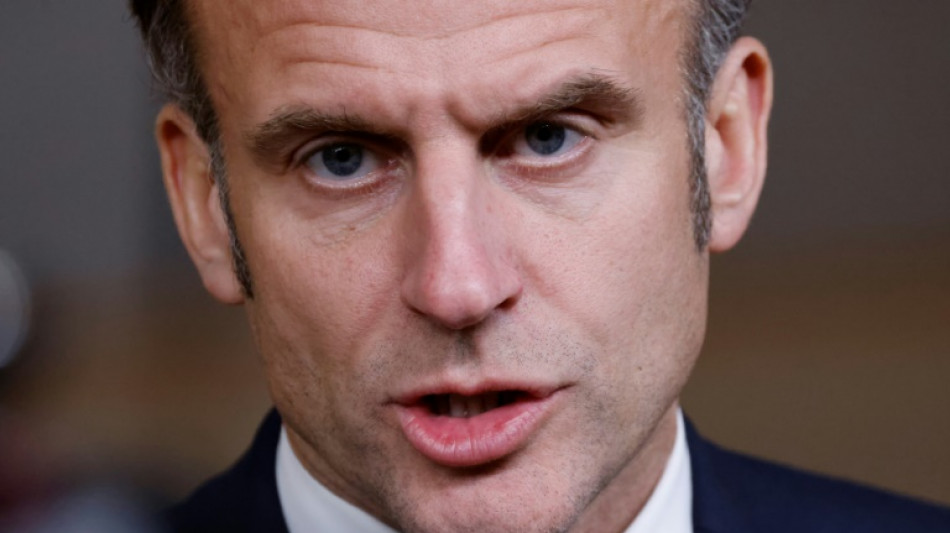
Macron announces fresh 'coalition of willing' meeting on Ukraine / Photo: Ludovic MARIN - AFP
French President Emmanuel Macron said leaders of the coalition backing Ukraine would meet again next week, hoping to finalise plans to secure a potential truce in the war with Russia.
The huddle in Paris with Ukrainian President Volodymyr Zelensky will be the latest in a series of high-stakes gatherings -- and will come after Kyiv and Moscow hold talks in Saudi Arabia with the United States on Monday.
Macron's announcement Thursday came after London played host to the latest discussions of military top brass from the so-called "coalition of the willing" around Ukraine.
British Prime Minister Keir Starmer said plans on policing a possible ceasefire were "coming together" as US President Donald Trump forges ahead with Russia on ending its war on Ukraine.
Macron -- who along with Starmer has said he is willing to deploy troops to Ukraine -- said the meeting next Thursday will be a chance to "fine-tune" work on ensuring any truce is durable.
Meanwhile, Zelensky told an EU summit that "nothing had changed" as Moscow has kept up bombardments despite agreeing with Trump to halt strikes on Ukraine's energy system.
Zelensky said Russian President Vladimir Putin must "stop making unnecessary demands that only prolong the war", calling on the EU to ramp up arms deliveries and keep sanctions in force.
EU leaders vowed in a joint declaration, which was agreed without the support of Russia-friendly Hungary, to step up military support despite Moscow's demands for foreign support to stop.
But they stopped short of endorsing a request from Zelensky, pushed by EU foreign policy chief Kaja Kallas, to give Kyiv five billion euros ($5.4 billion) for artillery shells, in the face of opposition from France and Italy.
In Norway, Zelensky said Ukrainian and US officials would meet in Saudi Arabia on Monday to build on US-led efforts to secure an end to the Russian invasion, now grinding into its fourth year.
The Kremlin had earlier confirmed Russian officials would also hold talks with the US side in Saudi Arabia on the same day.
- Power plants -
Zelensky and Putin both held talks with Trump this week, and have indicated they are prepared to halt attacks on energy infrastructure for 30 days.
But there has since been no let-up in fighting. Both countries reported a barrage of new drone strikes overnight, as questions remained about the exact details of any lasting peace deal.
Trump, who has spooked European and NATO allies by his overtures to Putin and lukewarm commitment to European security, suggested on Wednesday night the United States could take over and run Ukraine's power plants.
But on Thursday, Zelensky poured cold water on the idea, saying he could not legally negotiate ownership of the occupied Zaporizhzhia nuclear power station.
"If they want to take it back from the Russians, if they want to modernise it, invest -- this is a different question, this is an open question, we can talk about it," Zelensky added.
Trump later returned to a deal for access to Ukraine's rare earth minerals that he has pushed Kyiv to sign, insisting Washington would sign it "very shortly".
- Air defences -
Despite Trump going cold on support for Ukraine, the United States is looking at helping Kyiv to acquire additional air defence systems to counter Russia's ballistic missiles.
As Europe frets over the future of Ukraine, leaders once again debated plans to massively bolster defence spending in the bloc.
Kremlin spokesman Dmitry Peskov questioned whether Europe, where governments are looking at steep increases in domestic defence spending, was committed to ending the fighting.
"For the most part, the signals from Brussels and European capitals concern plans to militarise Europe," he said.
burs-del/ec/fox
U.Smet--LCdB