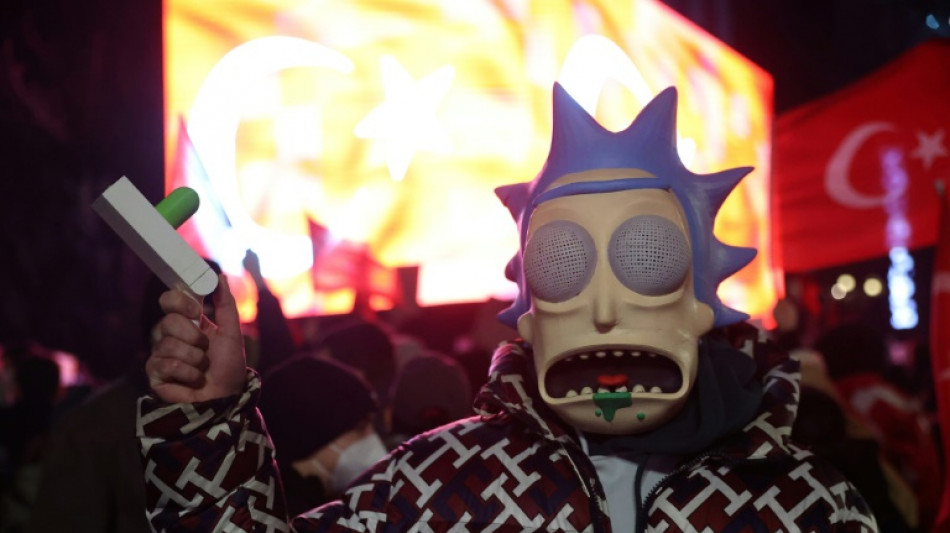
Istanbul court formally arrests mayor in graft probe amid protests / Photo: Adem ALTAN - AFP
A Turkish court formally placed Istanbul Mayor Ekrem Imamoglu under arrest as part of a graft investigation Sunday, after a fourth night of mass protests sparked heavy clashes with riot police.
The decision was confirmed by one of Imamoglu's lawyers, with the court also due to rule in a second "terror-related" probe into the popular opposition mayor, whose detention has sparked Turkey's worst street protests in over a decade.
"No despair! Keep fighting!" wrote the main opposition CHP party on X, denouncing it as "a political coup d'etat".
The news came as voters cast their ballots in a CHP primary to name Imamoglu the party's candidate for the 2028 presidential race.
The long-planned vote was the event which triggered the arrest of Imamoglu, who is widely seen as the only politician capable of challenging President Recep Tayyip Erdogan.
He was detained in connection with two probes alleging graft and "aiding a terror organisation" -- accusations which he on Saturday told police were "immoral and baseless".
The move against him sparked protests in Istanbul that have since spread to more than 55 of Turkey's 81 provinces, unleashing running battles with police, who arrested 323 people overnight, officials said.
Polls opened at 8:00 am (0500 GMT) with 5,600 ballot boxes in 81 cities. The CHP said the vote was open to everyone, not just members, in the hope of a massive show of support for Imamoglu.
"I invite our nation... to the ballot box. We are casting our vote to support President Ekrem: for democracy, justice and the future," said his wife, Dilek Kaya Imamoglu, on X, shortly after voting with her son Selim.
"We are not afraid and we will never give up."
- Rubber bullets, grenades -
Earlier, opposition leader and CHP head Ozgur Ozel said he and the mayor's wife had been allowed to spend five minutes with Imamoglu after the prosecution ended its all-night interrogation, saying he was in good spirits.
"He said this process had led to a great awakening for Turkey which he was happy about," said Ozel, who put turnout at the Istanbul protest Saturday at more than half a million.
Riot police used rubber bullets, pepper spray and percussion grenades on the Istanbul protesters, toughening their methods shortly after midnight (2100 GMT) and forcing those who could to take refuge inside City Hall building, an AFP correspondent said.
In the capital Ankara, riot police used water cannon to push back protesters, while in the western coastal city of Izmir police blocked a student march headed towards the local offices of the ruling AKP party.
"Dictators are cowards!" and "AKP, you will not silence us!" read some protesters' placards.
The nightly protests began shortly after Imamoglu was taken to the courthouse to answer prosecutors' questions in the two investigations.
The first interrogation began at 7:30 pm, ending around midnight, with the second starting shortly after, ending around 7:30 am, media reports and his legal team said.
Police set up a tight security cordon around the courthouse, where around 1,000 protesters stood nearby shouting slogans, an AFP correspondent said.
- Turkish lira slides -
On Saturday, the 53-year-old mayor denied the charges against him, telling police his arrest had done untold damage to Turkey's image, in a statement released by City Hall.
"This process has not only harmed Turkey's international reputation but has also shattered the public's sense of justice and trust in the economy," he said.
"We are here today to stand up for the candidate we voted for," 30-year-old Aykut Cenk told AFP outside the court, holding a Turkish flag.
"We are not the enemy of the state, but what is happening is unlawful."
The unrest has spread rapidly despite a protest ban in Turkey's three largest cities and a warning from Erdogan that the authorities would not tolerate "street terror".
J.Hermans--LCdB