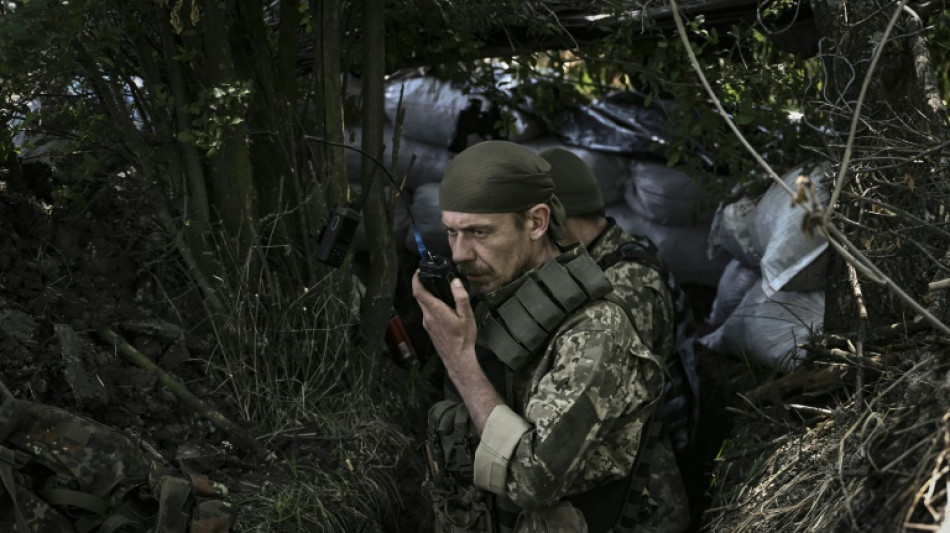
Ukraine hits Russian targets, France offers Odessa help / Photo: ARIS MESSINIS - AFP
Ukraine tried to push back Russian troops in the east and south on Friday as France offered to help ensure access to the port of Odessa and ease a global grain crisis.
The UN and Western countries meanwhile raised fresh concerns over death sentences handed by pro-Russian separatists to two Britons and a Moroccan who were captured while fighting for Ukraine.
Kyiv said Friday it had launched new air strikes on Russian positions in the captured southern region of Kherson, one of the first areas to be taken by Russia after the February 24 invasion.
Fierce fighting continued in the eastern Donbas region, where President Volodymyr Zelensky said that Ukrainian forces were "holding on" despite Moscow concentrating its firepower there.
The fiercest fighting remains around the eastern industrial city of Severodonetsk, a battle that Zelensky has said is pivotal for the fate of the Donbas region.
Local governor Sergiy Gaiday said on Friday that Russian forces had destroyed a major sports centre, adding: "One of the symbols of Severodonetsk was destroyed. The Ice Palace burned down."
People in the town of Lysychansk, which is located just across a river from Severodonetsk, spoke to AFP about the stark choices the war has forced on them: either stay and brave the shelling, or flee and abandon their homes.
Yevhen Zhyryada, 39, said the only way to access water was by heading to a water distribution site in the town.
"We have to go there under shelling, and under fire," he said. "This is how we survive."
- 'Victory for Ukraine' -
With the world still facing shockwaves from the war, an adviser to French President Emmanuel Macron said France was ready to assist in an operation to allow safe access to Ukraine's Black Sea port of Odessa.
The port has been subject to a de facto blockade by Russia, and grain is waiting to be exported amid mounting fears of global food shortages, especially in developing countries.
"We are at the disposal of the parties to put in place an operation which would allow access in complete safety to the port of Odessa, in other words for boats to pass through despite the fact that the sea is mined," said the advisor, who asked not to be named.
Macron will travel to Ukraine's neighbours Moldova and Romania next week but no date had been set for a visit by Macron to Kyiv, the advisor said.
France wants "victory for Ukraine", the advisor added, after Macron sparked controversy by suggesting Russia should not be humiliated.
Russia's invasion has put European countries on edge, and nine of them urged NATO on Friday to beef up its eastern flank.
The meeting of the leaders of Bulgaria, the Czech Republic, Estonia, Hungary, Latvia, Lithuania, Poland, Romania and Slovakia was held in the Romanian capital Bucharest less than three weeks ahead of a NATO summit meeting in Madrid.
"In view of the increased security risks in Romania and the Black Sea, consolidating NATO on its eastern flank... becomes all the more urgent and crucial," said Romanian President Klaus Iohannis.
- 'Shocking' death sentences -
Western countries reacted with fresh outrage after the separatist authorities in the Donetsk region of the Donbas on Thursday ordered the death penalty for Aiden Aslin, Shaun Pinner and Saadun Brahim.
Germany's foreign ministry said the "shocking" sentences show "once more Russia's complete disregard for international humanitarian law".
British Prime Minister Boris Johnson's office said he was "appalled", as London pressed the case with Kyiv. Ukraine's prosecutor general said she was probing the issue.
The United Nations warned that unfair trials of prisoners of war amounted to war crimes.
Zelensky separately praised British leadership and its support for Kyiv's fight against Russia during an unannounced visit from UK Defence Secretary Ben Wallace.
"Words turn into actions. That's the difference between Ukraine's relationship with Great Britain and other countries," Zelensky said in a video statement. "Weapons, finance, sanctions -- on these three issues, Britain shows leadership."
Kyiv has been critical of countries including Germany and France for the slow delivery of aid and for giving too much credence to negotiations with Vladimir Putin.
- 'Take back and strengthen' -
Russia has repeatedly warned the West against getting involved, with some officials warning of the risk of nuclear war.
Putin, who has said that what Russia calls its special military operation is meant to "de-Nazify" Ukraine, appeared to compare himself to Peter the Great's 18th century war against Sweden, in remarks on Thursday.
After visiting an exhibition in Moscow dedicated to the 350th birthday of the tsar, Putin said "you get the impression that by fighting Sweden he was grabbing something. He wasn't taking anything, he was taking it back".
In an apparent reference to Ukraine, Putin added: "It is our responsibility also to take back and strengthen."
"Back then there was fascism, now there is neo-fascism," said local resident Alexander Grachev, 50, referring to Ukraine's authorities.
burs-dk/har
Y.Bernard--LCdB