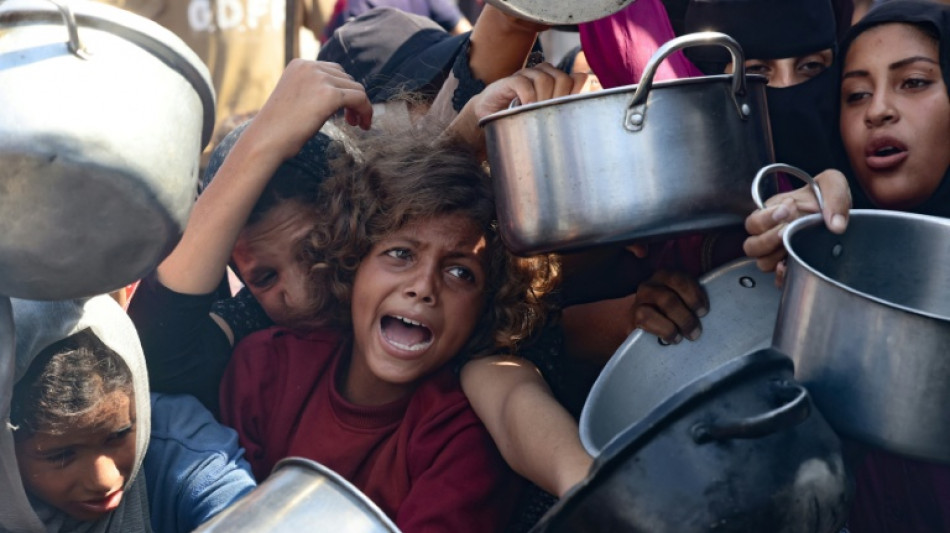
UN declares famine in Gaza, Israel rejects 'lie' / Photo: - - AFP
The United Nations officially declared a famine in Gaza on Friday, blaming "systematic obstruction" of aid by Israel during more than 22 months of war, with Prime Minister Benjamin Netanyahu swiftly dismissing the findings.
Netanyahu, whose defence minister meanwhile threatened to expand the offensive, rejected the UN-backed report as "an outright lie".
Hamas urged the United Nations and UN Security Council to "stop the war and lift the siege", calling for unrestricted access for food, medicine, water and fuel.
The Rome-based Integrated Food Security Phase Classification Initiative (IPC) said famine was affecting 500,000 people in the Gaza governorate, which covers about a fifth of the Palestinian territory including Gaza City.
Israel has pressed ahead with plans to seize Gaza City despite an international outcry, saying that taking the territory's largest city is key to defeating Hamas.
The IPC projected that the famine would expand to Deir el-Balah and Khan Yunis governorates by the end of September, covering around two-thirds of Gaza.
UN agencies and aid groups had warned for months of a looming famine in Gaza, where Israel has severely restricted aid and at times completely cut it off during its nearly two-year war with militant group Hamas.
COGAT, an Israeli defence ministry body which oversees civil affairs in the Palestinian territories -- including coordinating aid to Gaza -- argued that the IPC's findings rely on "partial data and unreliable sources".
UN aid chief Tom Fletcher said the famine was entirely preventable, saying food could not get through to Palestinians in need "because of systematic obstruction by Israel".
UN Secretary-General Antonio Guterres called for a ceasefire, saying: "We cannot allow this situation to continue with impunity."
- 'Man-made catastrophe' -
UN human rights chief Volker Turk said it was "a war crime to use starvation as a method of warfare" -- a charge for which the International Criminal Court in November issued an arrest warrants for Netanyahu.
In a statement, Netanyahu said "Israel does not have a policy of starvation", citing figures on aid it had allowed into Gaza.
The IPC report said that "over half a million people in the Gaza Strip are facing catastrophic conditions characterised by starvation, destitution and death."
It said the deterioration between July and August was the most severe since it began analysing hunger in Gaza, driven by a sharp escalation in the war and restrictions on supplies.
In early March, Israel completely banned aid from Gaza for two months, leading to severe shortages of food, medicines and fuel.
Speaking in Geneva, the UN's Fletcher said: "It is a famine that we could have prevented if we had been allowed. Yet food stacks up at borders because of systematic obstruction by Israel."
The International Committee of the Red Cross said Israel "must ensure that the basic needs of the civilian population in Gaza are met".
The famine declaration "must serve as a catalyst for immediate and concrete action," it added.
Britain's foreign minister, David Lammy, said that "the Israeli government's refusal to allow sufficient aid into Gaza has caused this man-made catastrophe. This is a moral outrage."
- 'We are dying' -
Israeli Defence Minister Israel Katz earlier warned that "the gates of hell will open upon" Hamas leaders, specifically in Gaza City, "until they agree to Israel's conditions for ending the war, primarily the release of all hostages and their disarmament."
Military chief Eyal Zamir said "we are expanding operations in Gaza in the coming days."
Late Thursday, Netanyahu said he had ordered immediate negotiations aimed at freeing the hostages still held in Gaza -- 49 people, including 27 the Israeli military says are dead.
The Israeli premier said the diplomatic push would accompany the operation to take control of Gaza City.
Mediators have been waiting for an official Israeli response to their latest ceasefire proposal, which Hamas accepted earlier this week.
On the ground, Gaza's civil defence agency said Israeli fire killed at least 46 people on Friday, more than half of them in Gaza City.
Umm Mohammed Nasr, a 42-year-old mother of four from Gaza City, said that "the bombing hasn't stopped since this morning... but we have no idea where to go."
"We are dying," she said.
Hamas's October 2023 attack that sparked the war resulted in the deaths of 1,219 people, mostly civilians, according to an AFP tally based on official figures.
Israel's offensive has killed at least 62,192 Palestinians, most of them civilians, according to figures from the health ministry in Hamas-run Gaza that the United Nations considers reliable.
W.Blondeel--LCdB