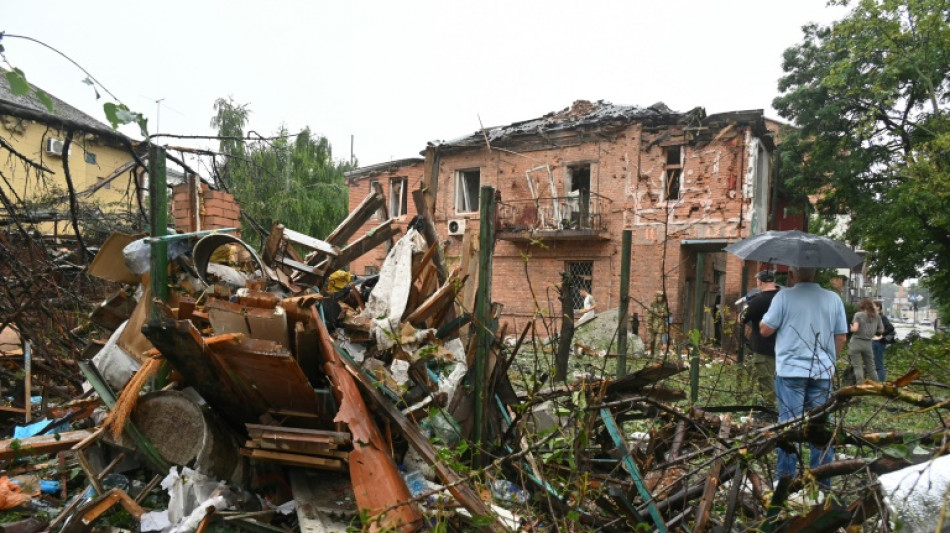
Kyiv warns Russia will step up Donbas fight / Photo: SERGEY BOBOK - AFP
Ukraine warned Monday that Russian forces were preparing to intensify their fight for key cities in the Donbas, as President Volodymyr Zelensky bitterly accused Canada of undermining sanctions against Moscow.
In eastern Ukraine -- the focal point for a grinding Russian offensive -- the death toll from a weekend attack in the town of Chasiv Yar in the Donetsk region rose to 30, according to emergency services.
Deadly Russian rocket strikes Monday slammed Kharkiv, the country's second city, in a targeted attack on "a shopping centre and civilian residences", regional chief Oleg Synyegubov said.
Prosecutors in his region said "six civilians were killed, including a 17-year-old and his father, who were driving past" at the time of the attack, according to the Interfax-Ukraine news agency.
The Ukrainian army warned, meanwhile, that Russian troops were likely planning to launch some of their heaviest attacks yet in the Donetsk region.
"There are signs of enemy units preparing to intensify combat operations in the direction of Kramatorsk and Bakhmut," it said, referring to two main cities still under Ukrainian control.
The latest attacks in Ukraine came as Europe braced for deeper cuts in gas supplies from Russia.
On Monday Russian gas giant Gazprom began more than a week of routine maintenance on its Nord Stream 1 pipeline -- with Germany and other European countries watching anxiously to see if the gas comes back on.
Over the weekend, Ottawa agreed to deliver to Germany a turbine that was undergoing maintenance in Canada, whose absence Russia had blamed for a decrease in supplies.
The move by Canada, which came despite sanctions in place against Russia and appeals from Ukraine, prompted Kyiv to summon Ottawa's ambassador.
"The Ministry of Foreign Affairs had to summon Canada's envoy to our country due to an absolutely unacceptable exception to the sanctions regime against Russia," Zelensky said in his daily address on Telegram.
Germany and other European countries are casting a worried eye on energy supplies after Italy's Eni and Austria's OMV said Gazprom was further reducing the supply of gas.
After Russia's invasion of Ukraine in February, Germany suspended certification of a second pipeline, Nord Stream 2, as fears grew over Europe's massive dependence on Russian gas.
- 'No safe place' -
Russian state-run news agency TASS reported meanwhile that the pro-Moscow head of the Russian-occupied village of Velikiy Burluk in Kharkiv had been killed after his car was blown up.
Russian defence ministry spokesman Igor Konashenkov claimed "more than 300" Ukrainian combatants had been killed in a Russian strike near Chasiv Yar, without giving a date.
Moscow's slow advance into the east -- despite fierce Ukrainian resistance emboldened by recent deliveries of Western-supplied artillery -- contrasts with their failure to capture the capital Kyiv at the start of the invasion.
In Bucha, a town outside Kyiv, 36-year-old web designer Maxim said just three months ago, Russian soldiers were rummaging through his home and sleeping in his children's bedroom.
"In this atmosphere, I feel like nothing can happen and that life is normal," he said, sitting with his family outside his home.
"But we know there's a war and there's no place safe in Ukraine right now."
With no end to the fighting in sight, Dutch Prime Minister Mark Rutte during a visit to Kyiv said his country would supply Ukraine with more long-range artillery and an aid package worth 200 million euro ($201 million).
Western weapons -- in particular precision, long-range artillery -- were "already changing the course of the war," Secretary of the National Security and Defence Council, Oleksiy Danilov, said earlier Monday.
But Moscow was also receiving a weapons boost, with Iran planning to supply hundreds of drones with combat weapon capabilities to Russia for use in Ukraine, a top US official said.
- 'Another encroachment' -
In a bureaucratic swipe at Kyiv, Russian President Vladimir Putin signed a decree Monday to fast-track citizenship for all Ukrainians.
The foreign ministry in Kyiv hit back calling it "another encroachment on the sovereignty and territorial integrity of Ukraine, incompatible with the norms and principles of international law."
Putin and his Belarusian counterpart, strongman Alexander Lukashenko, meanwhile discussed possible joint measures against neighbouring Lithuania over its "illegal" transit restrictions affecting Moscow's exclave of Kaliningrad.
burs-jbr/bfm/mlm
L.Dumont--LCdB