Trump announces tariffs on Iran trade partners as protest toll rises / Photo: - - IRAN PRESS/AFP
US President Donald Trump announced a 25 percent tariff on any country doing business with Iran, ramping up pressure as a rights group estimated a crackdown on protests has killed at least 648 people.
Trump, who has repeatedly threatened Iran with military intervention, said in a social media post on Monday that the new levies would "immediately" hit the Islamic republic's trading partners who also do business with the United States.
"This Order is final and conclusive," he wrote, without specifying who they will affect.
Iran's main trading partners are China, Turkey, the United Arab Emirates and Iraq, according to economic database Trading Economics.
Trump has been mulling his options on Iran, which has been roiled by more than two weeks of demonstrations that have defied a near-total internet blackout and lethal force.
Sparked by economic grievances, the nationwide protests have grown into one of the biggest challenges yet to the theocratic system that has ruled Iran since the 1979 Islamic revolution ousted the shah.
Iranian authorities have blamed foreign interference for stoking the unrest and staged their own nationwide counter-rallies.
Rights groups warned that the severed communications were aimed at masking a rising death toll.
The Norway-based NGO Iran Human Rights (IHR) said it had confirmed 648 people killed during the protests, including nine minors, but warned the death toll was likely much higher -- "according to some estimates more than 6,000".
The internet shutdown has made it "extremely difficult to independently verify these reports", IHR said, adding that an estimated 10,000 people had been arrested.
"The international community has a duty to protect civilian protesters against mass killing by the Islamic republic," said IHR director Mahmood Amiry-Moghaddam.
The White House said Monday that Trump remained "unafraid" to deploy military force against Iran, but was pursuing diplomacy as a first resort.
- 'Four-front war' -
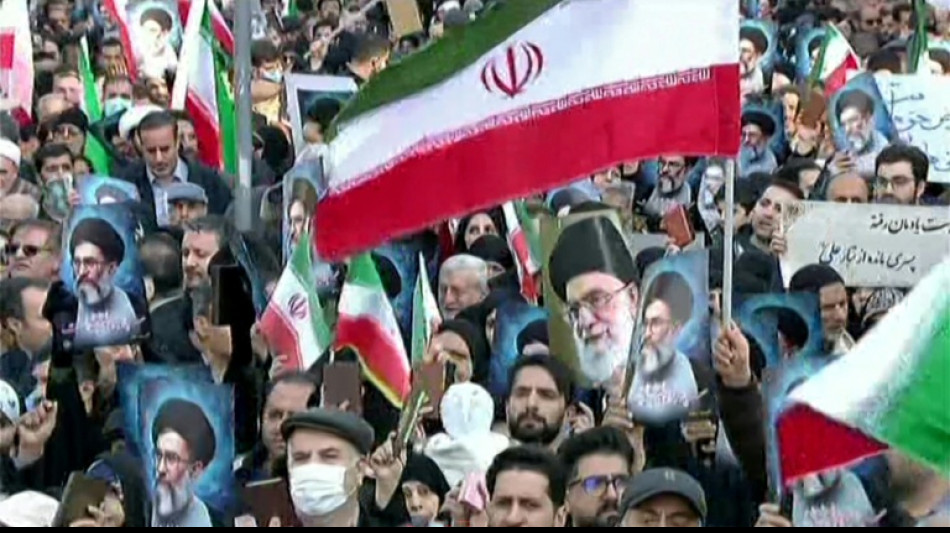
Iran on Monday sought to regain control of the streets with mass nationwide rallies that supreme leader Ayatollah Ali Khamenei hailed as proof that the protest movement was defeated.
In power since 1989 and now 86, Khamenei said the pro-government turnout was a "warning" to the United States.
"These massive rallies, full of determination, have thwarted the plan of foreign enemies that were supposed to be carried out by domestic mercenaries," he said, according to state TV, referring to pro-government demonstrations.
In the capital Tehran, state TV showed people brandishing the national flag and prayers read for victims of what the government has termed "riots".
At Enghelab (Revolution) Square, parliament speaker Mohammad Bagher Ghalibaf told the crowd that Iran was fighting a "four-front war" listing economic war, psychological war, "military war" with the United States and Israel, and "today a war against terrorists" -- a reference to the protests.
Flanked by the slogans "Death to Israel, Death to America" in Persian, he vowed the Iranian military would teach Trump "an unforgettable lesson" if attacked.
But Trump said Sunday that Iran's leadership had called him seeking "to negotiate".
Foreign Minister Abbas Araghchi told a conference of foreign ambassadors in Tehran that Iran was "not seeking war but is fully prepared for war", while calling for "fair" negotiations.
Foreign ministry spokesman Esmaeil Baghaei said a channel of communication was open between Araghchi and Trump's special envoy Steve Witkoff despite the lack of diplomatic relations.
He said Trump was "a man that means what he says and says what he means" and who "knows what's at stake".
"The red line that was drawn has been definitely surpassed by this regime."
- 'Respect for their rights' -
State outlets were at pains to present a picture of calm returning in Tehran, broadcasting images of smooth-flowing traffic.
Tehran Governor Mohammad-Sadegh Motamedian insisted in televised comments that "the number of protests is decreasing".
Iranian state media has said dozens of members of the security forces have been killed, with their funerals turning into large pro-government rallies. The government has declared three days of national mourning for those killed.
The European Union has voiced support for the protesters and on Monday said it was "looking into" imposing additional sanctions on Iran over the repression of demonstrations.
The European Parliament also announced it had banned all Iranian diplomats and representatives from the assembly's premises.
Tehran ally Russia, for its part, slammed what it called attempts by "foreign powers" to interfere in Iran, state media reported, in Moscow's first reaction to the protests.
K.Smeets--LCdB