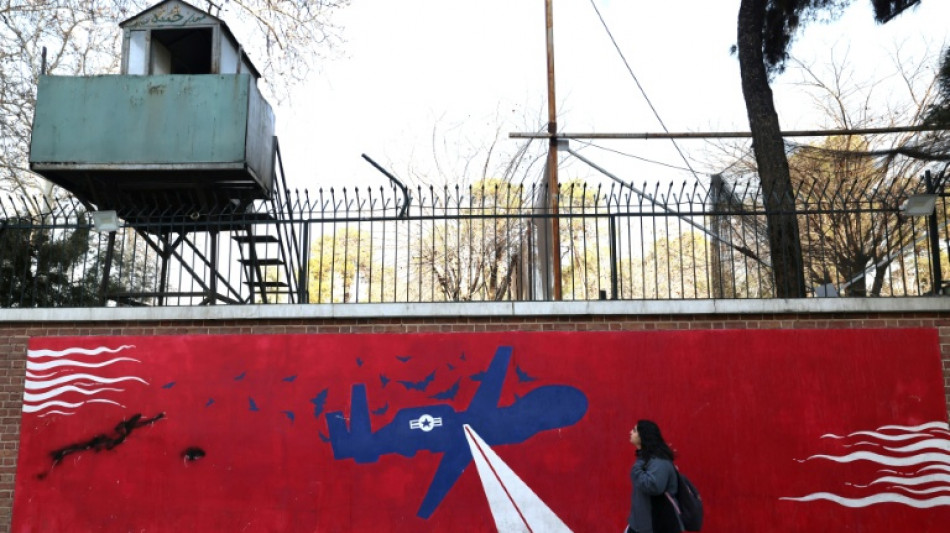
US jet downs Iran drone but talks still on course / Photo: ATTA KENARE - AFP
A US fighter jet shot down an Iranian drone that approached an American aircraft carrier in the Middle East on Tuesday, Washington said, as renewed tensions on the high seas overshadowed plans for nuclear talks.
White House spokeswoman Karoline Leavitt told Fox News that US envoy Steve Witkoff is still expected "to have conversations with the Iranians late this week," despite the incident.
The downing of the drone was the second clash between the foes in Middle Eastern waters on the same day, after Iranian forces attempted to detain a US-flagged tanker in the Strait of Hormuz.
Washington and Tehran have agreed to talks after US President Donald Trump repeatedly threatened Iran with military action -- and Iran warned that it would respond with strikes on US vessels and bases.
The United States bombed Iran's nuclear sites last summer, and has sent a naval battlegroup back to the region since Tehran's deadly crackdown on anti-government protests.
Negotiations are now set for Friday, but Trump has refused to rule out military action and his Iranian counterpart Masoud Pezeshkian insists talks will only go ahead provided they were free of threats.
"An F-35C fighter jet from Abraham Lincoln shot down the Iranian drone in self-defence," Central Command spokesman Captain Tim Hawkins said in a statement.
The aircraft carrier was dispatched to the Arabian Sea last month amid a build up of American forces.
- 'Bad things' -
Trump had told Iranians that "help is on its way" during anti-government protests in Iran that were met with a deadly crackdown last month.
Pezeshkian confirmed on Tuesday that he had ordered the start of talks with the United States, provided they were free of threats, after Trump suggested "bad things" would happen without a deal.
There has been no official confirmation from Iran on where the talks would be held, but an Arab official, speaking on condition of anonymity, told AFP a meeting was likely to take place in Turkey.
US outlet Axios reported that Iran wanted the venue moved to Oman.
Israeli Prime Minister Benjamin Netanyahu told Witkoff in Jerusalem on Tuesday that Iran "cannot be trusted," according to a statement from Netanyahu's office.
The US opposes Iran's nuclear program, which it maintains is a precursor to acquiring nuclear weapons, while Tehran insists it is for civilian research purposes.
Washington also wants to curtail Iran's support for proxy forces in the region and cut its vast arsenal of ballistic missiles.
"I have instructed my minister of foreign affairs, provided that a suitable environment exists -- one free from threats and unreasonable expectations -- to pursue fair and equitable negotiations," President Masoud Pezeshkian wrote in a post on X.
Iran has repeatedly stressed that any talks should focus solely on the nuclear issue and not its missile program or defense capabilities.
While Trump and Pezeshkian insisted they were dedicated to talks, US and Iranian forces were in action at sea.
A US-flagged tanker was challenged on Tuesday by Iranian gunboats in the Strait of Hormuz, US Central Command said.
Spokesman Captain Tim Hawkins said two Iranian boats and a drone approached the M/V Stena Imperative "and threatened to board and seize the tanker."
An American destroyer responded with air support and escorted the tanker onwards.
British maritime security firm Vanguard Tech reported that the Stena Imperative was approached by three pairs of small armed boats belonging to the Revolutionary Guards while transiting the strait 16 nautical miles (30 kilometers) north of Oman.
The ship increased speed and maintained course, the firm added, stressing it did not enter Iranian waters.
But the Iranian news agency Fars said a vessel, whose nationality it did not specify, had entered the country's territorial waters in the Strait of Hormuz.
"It was therefore warned and immediately left Iranian waters," Fars said.
- Thousands arrested -
Protests against the rising cost of living broke out in Tehran in December before evolving into wider nationwide anti-government demonstrations that triggered a deadly crackdown by the authorities.
Iranian officials have acknowledged more than 3,000 deaths during the unrest, but insist that most were members of the security forces and innocent bystanders, attributing the violence to "terrorist acts."
The Human Rights Activists News Agency, a US-based NGO, says it has confirmed 6,854 deaths, mostly protesters killed by security forces, with other rights groups warning the figure is far higher.
On Tuesday, the NGO said it had counted at least 50,235 arrests linked to the protests, with further detentions ongoing.
Iranian authorities have said the "riots" were inflamed by the United States and Israel.
A.Peeters--LCdB