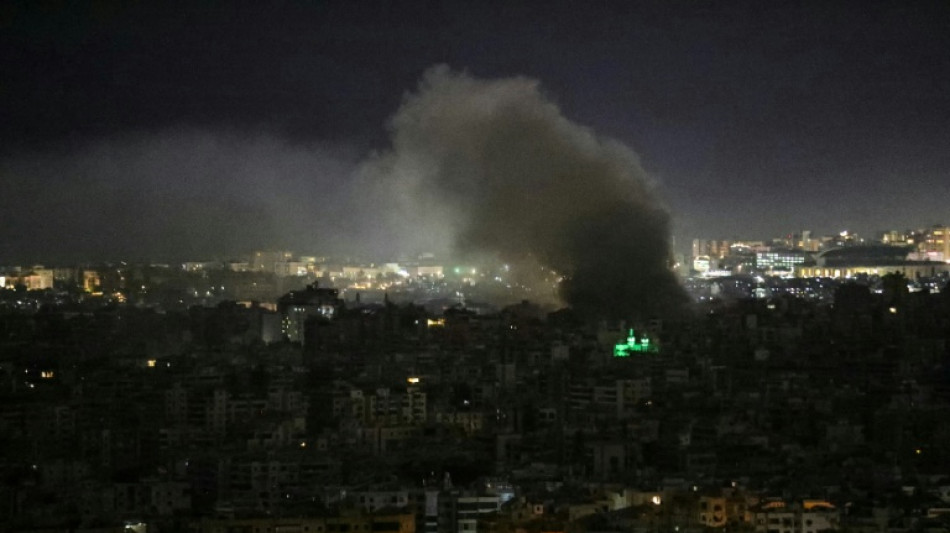
Lebanon says Israeli strike in south kills 12 medics / Photo: - - AFP
An Israeli strike in southern Lebanon killed a dozen medical staff at a clinic, Lebanese health authorities said Saturday, after Iran-backed Hezbollah's leader said his group was ready for a long confrontation with Israel.
Lebanon was drawn into the Middle East war last week when the Tehran-backed militant group attacked Israel in response to the killing of Iranian supreme leader Ayatollah Ali Khamenei in US-Israeli strikes.
Hezbollah chief Naim Qassem said on Friday his group was ready for a long confrontation with Israel, as the latter threatened to make Lebanon pay an "increasing price" in damage to infrastructure.
"We have prepared ourselves for a long confrontation, and God willing, they (Israelis) will be surprised on the battlefield," Qassem said in his second televised address since the latest war began.
"This is an existential battle, not a limited or simple battle."
Lebanese health authorities said an Israeli strike killed 12 doctors, paramedics and nurses working at a healthcare centre in the town of Burj Qalawiya, following another strike on the town of Sawaneh that left two paramedics affiliated with Hezbollah and its ally Amal dead.
Israel on Friday destroyed a bridge over the Litani River between the towns of Zrariyeh and Tayr Falsay, according to Lebanon's state-run National News Agency. The river bisects southern Lebanon, from east to west.
In a statement, the Israeli military described the bridge as a "key crossing" for Hezbollah "from northern to southern Lebanon, to build up its power and prepare for combat".
The attack was the first on Lebanese public infrastructure to be acknowledged by Israel since the start of the Middle East war.
"This is just the beginning and the Lebanese government and the state of Lebanon will pay an increasing price in damage to Lebanese national infrastructure used by Hezbollah terrorists," Israeli Defence Minister Israel Katz said on Friday.
He said Lebanon would suffer "loss of territory -- until it fulfils its central commitment of disarming Hezbollah".
Earlier this week, Lebanese President Joseph Aoun offered to negotiate directly with Israel, but on Friday he said he had not received a response.
The Israeli military bombed several roads in southern Lebanon on Friday, according to the official National News Agency, blocking access from the north of the Litani River and from the Bekaa valley, an eastern area Hezbollah uses to transport weaponry.
The NNA also reported that Israeli shells hit a United Nations base hosting Nepali peacekeepers in the southern town of Mays al-Jabal.
A spokesperson for the UN secretary-general said they were aware of the reports and would provide further information "as soon as possible".
The Israeli military did not immediately comment on the incident.
- 'Stop the war' -
UN chief Antonio Guterres called on Israel and the Iran-backed Hezbollah to "stop the war" at the start of a visit to Beirut on Friday.
"My strong appeal to those parties, to Hezbollah and to Israel, is for a ceasefire to stop the war," Guterres said.
Guterres launched a $325 million humanitarian appeal to support Lebanon as it responds to the displacement of hundreds of thousands of people by the war.
Israeli strikes had continued on Friday, including an attack that killed eight people in the south Lebanese village of Miyeh w Miyeh near the port city of Sidon, according to the health ministry.
In the nearby village of Irkey, Mohammad Taqi buried his four daughters, aged six to 13, who were killed in an Israeli strike on Thursday along with five relatives.
"The Israeli enemy says every day that it is targeting infrastructure," he told AFP at the funeral, his head wrapped in a white bandage and his face covered in wounds.
"Is this the infrastructure? Have you seen it?" he asked, gesturing to his daughters' bodies.
"I've lost four daughters. I don't have any others. Zainab, Zahra, Malika and Yasmina," he said, adding that he had also lost his parents, brother, nephew and brother-in-law in the same strike.
- Propaganda leaflets -
Hezbollah also launched attacks against Israeli forces on Friday, as part of what it said was a Quds Day operation.
Quds Day is an annual demonstration in support of the Palestinian cause in Iran, on the last Friday of the holy month of Ramadan.
Israel's military also renewed its evacuation warnings, including for Beirut's southern suburbs, and launched several strikes on the area according to the NNA.
On Thursday it had issued a similar warning, expanding the evacuation zone in southern Lebanon to reach more than 40 kilometres from the Lebanon-Israel border.
Israeli planes also dropped leaflets over Beirut on Friday.
One of the leaflets, addressed to the Lebanese people, said: "You must disarm Hezbollah, Iran's shield" and "Lebanon is your decision, not someone else's".
A.Louis--LCdB