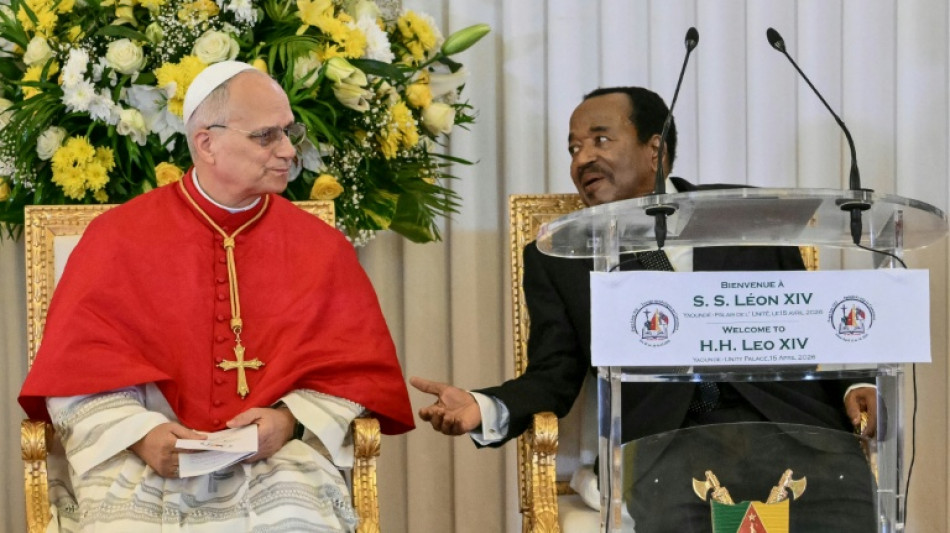
Pope urges Cameroon's leaders to examine 'conscience' / Photo: Alberto PIZZOLI - AFP
Pope Leo XIV on Wednesday urged Cameroon's leaders to examine their "conscience" and tackle corruption and rights abuses, in a pointed speech on the first day of his visit to the central African country.
After two days in Algeria marred by two suicide attacks and a spat with US President Donald Trump, the pontiff received a warm welcome from the thousands of people, some of them singing and dancing, who lined the road en route to a meeting with President Paul Biya.
In his address in an unusually direct tone to officials, including Biya, 93, who has led the central African country with a tight grip since 1982, Leo urged Cameroon's authorities to "serve as bridges, never as sources of division, even when insecurity seems prevalent".
"Security is a priority, but it must always be exercised with respect for human rights," the pope said in the presence of Biya, whose authorities repressed protests sparked by his disputed re-election for an eighth term in October.
"It is time to examine our conscience and take a bold leap forward," the pope told diplomats and officials in the capital Yaounde.
"In order for peace and justice to prevail, the chains of corruption... must be broken," he told the Cameroonian authorities.
The country ranked 142 out of 180 on the Transparency International watchdog's 2025 Corruption Perceptions index.
In response, Biya said that "the world needs the message of peace" brought by Leo.
The pope's four-nation African tour began amid remarks by US President Donald Trump that he was "not a big fan" of Leo after the US-born pontiff called for peace in the Middle East.
- Warm welcome -
Thousands of people, some of them playing music, singing and dancing, had gathered in the scorching sunshine outside the airport to welcome the pope.
"It's such a relief that the pope is coming to see us, because there are so many problems in this country," Helene Ebogo, 19, told AFP outside the airport.
The welcome was similarly warm at the Ngul Zamba Catholic orphanage, where the 70-year-old pontiff promised that the children were "called to a future greater than your wounds".
In the central African country where more than a third of the around 30 million people are Catholic, the Church plays a key mediation role and runs a large network of hospitals, schools and charities.
Clergy members had voiced fears that Leo's meeting with Biya would help the president to burnish his image.
On Tuesday, several civil society groups condemned "an unprecedented period of repression" since the presidential polls.
They also called for the release of political prisoners.
- Separatist conflict -
On Thursday, Leo will make a high-security visit to a conflict zone where English-speaking separatists are fighting the army in the northwest.
"We hope that as soon as he sets foot on Cameroonian soil, the war will stop," Benedicte Belinka, dressed in a tunic bearing the pope's image, told AFP on Wednesday.
The violence has seen civilians become the target of killings and kidnappings.
Earlier this week, separatist groups announced a three-day truce starting on Wednesday to allow the highly symbolic visit in the western anglophone region, where nearly a fifth of the population lives.
The pope will give a speech and celebrate mass in the main city of Bamenda, at the centre of the conflict that erupted after demonstrations in 2016 were put down by the authorities.
The crackdown led to a full-blown rift between the army and English-speaking separatists that has yet to be resolved.
The violence had caused more than 6,000 deaths by 2024, according to rights groups.
- 'Blessed are the peacemakers' -
On Friday, Leo holds mass for hundreds of thousands in a stadium in the economic capital Douala.
He leaves Cameroon for Angola on Saturday and next week heads to Equatorial Guinea.
Leo brushed the jibes aside.
"I have no fear, neither of the Trump administration, nor speaking out loudly about the message of the Gospel," he told reporters on the papal plane as he headed to Algiers on Monday.
burs-sbk/kjm
H.Vermeulen--LCdB