RBGPF
-1.5200
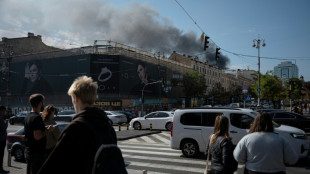
An overnight Russian barrage of missiles killed at least 11 people across Ukraine and sparked a fire at one of the most important Orthodox monasteries in the capital, Kyiv said Monday.
AFP journalists across Kyiv witnessed residents running through the streets seeking shelter throughout the night as projectiles were intercepted in the sky and glowing debris fell across the city.
In response to the assault, Ukrainian President Volodymyr Zelensky called for more pressure on Moscow from G7 leaders, who were gathering at a summit in France set to be dominated by the US-Iranian deal to end the Middle East war.
The violence killed five people and wounded 34 in the capital as a fire broke out on the grounds of the Kyiv-Pechersk Lavra UNESCO world heritage site, setting ablaze the roof of its Dormition Cathedral.
"This is one of Russia's most serious crimes against Christian culture to date," Zelensky said on social media.
Founded in the 11th century, the site holds huge significance for Orthodox believers in both Ukraine and Russia.
Russia's military said it had carried out a "massive strike" on military sites in Kyiv, as well as the Kharkiv and Dnipro regions, but denied targeting the Lavra, saying it was hit by an outdated US Patriot air defence missile.
After he visited the site, Zelensky said two Russian drones "deliberately" targeted Kyiv's monastery quarter.
Moscow fired 70 missiles and 611 drones, mainly targeting the capital, Ukraine's air force said, adding that it had downed 50 of the missiles and 582 drones.
In the morning Kyiv sun, an AFP reporter saw rescuers carefully cleaning up rubble at the monastery, as the church bells rang out the tune of the Ukrainian anthem.
The Ukrainian security service said it was putting the debris from one of the drones on display.
- 'You cannot strike shrines' -
Makariy, a monk who lives in the monastery, said he "jumped" from his bed after having been woken by a strong "roar" at five in the morning.
After stepping out of his room, he saw the complex engulfed in "fire and smoke" and took cover in a shelter.
Emergency service worker Ivan told AFP that "everything is fine inside" the Dormition Cathedral and that its roof took most of the damage.
Inside the building, AFP reporters saw water trickling through a few holes in the charred roof, but the cathedral's icons were intact.
Kyiv museum worker Natalia Korol said she was "outraged" by the strike on the monastery.
"It is a shrine. They also say that it is their shrine. You cannot strike shrines," the 52-year-old woman told AFP.
The Kyiv-Pechersk Lavra, a monastery with emblematic golden domes, is venerated by both the Russian and Ukrainian wings of the Orthodox Church as one of their most important spiritual centres.
Its sprawling cave system holds the relics of dozens of saints revered by both Churches.
The Dormition Cathedral, set alight in the overnight attacks, was almost completely destroyed during World War II and rebuilt only in the 1990s.
The Russian Orthodox Church administered the site via its Ukrainian branch for centuries.
In 2022-2023, the monks serving in the Ukrainian branch of the Moscow church were evicted from the monastery, accused of having ties to Russia.
The United Nations' cultural agency UNESCO condemned the air raid, saying that "the strike reportedly caused significant damage to the exterior and interior of the Dormition Cathedral".
Kyiv's Metropolitan Epiphanius, who heads the Ukrainian Orthodox Church, denounced the attack.
"What more must the Kremlin antichrist do for the world to realise that decisive action must be taken to stop Russian terror against Ukraine and against the very principles of peace?"
- Zelensky, Putin call Trump -
In total, 11 people were killed in the overnight barrage, including four in Kyiv and five -- rescue workers and a civil servant -- in the northeastern city of Kharkiv.
In Russia, a Ukrainian drone strike also killed three people and wounded three others in the Russian city of Tula, around 200 kilometres (125 miles) south of Moscow, the regional governor Dmitry Milyaev said on Monday.
The strikes came hours after the US and Iran announced a peace deal and after Zelensky and Putin both called their US counterpart Donald Trump on Sunday to discuss the war in Ukraine.
Russia's February 2022 invasion of Ukraine has turned into Europe's worst conflict since World War II, with thousands of civilians and hundreds of thousands of troops killed.
X.Hardy--LCdB