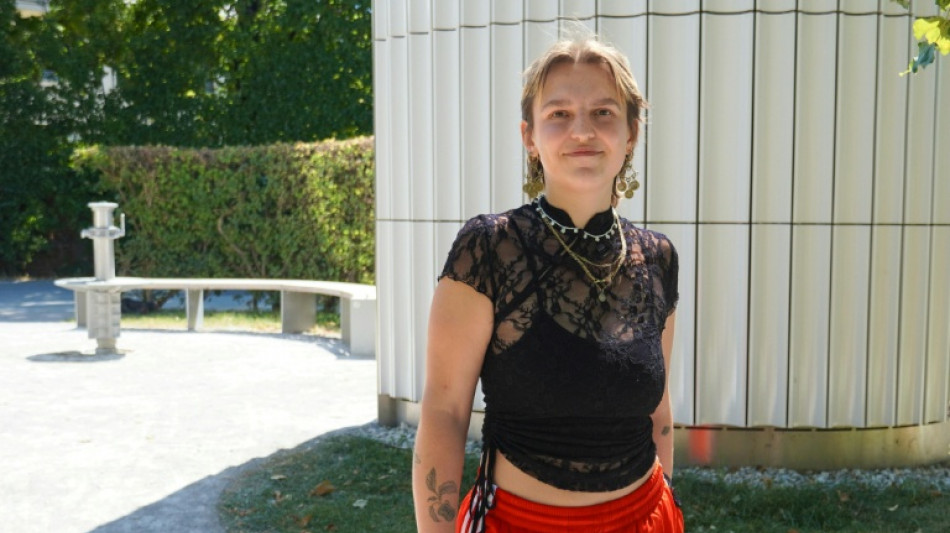
Viennese woman sues city over 'discriminatory' toilet fees / Photo: PATRICK SIEBER - AFP
A Viennese woman is suing the city council for discrimination over access to public toilets, complaining that women must pay to use cubicles while men can use urinals for free.
"I was in a park with a friend and we both needed to use the bathroom. He could go for free, but I had to pay 50 cents. I thought to myself: How is that possible?" Melanie Gradik, 27, told AFP in the Austrian capital's Augarten park.
"I want everyone to be able to use the bathroom on an equal footing. Either we all pay 50 cents or no one pays 50 cents," she said.
It's not about the money, Gradik added: "It's a small thing, but it's also an example of how women are treated unequally in everyday life."
Gradik has filed a legal complaint against the municipality, arguing that exclusively charging women for access to public toilets violates the city's anti-discrimination laws.
According to her lawyer, Petra Laback, the fact that some public facilities offer free urinals for men creates inequality between the sexes.
"Men have an additional free alternative, women do not," she said.
If Gradik wins her case, it could set a precedent across Austria, the lawyer said. "This will certainly have an impact on other municipalities."
- 'Objective justification' -
Vienna currently has 168 publicly managed toilet facilities, 139 of which are free to use.
According to the city authorities, the 29 facilities that charge a fee do so because they employ toilet attendants.
"In very busy locations with intensive use it is necessary for organisational reasons to ensure supervision in order to guarantee proper use and cleanliness," Sandra Holzinger, a spokeswoman for the municipality, told AFP.
"In these 29 facilities, a usage fee of 50 cents must be paid for the use of cubicles by people of all genders," she said, adding that urinals were additionally provided "in order to prevent fouling caused by urinating in public spaces".
But for law professor Anna Gamper of the University of Innsbruck, this system raises serious questions about equality.
Under Austrian law, "a distinction between men and women may only be made if there is a special, objective justification for it", she said.
In the case of public toilets, such a justification "does not appear to exist" since the cost of building, maintaining and cleaning cubicles and urinals is basically the same, the professor said.
Even if cubicles were slightly more expensive to maintain or consumed more water, this would not necessarily be enough to justify a price difference compared with urinals, she added.
- Free for everyone -
The argument that men also have to pay to use a cubicle does not hold up because they still have a free option that is not available to women, she added.
In Gamper's view, women should not be financially disadvantaged because of their anatomy or because they need cubicles for safety reasons, for example.
Women in Austria face several extra costs compared with men in everyday life, such as having to pay for menstrual products and more expensive cosmetics, according to a spokesman for Elke Hanel-Torsch, the city of Vienna's representative for women's issues.
In their coalition agreement for governing the city, the Social Democrats and liberals pledged to expand public toilet provision and examine whether public toilets could be made free for everyone.
In the Augarten park, new public toilets opened in 2025 provide a possible blueprint for the future.
Designed to blend into the historic Baroque park, they are notable for their curved ceramic facades, daylight from skylights, accessibility features, drinking fountains -- and free use.
The new facilities replaced older toilets and were intended to provide free, accessible toilets for everyone, regardless of gender.
F.Claes--LCdB