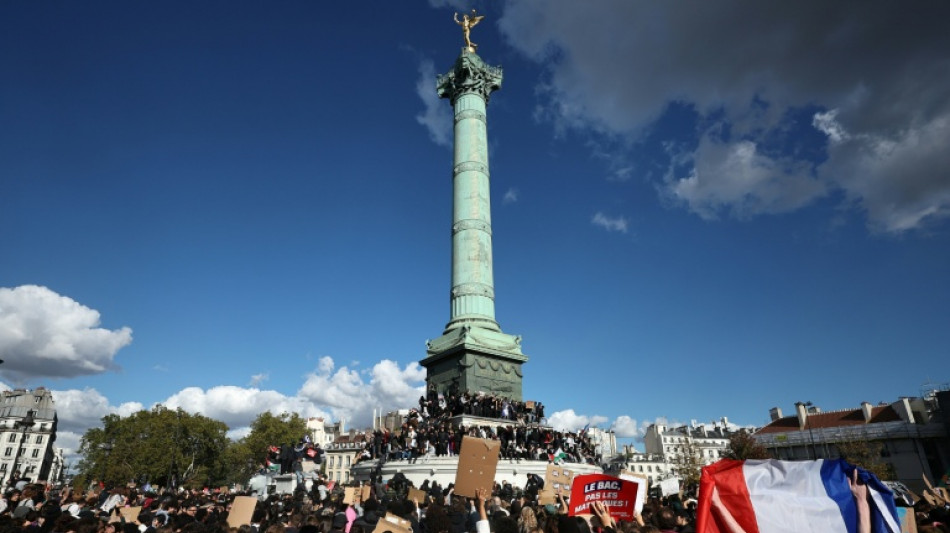
High school students turn out for new protests across France / Photo: SIMON WOHLFAHRT - AFP
High school pupils across France launched a fresh day of protests on Thursday, despite government attempts to ease a crisis that has rocked the country for days.
Children have blocked entrances to hundreds of high schools across the country for more than a week, with squads of riot police deployed to control the situation -- occasionally resulting in violent clashes.
High school and university students urged mobilisation on Thursday, with rallies in Paris and other major cities, and national education unions calling a general strike.
While the rallies have been largely peaceful, some demonstrators have started fires and vandalised bus shelters, and police have used tear gas, batons and blast balls -- with rights groups and the children accusing officers of using disproportionate force.
In a televised address on Wednesday evening, Prime Minister Sebastien Lecornu promised a plan to respond to the crisis by the end of October.
Although he denied security forces had been given "orders to confront" the young people, many were unconvinced.
"We don't want words, we want action," 17-year-old Camille told AFP from a student march in the western city of Nantes.
Outside one high school in Rennes, 18-year-old Hanaa told AFP she was "disappointed and unconvinced" by Lecornu's remarks.
"We expected more from him," agreed fellow student Salyna, 17.
In Paris, several marches made their way through the streets of the capital, while thousands gathered at the Place de la Bastille.
Crowds of students climbed the famous Bastille monument, some waving the French flag and singing the national anthem.
- Student 'dialogue' -
As the government tried to adopt a conciliatory tone, Education Minister Edouard Geffray promised to present an "emergency plan" on teacher replacements within "a few hours or a few days".
A fresh meeting between the main student associations with Geffray and Baptiste started Thursday afternoon.
Students have asked for a direct meeting with Lecornu to present what they say are costed proposals to address their demands.
Student demonstrators -- many attending high schools called lycees for children aged between 15 and 18 years old -- have complained of missing teachers, overloaded timetables, dilapidated classrooms and buildings that cannot cope with rising temperatures.
Assane Seck, father of a 15-year-old student in a Paris suburb, told AFP that at his son's school, "a teacher in one subject or another is missing" almost every day.
"There are genuine, fundamental issues that deserve reflection -- issues that warrant the government looking into them and listening to those students and seeing what they have to say," he said.
Economy Minister Roland Lescure said this week there was room to address demands for more school resources within the highly constrained 2027 budget, which is facing heated political debate.
In the current draft, education has the second largest increase in funding -- after defence -- with a boost of 1.4 percent to 90.9 billion euros.
France's spending picture on education is mixed.
A report from the Organisation for Economic Cooperation and Development found that France spends 24 percent more per student on upper secondary education than the OECD average -- but it spends markedly less at earlier stages, particularly primary schools.
The country's recent PISA score -- an annual survey which assesses the performance of education systems by measuring the skills of 15-year-old students -- was France's worst since the rankings began in 2000.
- 'Cracking down' on children -
At one Paris high school, AFP reporters saw adult protesters forming a human chain between police and protesting teenagers, who huddled together carrying backpacks and placards.
In the southern city of Toulouse, high school protesters waved the French flag and placards, while graffiti on a school wall read: "The police are cracking down on France's children."
Hundreds of students, police and teaching staff have been injured since the protests began, and more than 6,500 people -- mostly children -- have been arrested.
A 15-year-old lost a hand on Monday after police fired a stun grenade, and the government suspended the use of the weapons in response.
Police have opened 18 internal investigations into allegations of misconduct.
F.Claes--LCdB