Biden rebukes Putin after new Ukraine escalation / Photo: TIMOTHY A. CLARY - AFP
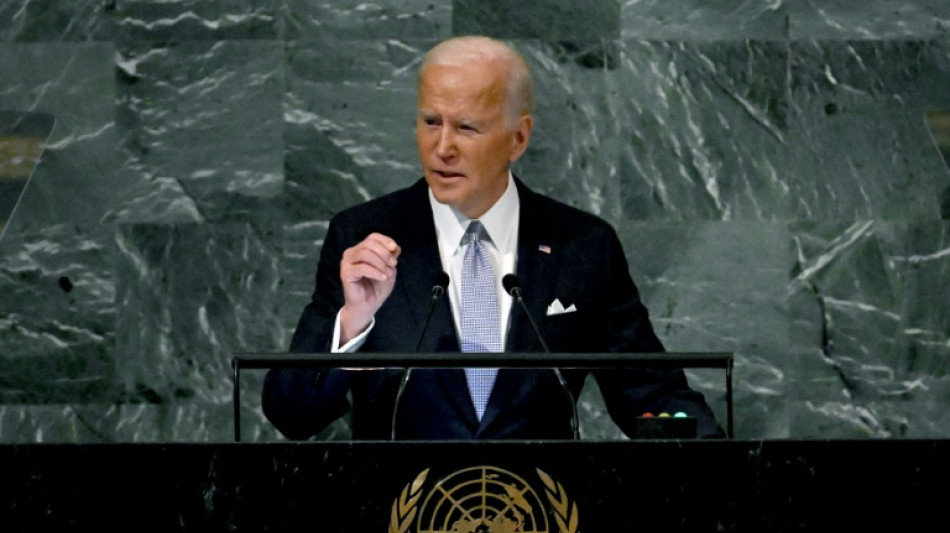
US President Joe Biden tore into Vladimir Putin Wednesday as he addressed the United Nations just hours after the Russian leader dramatically escalated his seven-month war in Ukraine by calling up his country's military reservists.
Biden accused Putin of "shamelessly" violating the UN Charter and castigated him over a veiled threat to use nuclear weapons -- after Putin said his promise to use all military means in Ukraine was "no bluff."
"Russia has shamelessly violated the core tenets of the United Nations Charter," Biden said as he addressed the UN General Assembly, warning that "a nuclear war cannot be won and must never be fought."
Russian forces have attacked Ukrainian schools, railway stations and hospitals during a war that Biden said was aimed at "extinguishing Ukraine's right to exist as a state."
John Kirby, spokesman for the White House's National Security Council, had said ahead of Biden's address that Washington was taking Putin's "irresponsible" apparent threat to use nuclear weapons "seriously" and warned it could alter its "strategic posture" if need be.
Putin's mobilization call came as Moscow-held regions of Ukraine prepare to hold annexation referendums this week, ramping up the stakes in the conflict by allowing Moscow to accuse Ukraine of attacking Russian territory.
Four Russian-occupied regions of Ukraine -- Donetsk and Lugansk in the east and Kherson and Zaporizhzhia in the south -- said on Tuesday that they would hold the votes over five days beginning Friday.
In a pre-recorded address to the nation early on Wednesday, Putin accused the West of trying to "destroy" his country through its backing of Kyiv. Russia needed to support those in Ukraine who wanted to "determine their own future", he said.
The Russian leader announced a partial military mobilization, with Defense Minister Sergei Shoigu telling state television that some 300,000 reservists would be called up.
- 'Not a bluff' -
"When the territorial integrity of our country is threatened, we will certainly use all the means at our disposal to protect Russia and our people. This is not a bluff," Putin said.
"Those who are trying to blackmail us with nuclear weapons should know that the wind can also turn in their direction," Putin added.
But Ukrainian President Volodymyr Zelensky said in an interview with Germany's Bild media group released Wednesday that he did not think Putin would resort to nuclear weapons.
"Tomorrow, Putin can say -- as well as Ukraine, we want part of Poland, otherwise we will use atomic weapons. We cannot make these compromises," he said.
Separately, Zelensky's foreign minister Dmytro Kuleba called Western allies to increase military aid to Kyiv and further isolate Moscow.
On the sidelines of the UN gathering, French President Emmanuel Macron urged the world to "put maximum pressure" on Putin, whose decisions "will serve to isolate Russia further."
German Chancellor Olaf Scholz denounced the call-up as "an act of desperation" in a "criminal war" he said Russia could not win.
In the wake of the reservist announcement flights out of Russia to neighboring ex-Soviet countries were booked up for days to come, airline data showed, in what appeared to be a rush to quit the country. Prices for remaining seats skyrocketed.
The sudden flurry of moves by Moscow this week came with Russian forces in Ukraine facing their biggest challenge since the start of the conflict.
In a sweeping Ukrainian counter-offensive in recent weeks, Kyiv's forces have retaken hundreds of towns and villages that had been controlled by Russia for months.
In a rare admission of military losses from Moscow, Shoigu said on Wednesday 5,937 Russian soldiers had died in Ukraine since the launch of the military intervention in February.
- World peace 'in jeopardy' -
As Putin made his announcement, residents were clearing rubble and broken glass from a nine-story apartment block hit by an overnight missile strike in the eastern Ukrainian city of Kharkiv.
"They want to liberate us from what? From our homes? From our relatives? From friends? What else?" she told AFP. "They want to free us from being alive?" said a 50-year-old resident, who gave her name as Galina.
The referendums follow a pattern established in 2014, when Russia annexed the Crimea peninsula from Ukraine after a similar vote.
Like in 2014, Washington, Berlin and Paris denounced the latest ballots, saying the international community would never recognize the results.
Beijing, which so far has tacitly backed Moscow's intervention called on Wednesday for a "ceasefire through dialogue" after Putin's address and in likely reference to the referendums said the "territorial integrity of all countries should be respected".
NATO Secretary General Jens Stoltenberg meanwhile denounced Putin's "dangerous and reckless nuclear rhetoric."
"Putin's announcement of sham referenda, partial military mobilization and nuclear blackmail are a grave escalation," Borrell wrote on Twitter.
"Threatening with nuclear weapons is unacceptable and a real danger to all," he said.
Kyiv said the referendums were meaningless and vowed to "eliminate" threats posed by Russia, saying its forces would keep retaking territory regardless of what Moscow or its proxies announced.
F.Claes--LCdB