Munich mall shooting: what we know
Germany is reeling after a teenager went on a shooting spree at a Munich shopping mall, killing nine people and wounding 16 others before turning the gun on himself.
The gunman, a German-Iranian named David Ali Sonboly, suffered depression and was obsessed with shooting sprees like the 2011 massacre by Norwegian rightwing fanatic Anders Behring Breivik.
Officials stressed that Sonboly, 18, had no links with the Islamic State (IS) jihadist group.
Here is what we know about the attack.
- What happened? -
The shooting began at a McDonald's fast-food restaurant at the Olympia shopping mall near Munich's Olympic stadium shortly before 1600 GMT on Friday.
Interior Minister Thomas de Maiziere said Sonboly likely hacked a girl's Facebook account and used it to lure victims to the McDonald's with a fake promotion, "offering them special reductions".
The victims were mostly young -- three of them aged just 14, according to police -- and a majority were foreign nationals.
Three were Turkish, three were from Kosovo and one was Greek. It was not immediately clear if any of them held dual nationality.
A video posted on social media appeared to show Sonboly, dressed in black, walking away from the McDonald's while firing repeatedly on people as they fled.
Another video appeared to show him on a car park roof in a heated exchange with a man on a nearby balcony.
"I'm German, I was born here," the assailant replied after the man fired off a volley of swear words, including an insulting term for foreigners.
- Manhunt -
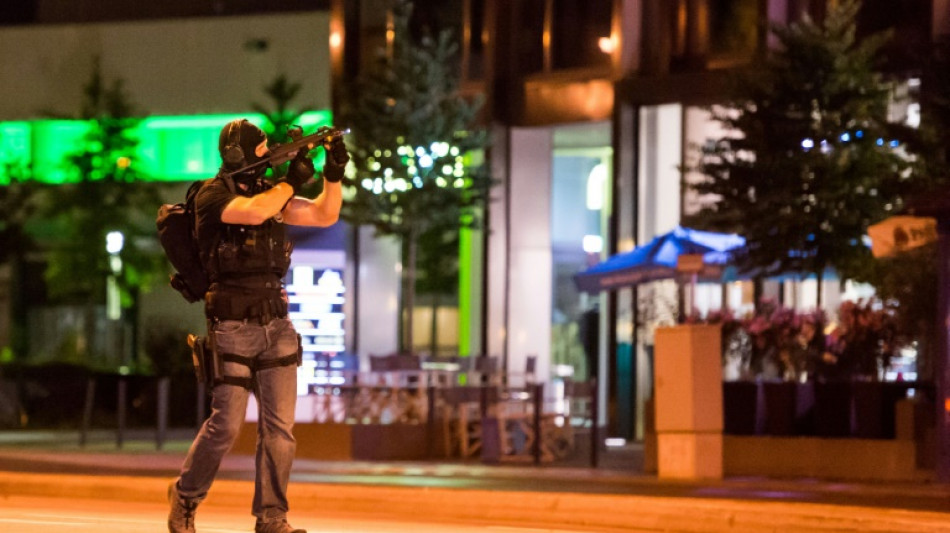
Initially believing three gunmen were involved, authorities launched a city-wide manhunt, mobilising more than 2,000 police supported by the elite GSG-9 anti-terrorist unit and helicopters.
Munich's main train station was closed and public transport suspended for several hours.
A police patrol shot and wounded Sonboly but he escaped before police found his body a kilometre (0.6 miles) from the scene of the attack. He had killed himself with a shot to the head.
- Who was the gunman? -
A picture is emerging of a lonely young man with a history of mental illness. The interior minister said Sonboly had probably been bullied.
Born in Munich to Iranian parents, neighbours described him as quiet and polite, while a police source told DPA news agency he was a fan of violent video games.
Investigations of his home and police files point to "a classic act by a deranged person," said Munich police chief Hubertus Andrae.
"There is absolutely no link to the Islamic State," he said, adding that the suspect had been obsessed with books and articles about mass killings "linked to maniacs".
He said German investigators have established an "obvious link" between Friday's shooting and Breivik's mass killings exactly five years earlier, on July 22, 2011, which left 77 people dead.
The city's chief prosecutor also said the suspect had suffered "some form of depression", but voiced caution over reports he may have undergone psychiatric treatment.
- Wave of attacks -
While Sonboly's attack does not appear to have been religiously motivated, his rampage follows a string of jihadist attacks that have left western Europe on edge.
On July 14, Tunisian Mohamed Lahouaiej Bouhlel rammed a lorry into crowds enjoying a firework display on the seafront promenade in the French Riviera city of Nice, killing 84 people including children.
It was the third major attack on French soil in the past 18 months.
The IS group also claimed suicide bomb attacks at Brussels airport and a city metro station in March that killed 32 people.
N.Lambert--LCdB