Attempted coup in Turkey: what we know so far
A Turkish army faction backed by tanks and fighter jets launched a coup attempt against President Recep Tayyip Erdogan that appeared to be faltering on Saturday.
Here is what we know so far:
- Who is in control? -
Turkey's acting army chief, General Umit Dundar, said late on Saturday morning that the coup attempt had been foiled.
Authorities had regained control of the parliament, which was hastily reconvened into a session broadcast live on television.
A total of 1,563 military officers had been arrested, authorities said.
Erdogan returned to Istanbul airport during the early hours of Saturday, saying the hotel he was staying at on Turkey's Aegean coast was bombed after he left.
Erdogan appointed Dundar, commander of the First Army, as acting chief of staff after General Hulusi Akar was captured by putschists.
Akar was later rescued, the private TV station CNN-Turk reported.
Prime Minister Binali Yildirim, who has spoken on media via telephone throughout the night, is believed to be in Ankara.
- What happened? -
Government-backed jets downed pro-coup aircraft and bombed tanks surrounding the presidential palace in the capital Ankara.
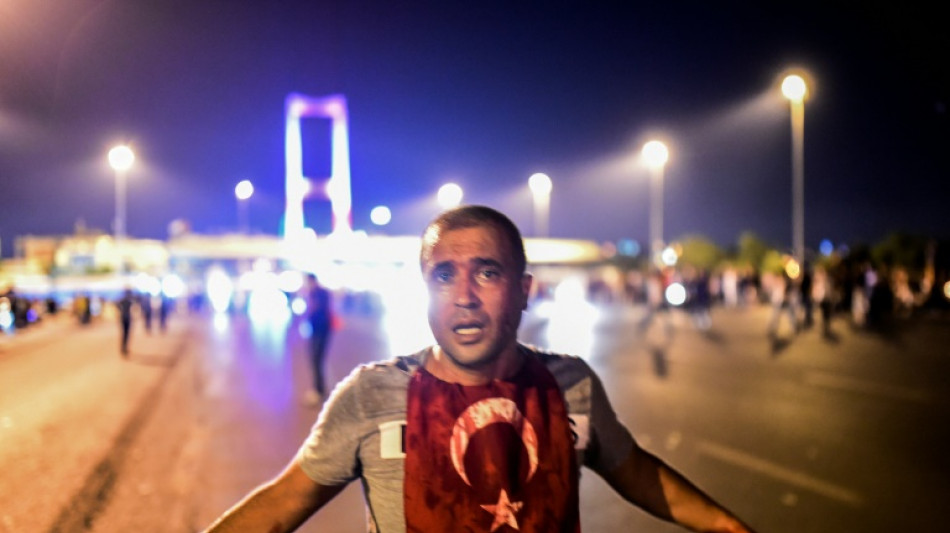
Dozens of soldiers backing the coup surrendered on the Bosphorus bridge in Istanbul they had held throughout the night, holding their hands above their heads as they were detained
Nearly 200 soldiers surrendered at the military headquarters in Ankara on Saturday, the state-run Anadolu news agency reported. An official said special forces were currently securing the complex.
Istanbul authorities sought to make a show of normalisation with the bridges reopening to traffic and Ataturk International Airport -- which had been shut down by the plotters -- gradually reopening.
But Erdogan, who had called on people during the night to take to the streets to help foil the coup, urged them in a late morning Twitter message to stay out "because a new flare-up could take place at any moment".
- Who is behind the coup? -
A group calling itself the "Council for Peace in the Homeland" declared martial law and a curfew in a statement, saying it had launched the coup "to ensure and restore constitutional order, democracy, human rights and freedoms and let the supremacy of the law in the country prevail..."
No named military officer claimed responsibility for the actions.
Erdogan put the blame the coup on supporters of his arch-foe, US-based Turkish cleric Fethullah Gulen, whose Hizmet movement and its powerful presence in Turkish society, including the media, police and judiciary.
Gulen denied being behind the coup attempt and condemned it "in the strongest terms".
- How many people have been killed and injured? -
Acting army chief Dundar said on television that nearly 200 people had been killed.
That includes 104 coup plotters, 41 police, 47 civilians and two loyalist soldiers.
The state-run news agency Anadolu had earlier reported that 1,154 people had been wounded.
Erdogan had called his supporters out onto the streets, and in several locations they outnumbered putsch soldiers.
Soldiers also shot at protesters angrily denouncing the coup bid at Istanbul's famous Taksim Square, injuring several.
Explosions rocked areas near official buildings as government aircraft sought to eject pro-coup tanks.
X.Hardy--LCdB