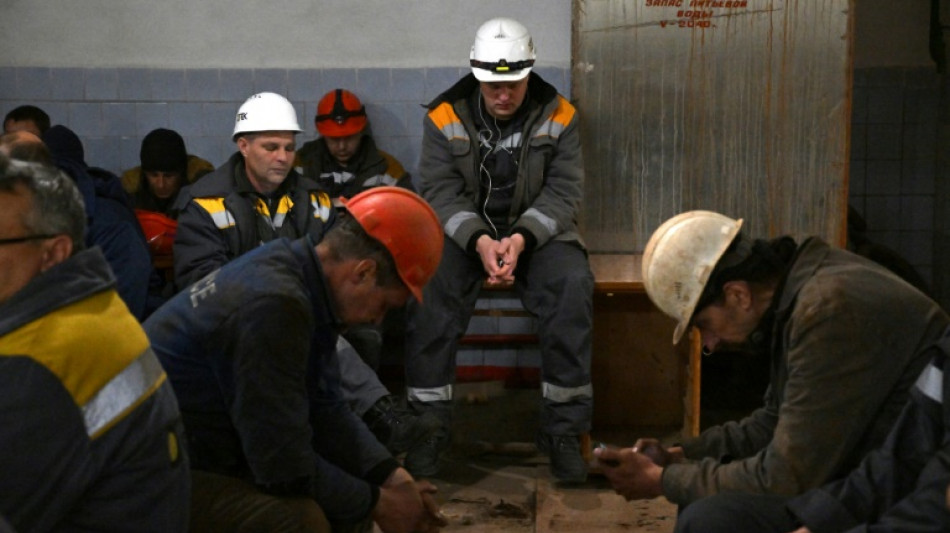
Ukraine braces for more power cuts, as Russia hits call-up target / Photo: Sergei SUPINSKY - AFP
Four million people across Ukraine have been hit by power cuts due to Russia's bombing campaign, President Volodymyr Zelensky said Friday, as officials in the capital Kyiv warned of "unprecedented" outages.
Zelensky was speaking hours after Russia said it had completed its call-up of 300,000 reservists to fight there.
The United States meanwhile announced fresh military aid to Ukraine -- in part because of Russia's attacks on the country's civilian infrastructure.
In his evening address Friday, Zelensky stressed that the whole country was suffering the consequences of the Russian campaign.
"About 4 million Ukrainians face restrictions now" from the rolling blackouts, he said. "We are doing everything so that the state has the opportunity to reduce such blackouts."
Russian forces have for weeks pummelled Ukraine with air strikes especially targeting energy infrastructure, destroying at least a third of the country's power facilities ahead of winter.
As a result, energy company DTEK, the operator for the Kyiv region, warned Friday that Russian strikes meant it would have to introduce "unprecedented" power cuts there to prevent a complete blackout.
"More severe and longer blackouts will be implemented in the coming days," it said.
- Call-up complete -
In Moscow meanwhile, Defence Minister Sergei Shoigu told President Vladimir Putin in a televised meeting that they had hit their call-up target of 300,000 soldiers.
The mobilisation, which led to some Russian men dashing for the borders to avoid the fighting, was announced on September 21 to help turn the tide after Moscow suffered a series of defeats in Ukraine.
According to Shoigu, 82,000 recruits were already in Ukraine, 41,000 of them deployed to military units.
After making major gains in Ukraine's east and south, Kyiv's forces are now closing in on the key southern city of Kherson.
The announcement of the draft's completion came as Moscow's proxies said they had finished a pull-out of civilians from Kherson.
The city, which had a population of around 288,000 people before the fighting, was one of the first to fall to Moscow's troops in the early days of the February offensive.
Retaking it would mark a major milestone for Kyiv.
Since mid-October, the occupation authorities have urged Kherson residents to cross the Dnipro River, deeper into Moscow-controlled territory and closer to regions of southern Russia.
A Russian-installed official in Kherson, Vladimir Saldo, has said that at least 70,000 people had left their homes in the region in the space of a week.
Kyiv has compared the operation to Soviet-era "deportations".
- Russian losses -
Kyiv's army said Friday that the Russian command in Kherson was trying to "hide the real losses of servicemen" in order to "avoid panic".
In one indication of Russian losses, Chechen leader Ramzan Kadyrov said late on Thursday that 23 of his fighters had been killed in battles around Kherson this week with dozens more wounded.
"At the beginning of this week, one of the Chechen units was shelled in the Kherson region," Kadyrov said on Telegram. The Kremlin ally, who rarely reveals defeats, admitted that losses were "big on that day".
On Friday, Iranians living in Ukraine held a rally in central Kyiv against the alleged use of Iranian-made drones by Russian forces to carry out the strikes.
"The country where we were born and the regime currently in power sends drones to kill us and our friends," 34-year-old Iranian architect Maziar Mian told AFP.
Iran has rejected these claims and Moscow has accused the West of using these accusations to put "pressure" on Tehran.
Partly in response to the strikes on Ukraine's infrastructure, Washington announced another $275-million military aid package.
It includes ammunition for Himars precision rocket launchers, other ammunition and four satellite communications antennas, said Pentagon spokesman Sabrina Singh.
"We're seeing Ukrainian infrastructure and electrical grids being targeted by the Russians and these antennas provide an additional capability on the ground at a critical time when Ukraine's infrastructure is being hit," Singh said.
- Fresh sanctions -
Canada on Friday announced fresh sanctions against 35 individuals and six companies in Russia's energy sector, as a well as a bond issue to support Ukraine.
Those individuals named include National Hockey League player Alexander Frolov and chess grandmaster Anton Demchenko.
Ukraine has repeatedly urged its allies in the West to extend its sanctions to high-profile personalities who have publicly backed Russia's invasion.
So far, he said, "the United Nations is not aware of any such biological weapons programme".
I.Kusters--LCdB