Key US-Canada bridge reopens, truckers still cripple Ottawa
A border crossing vital to US-Canada trade was operating again Monday after police ended a trucker blockade over Covid rules, but downtown Ottawa remained paralyzed by a swelling protest movement now in its third week.
The truckers and their supporters are pushing an anti-vaccine mandate and wider anti-establishment agenda that has triggered copycat movements in France and the Netherlands, Australia and New Zealand, with some US truckers mulling a protest for March.
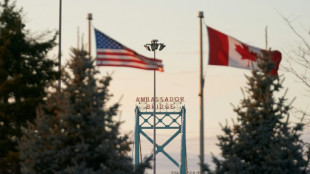
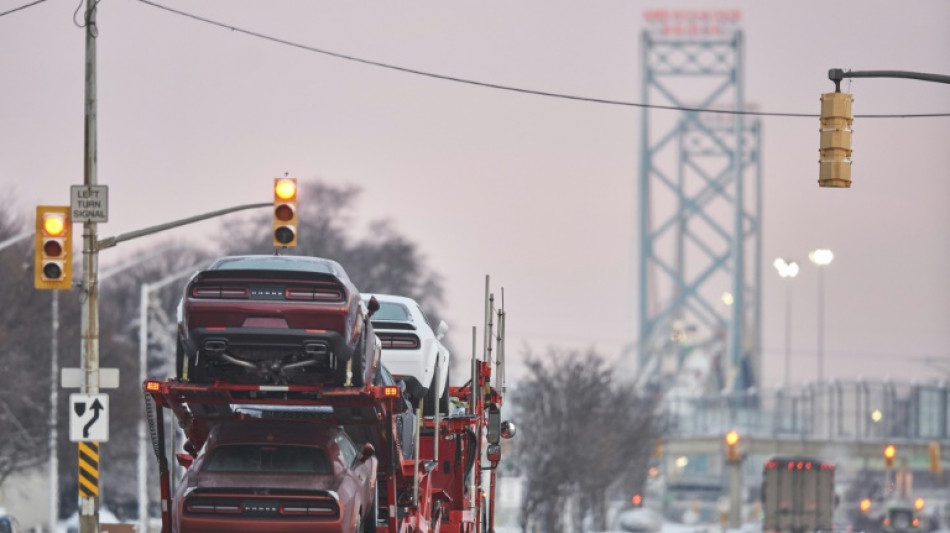
The blockading of the Ambassador Bridge, which handles an estimated 25 percent of trade between the two countries, had disrupted business in the world's largest economy and forced automakers in the United States and Canada to halt or scale back production.
"The Ambassador Bridge is now fully open, once again allowing the free flow of commerce between the Canadian and US economies," the Detroit International Bridge Company said in a statement.
In a tweet, Canadian Border Services confirmed the reopening but said "non-essential travel is not advised."
Police had begun clearing the bridge to the US city of Detroit on Saturday, successfully removing trucks from one major intersection. But some demonstrators remained, extending the protracted standoff and preventing traffic from flowing.
By Sunday, police said between 25 and 30 protesters had been arrested.
"There will be zero tolerance for illegal activity," tweeted police in Windsor, Ontario.
- Copycat movements -
The truckers have found support among conservatives and vaccine mandate opponents across the globe, even as Covid-19 measures are being rolled back in many places.
In Paris on Saturday, police fired tear gas and issued hundreds of fines in an effort to break up convoys coming from across France.
The Netherlands, Switzerland and Austria have also seen copycat movements, and Belgian authorities said Monday they had intercepted 30 vehicles as police scrambled to stop a convoy of trucks.
Demonstrators were seeking to head north to the seat of the European Union in defiance of a Belgian ban.
Brussels mayor Philippe Close told local RTBF radio that a total of 400-500 cars and vans had been spotted en route for the Belgian capital.
"About 30 have been blocked and the others have vanished," Close said.
Outside the Belgian capital several dozen motorhomes, vans and small vans were gathered on Monday morning in a parking lot reserved by police for the demonstrators.
Many of them came from France, including Antoine Medina, an electrician from Saint-Etienne, who said he had also participated in the convoy to Paris.
He said he was demonstrating in solidarity with his children "who do not want to be vaccinated."
Several demonstrators also seemed determined to reach Strasbourg, in the hope of meeting with European lawmakers.
"We want to be heard by Europe," one of the drivers told AFP, without giving a name.
- 'Serious consequences' -
Washington had ramped up pressure on the Canadian government to end the border blockade, with President Joe Biden personally voicing his concerns to Prime Minister Justin Trudeau about the "serious effects" on US companies.
As police moved to clear the protest over the weekend, US officials praised the "decisive" action.
Speaking before the bridge resumed operations, White House national security advisor Liz Sherwood-Randall said US and Canadian officials recognized "the imperative of taking swift, strong action and deterring future blockades."
Trudeau had underscored that "this conflict must end," but faced criticism for failing to act more decisively.
Truckers had originally converged on the Canadian capital to press their demand for an end to a vaccination requirement affecting drivers crossing the international border.
But the movement spread, with protesters eventually calling for an end to all vaccine mandates, whether imposed by the federal or provincial governments.
Ottawa has been the epicenter of protests with hundreds of trucks still blocking the downtown area, in what is now the third week of the movement.
The atmosphere among protesters has been mostly festive, with music, dancing and constant sounding of air horns -- but the noise, obstruction and sometimes rude and aggressive behavior of demonstrators has harmed area businesses and infuriated many locals.
In response, authorities in Ontario declared a state of emergency, while the provincial supreme court ordered truckers to end their blockade.
But the truckers' message has resonated more widely than officials expected.
R.Michiels--LCdB