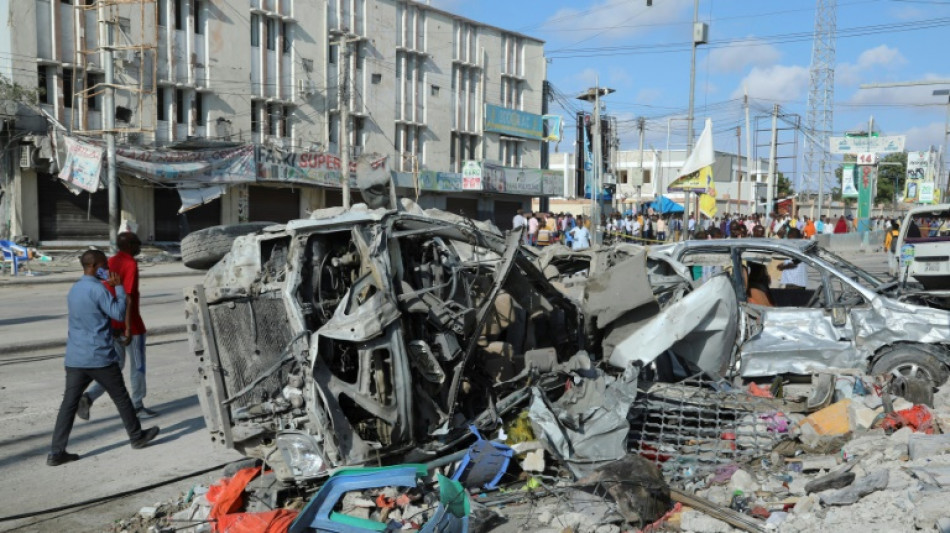
'Horrible scene': Somalis in desparate search for missing relatives after blasts / Photo: HASSAN ALI ELMI - AFP
Anguished families in Somalia on Sunday desperately searched under debris and into body bags for loved ones after two simultaneous bombings tore through a busy intersection in the capital Mogadishu.
At least 100 civilians lost their lives and 300 others were wounded in Saturday's attack claimed by Al-Qaeda-linked Al-Shabaab jihadists, the deadliest assault in the troubled nation in five years.
President Hassan Sheikh Mohamud said the death toll was expected to rise.
Abdiasis Abdi, a 22-year-old student, spent hours into the night looking for his sister who last said she lived in Zobe, a busy commercial hub with restaurants, pharmacies and banks hit by the car bombs.
"We found her this morning with only some of her clothes recognisable," Abdi said. Her body had been completely charred.
"I have never seen a horrible scene like that."
The attack has inundated first responders and hospitals in the Horn of Africa nation, which has one of the world's weakest health systems after decades of conflict.
The government put out an appeal for blood donations with dozens of people gathered outside hospitals in the capital Mogadishu, seeking news of family members.
Mohamed Ganey described seeing victims "scattered" on hospital floors as they looked for his missing sister-in-law. But the joy of finding her did not last long.
"Unfortunately, she died from the injuries just a few minutes after we found her.
"Everybody is shocked. The only question people have in common today is why kill so many innocent people?"
Police officer Adan Mohamed who was among the first to arrive at the scene after the second car bomb went off sending shrapnel flying and plumes of smoke and dust into the air, said he could not contain his emotion.
"I could not sleep last night because of the horrible scene," he told AFP, recounting how his colleagues found a baby whose mother had been killed in the blast.
"I cried again and again after I saw her face with blood stains presumably from her mother's body," he said.
"She could not even cry because of the horrible situation. All she could do was stare and blink her eyes."
- 'Waiting to get killed'-
Police spokesman Sadik Dudishe on Saturday said the "ruthless terrorists" had killed mothers some of whom had "children trapped on their backs."
The attack took place at the same busy junction where a truck packed with explosives blew up on October 14, 2017, killing 512 people and injuring more than 290, the deadliest attack in the troubled country.
Witnesses said the road was busy with rows of tuk-tuks and other vehicles when the first blast hit.
"Rescuers, security forces and people seeking their relatives immediately rushed to the scene and the second blast went off," Sumayo Ali who survived the attack said.
Shop owner Mohamed Jama, who was with four other men when he heard a loud explosion, said he crawled through broken glass to safety.
"Outside the shop, dead bodies and injuries were everywhere, some injured were screaming, that's what I can remember now," he told AFP from his hospital bed.
On Sunday morning, the area surrounding the intersection was quiet, patrolled by a handful of security officers as emergency workers cleared the rubble and removed more bodies.
Nearby buildings sustained heavy damage with their windows shattered and walls collapsed.
International condemnation of the attack has poured in, including from the United Nations, African Union and Turkey.
Pope Francis offered condolences. "Let us pray for the victims of the attack in Mogadishu in which more than 100 people lost their lives, among whom many children," he said, following the traditional Angelus prayer in Saint Peter's Square.
"I think the streets in Mogadishu are like walking on a sharp sword, we are all waiting to get killed or wounded like this one day."
R.Lacroix--LCdB