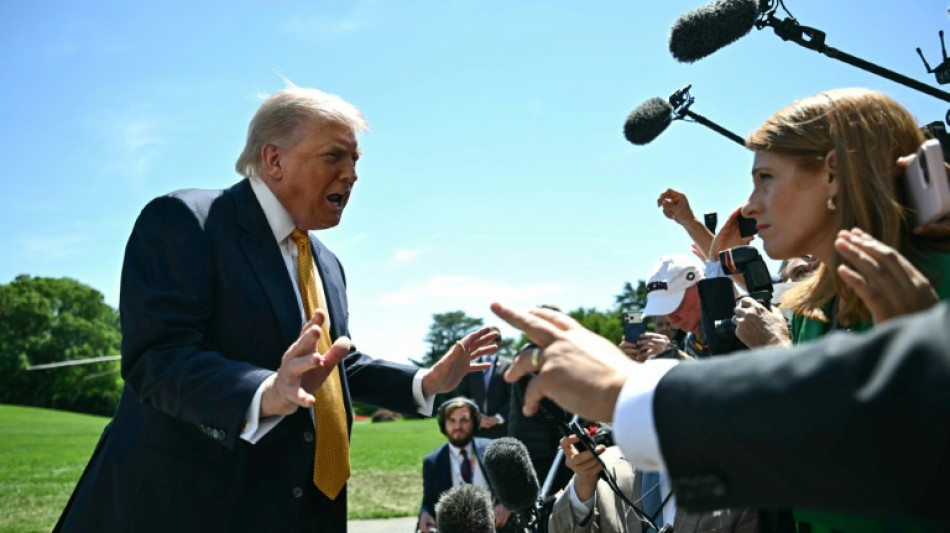
AI rivalry overshadows push for guardrails at Xi-Trump talks: experts / Photo: Kent NISHIMURA - AFP
Fears that artificial intelligence could help people design bioweapons or hack into national infrastructure are mutual concerns for Xi Jinping and Donald Trump, despite their countries' fierce rivalry over the technology, analysts say.
As the leaders prepare for a rare summit in Beijing this week, policy experts have stressed the importance of US-Chinese discussions on steps to contain the risks, such as a hotline for de-escalation when an AI crisis hits.
But with China set on narrowing the United States' lead in the strategic sector, the stakes will be high.
"There is a kind of shared concern about where this AI arms race might be going," and if it could create an "out of control" scenario, said Michael Jinghan Zeng, a professor at City University of Hong Kong.
"Despite critical disagreements on a wide range of issues, there is also this kind of understanding from both sides" on the need for AI guardrails, he told AFP.
The White House recently accused Chinese entities of "industrial-scale" efforts to steal US technology, while Beijing blocked the acquisition of a Chinese-founded AI agent tool by tech giant Meta.
In 2024, Xi agreed with Trump's predecessor Joe Biden that humans must remain in control of the decision to fire nuclear weapons.
Although little more has followed, Xi and Trump could "commit to some rhetorical signal" in Beijing as a basis for further cooperation, Zeng said.
- 'Catastrophic risks' -
The AI cybersecurity threat has been highlighted by Mythos, a powerful new model that US startup Anthropic withheld from public release to stop it from being exploited by hackers.
And "if a non-state actor uses an AI model to develop a biological weapon, that could pose catastrophic risks to both the United States and China," Chris McGuire of the Council on Foreign Relations wrote in a recent article.
"Over the long term, addressing these risks will require cooperation," McGuire said, cautioning that China's "willingness to make and abide by robust international commitments on AI safety is low".
Washington says the latest AI model from Chinese startup DeepSeek -- considered the country's most advanced -- is about eight months behind the top offerings from US companies.
To stop Chinese tech firms catching up too quickly, the United States bars them from purchasing the most cutting-edge chips made by California-based Nvidia.
China has boosted its domestic AI chip industry in response, and could be hoping to use its control over rare earths as leverage at the summit on Thursday and Friday.
- 'Intertwined' -
Top US executives, including Tesla's Elon Musk and Apple's Tim Cook, will accompany Trump -- with Nvidia boss Jensen Huang a last-minute addition to the trip.
Chen Liang, founder of Strategic Times Consulting, told AFP he did not expect any "dramatic breakthroughs".
Trump's visit will merit attention if he and Xi manage to "shelve the most sensitive issues" while establishing "rule-based tracks" on points of cooperation, Chen said.
But competition is likely to remain stiff "in high-tech sectors like AI chips that directly involve the core interests of both sides".
Beijing has refuted accusations made by the White House of large-scale Chinese AI "distillation" of US rivals -- a practice often used by companies to create cheaper, smaller versions of their own models.
Meanwhile, China's top economic planning body has blocked Meta's $2-billion bid for China-founded, Singapore-based AI agent startup Manus.
The move, which followed a regulatory review, has been seen as a sign of China's growing oversight of its AI sector.
Yet "the talent, capital, and supply chains underpinning the field are deeply intertwined across the United States and China," said Grace Shao, a China AI analyst and author of the AI Proem newsletter.
"Any delusion of full decoupling isn't realistic on any near-term horizon", she told AFP.
"Leadership in the technology... will define the next decade of productivity and growth, so it's in everyone's interest that the two superpowers find common ground on sensible guardrails for AI."
H.Goossens--LCdB