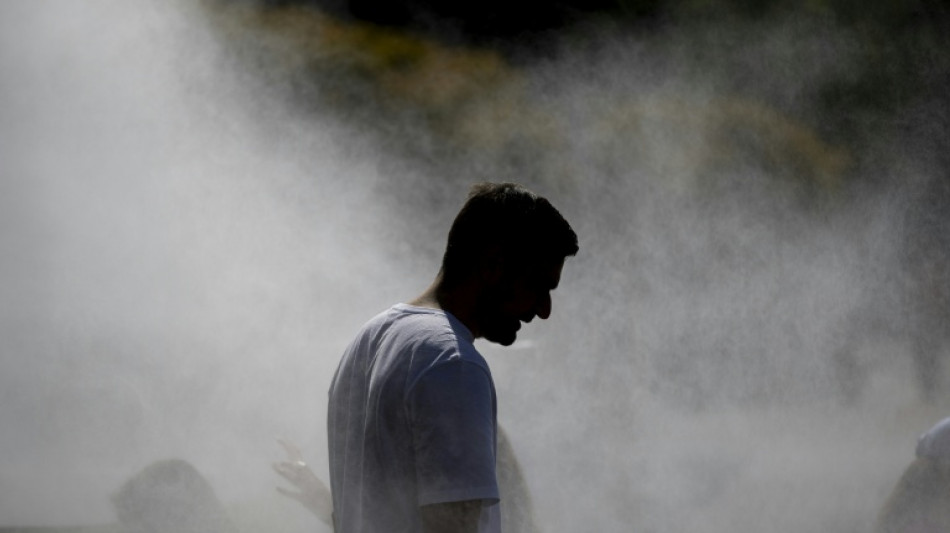
France presses ahead with street music festival despite extreme heat / Photo: ROMEO BOETZLE - AFP
France went ahead with its annual street music festival on Sunday in boiling heat, with a third of the country on red alert and alcohol consumption banned in the streets.
Every year on June 21, musicians take over France, filling bars, street corners and rooftops as revellers celebrate the start of summer -- as measured by the summer solstice -- late into the night.
This year, however, the Fete de la Musique coincides with a ferocious heatwave.
A record 35 departments -- roughly a third of the country -- have been placed under the highest heat alert.
Weather service Meteo-France warned that temperatures could reach as high as 41C in some places as France finds itself at the epicentre of a heat anomaly also affecting southern Britain, Spain and Portugal.
While some French cities have cancelled street events, celebrations in others -- including Paris, Lyon and Strasbourg -- were largely going ahead.
The Louvre museum in Paris, though, announced that its planned free concert under its famous glass pyramid had been scrapped due to the heatwave.
To minimise health risks and prevent potential public disturbances, the government announced a ban on alcohol consumption in public places during the festivities in departments under red alert.
Some Parisians were in favour of the ban.
"I think it's a good thing," said Hailey Infante, 21.
"Honestly, it's really hot, and even a drop of alcohol can quickly go to your head."
Nicolas Pilc was more sceptical, saying the measure would have "absolutely no effect".
"Everyone will do whatever they want," said the 48-year-old.
- Paris street parties -
The government said it would be up to local event organisers to adapt festivities outside red-alert areas but alcohol will not be served at state-organised events.
Bartender Mona Jaffart said her establishment would not be selling takeaway alcohol and it would "just be a normal day" inside.
Last year, around two million people attended the June 21 street music parties in Paris alone, many of them travelling from Britain.
To ensure public safety, authorities have deployed 4,800 police officers and gendarmes, along with 2,500 firefighters, in and around the capital.
Gatherings along the lower banks of the Seine river will be prohibited to reduce the risk of people falling into the water.
Officials warned about risks linked to swimming, after four teenagers drowned in France on Saturday.
According to AFP estimates, around 53 million people in France will be affected by the heat on Sunday, with a further 45 departments under orange alert.
The number of departments on red alert has reached a record high, surpassing the previous peak of 20 recorded on July 24–25, 2019.
French President Emmanuel Macon on X urged citizens to "look out for others", especially the elderly, children and isolated or vulnerable people.
Thirteen of the 17 regions of neighbouring Spain were on orange alert on Sunday, while the northern Basque Country bordering France was on red.
The public screening of Spain's World Cup match against Saudi Arabia in Madrid was cancelled after national weather agency AEMET forecast temperatures could reach 40C in the capital.
Portugal's weather agency placed three inland districts on orange alert, warning of temperatures of up to 42C.
In Britain, the Met Office expanded its amber extreme heat warning for much of England for between Monday and Thursday, forecasting some places could reach 37C.
F.Cornelis--LCdB