An 'angel' in darkness after Venezuela's deadly quakes / Photo: Juan BARRETO - AFP
Just when Pedro Cordido thought all was lost, he heard Erick Roa's voice.
Cordido's eyes can't help but radiate with gratitude when he speaks about the volunteer rescuers who pulled him from the ruins of Venezuela's double earthquake, which killed more than 2,600 people.
He spent nearly 30 hours trapped in the fetal position after his building collapsed.
In seconds, the earth swallowed the 12-story structure, and he watched as Hernando, his adopted son, and Hernando's wife were sucked into a kind of dust devil, powerless to do anything to save them.
The darkness was total; there was no air. He couldn't move in any direction, pinned with sharp fragments all around.
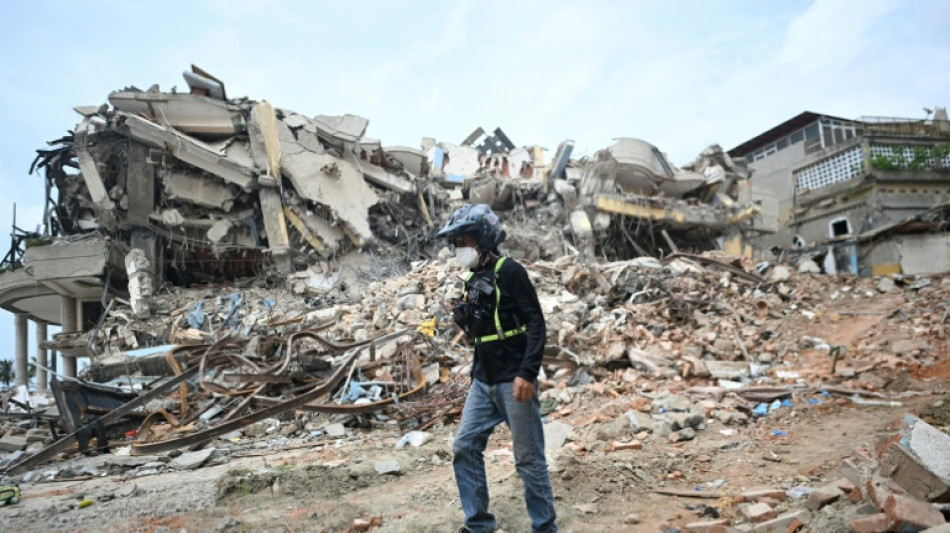
Then he heard Roa, who is one of a group of five volunteer rescuers who gathered in La Guaira, a popular beach resort 40 kilometers (25 miles) from Caracas, to search for survivors after the violent 7.2 and 7.5 magnitude earthquakes that struck on June 24.
A woman alerted them that she had just heard screams.
It was Cordido. The rescuers formed a human chain in the pitch black, using only a small flashlight. Roa and his companions initially crawled and then cut a hole to reach the site.
"There wasn't a single ray of light coming through a crack in the rubble; despair threatened to overwhelm me," Cordido told AFP from his daughter's house in Caracas.
Roa, a former military nurse, spoke to him for four and a half hours during the rescue. He tried to keep him awake, hoping he would stay alive. It worked.
Cordido suffered lacerations and is being cared for by a neighbor who is a nurse and visits him daily.
Of course, Cordido has not been the only one found under the rubble.
"It's been exhausting, crazy," Roa says about the countless hours they've worked both to find survivors and to recover bodies and return them to their families.
Official figures indicate that nearly 6,500 people have been rescued, many by volunteer teams.
- 'I always talked to him' -
On his index finger, Roa has a tattoo: "Faith in God."
Two years ago, he went through one of the hardest moments of his life; he attempted to take his own life, and an evangelical pastor intervened to stop him.
From then on, he says he understood that he had a purpose: to help others.
When the earthquake struck, Roa was resting at home in Caracas. A nephew texted him to say his ex-girlfriend was missing in La Guaira. He got on his motorcycle and set off to look for her.
She turned up safe and sound, but Roa decided to stay after seeing the magnitude of the tragedy.
He then met Enmanuel Andrade, Jose Luis Fonseca, Carlos Alexander Marval Balza and other rescuers working without sophisticated equipment -- but convinced that all they needed were hands to pull lives from the rubble.
Roa says he was "desperate" to help save Cordido.
"I always talked to him, telling him, 'Stay still, you're coming out with me,'" he recalls telling Cordido as they struggled to reach the spot where he was trapped.
Cordido says the phrase that gave him a second chance is etched in his mind: "Is anyone there?"
He shouted for help.
"With all his love, one of them told me, 'Pedro, I came from Caracas, and I came because I had to save you. God told me I had to save you. I love you,'" the survivor says, recalling Roa's words.
"How wonderful," Cordido recounts between sobs. "Without any specialized equipment to move the rocks, they used their bare hands to remove them until they could pull me out."
After leaving the hospital where he spent several days stabilizing, Cordido shared a message of gratitude with the man he calls his angel.
"Brother, I truly love you. My God, your words when you found me, the way you acted... I truly have no words to thank you. There aren't any," he says in a WhatsApp voice message.
"I never thought I would be rescued, and you arrived like an angel, opened the door, and said, 'I'm here to help you...' I love you, brother. I will love you forever."
V.Nijs--LCdB