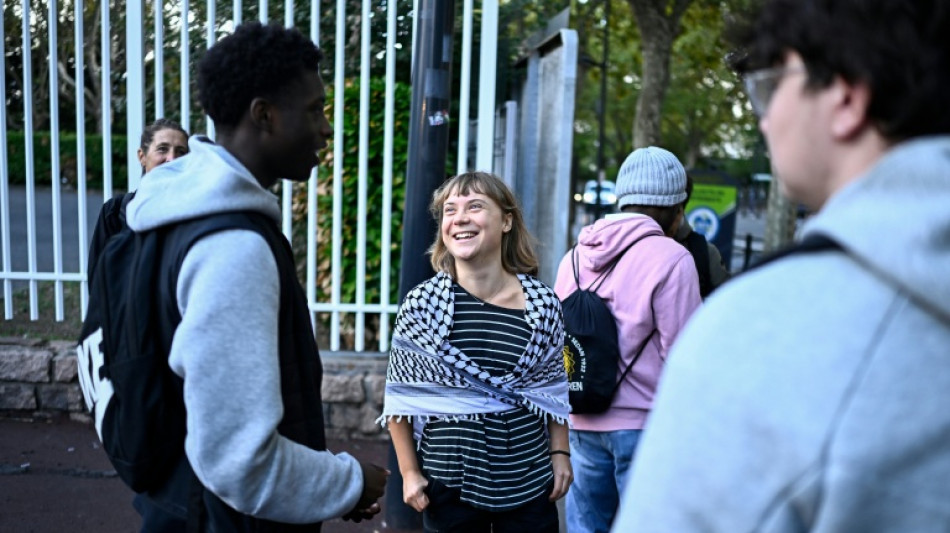
Activist Thunberg joins France student rally after violence at protests / Photo: JULIEN DE ROSA - AFP
French high school pupils staged fresh nationwide rallies Tuesday urging better learning conditions, supported by university students and Swedish activist Greta Thunberg, with authorities and participants wary of further violence.
With just months to go before elections to replace President Emmanuel Macron, French authorities had been hoping that the protests would start to ease ahead of half-term holidays to start at the end of the week.
But teenagers at high schools called lycees -- backed by university students, teachers, unions and the far-left opposition France Unbowed party -- have said their demands have not been met.
"They're not listening to us, so we're going to them," university student union l'Union etudiante wrote on X.
Outside an art college in Paris, 19-year-old Gabin Jaze--Gaugain was among dozens of students striking peacefully in support of high school pupils, as police vans lined up on the other side of the boulevard.
"It's a blockade in solidarity with the distress in public high schools in the suburbs and the rest of France," he told AFP.
"High school kids have suffered great brutality," he added after multiple allegations of police violence against protesters in recent weeks.
The student union reported 90 percent of universities had closed nationwide to show support.
Thunberg, who became famous as a teen for school strikes to demand action on climate change, stood among pupils demonstrating outside a school at the heart of the movement in the capital's largest suburb, Saint-Denis.
"Young people are not being included in the conversation. Our future is being robbed away from us," the 23-year-old told reporters at the Paul Eluard high school.
- 'Just don't get it' -
French students say they are determined to press the government to address the problems of too many absent teachers, dilapidated buildings, overcrowded class schedules and other grievances.
The protests since last month have seen teenagers pile up dumpsters and security barriers outside hundreds of France's 3,700 lycees.
The mobilisation was to include an early afternoon march through Paris, but rallies were alreay underway in other cities.
In the western city of Nantes, thousands marched behind a banner reading "Schools without money, a country without a future".
"I think there are a lot of us in France who are still motivated," 16-year-old Mariolino said.
"Those who think the anger will disappear with the holidays just don't get it."
In the northeastern city of Strasbourg, Adeline Ferier, 42, a middle school French teacher, said she was demonstrating to support her 16-year-old daughter.
"I think it's great that young people are aware of inequalities and are getting involved," she said.
More than 70,000 people took to the streets last Thursday in the last major event of a movement that sprang up in late September.
- 'Issues that deserve time' -
The demonstrations in recent weeks have mostly been peaceful, but clashes have occasionally broken out with police.
The education ministry said eight members of teaching staff were injured on Monday, mostly in the Paris region and the cities of Bordeaux and Lyon, in relation to the protests.
Authorities said fireworks fired through tubes injured two school workers in Reims, one school worker in a Paris suburb and a police officer outside a school in Marseille.
Tuesday's demonstrations supporting the students were to be followed on Saturday by wider public rallies against the rising cost of living.
Macron, speaking to reporters at a car show on Monday, urged restraint from protesters.
"These are issues that deserve time, consultations, discussion and respect," Macron said just months before elections to replace him.
More
than 6,800 people -- largely minors -- have been taken into police custody over the course of the protests, according to the justice ministry.
Police have opened internal investigations into 24 allegations of brutality against demonstrators.
After last week's nationwide demonstrations, the government promised some 3,000 substitute teachers would be deployed in the coming days to replace absent staff at the 114 worst-affected high schools.
The education minister said on Tuesday that 35 percent had already been assigned.
High school students are demanding a 10 billion-euro ($11 billion) boost for lycees.
burs-ah/rlp
P.Verhoeven--LCdB