SF Opera’s Energetic ‘Marriage of Figaro’ Cranks Volume to Eleven
San Francisco Opera has followed its recent production of Rossini’s The Barber of Seville with Mozart’s chronological sequel, The Marriage of Figaro. Running through November 29 at the War Memorial Opera House, the production is characterized by relentless energy and slapstick choreography that critics describe as both spirited and exhausting.
San Francisco Opera has launched a new production of Wolfgang Amadeus Mozart’s The Marriage of Figaro, following its earlier-season presentation of Gioachino Rossini’s The Barber of Seville. The two operas share a narrative continuity, with Figaro serving as the central character in both works. The current production is scheduled to run through November 29 at the War Memorial Opera House in San Francisco.
The Marriage of Figaro is set a few years after the events of The Barber of Seville. In this installment, the title character, portrayed by Slovak bass Peter Kellner, is working as a head servant and preparing for his marriage to Susanna, played by Slovak soprano Slávka Zámečníková. The plot complicates when Figaro discovers he has previously entered into a business arrangement with Marcellina, portrayed by Bay Area mezzo-soprano Catherine Cook, which obligates him to marry her if certain terms are not met.
Compounding the conflict is Dr. Bartolo, played by Italian bass-baritone Maurizio Muraro, who seeks to assist Marcellina in reclaiming Figaro from his previous romantic entanglements. Simultaneously, Count Almaviva, portrayed by UK baritone Thomas Mole, asserts his claim to Susanna based on an archaic feudal right known as the prima nocte. This development angers the Count’s wife, Rosina, who is played by Canadian soprano Olivia Smith.
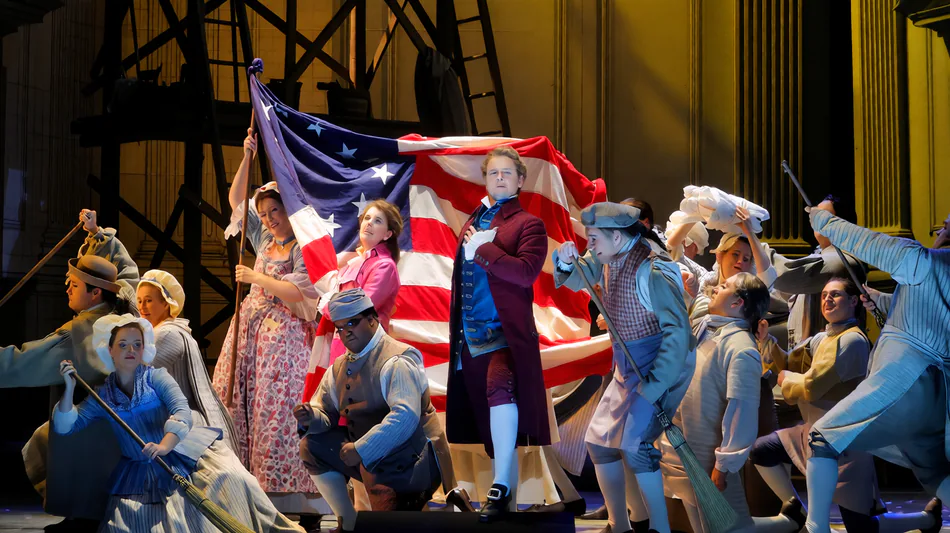
The production is directed by Shawna Lucey and conducted by Maestro Sebastian Weigle. Reviews of the performance highlight a high level of physical commitment from the cast. Lucey’s direction incorporates elements of commedia dell’arte, utilizing slapstick choreography where performers move rapidly across the set. The production emphasizes physical comedy, allowing performers to rely on bodily expression as well as vocal projection.
Catherine Cook and Slávka Zámečníková have been noted for their vocal power. Simone McIntosh, a Swiss-Canadian mezzo-soprano, performs in the role of Cherubino, a part traditionally sung by women despite the character being male.
Critics have described the production as intensely energetic, noting that it maintains a high level of activity throughout its duration. The performance is characterized as an endurance test for both the cast and the audience. While the energy prevents any lulls in momentum, the relentless pace has been described as exhausting. This stands in contrast to the previous summer’s production of The Barber of Seville, which was noted for having periods of lower energy.
The review notes that the production functions as a marathon performed at a sprint. It suggests that audiences with the capacity to tolerate sustained high-energy comedy will find the performance satisfying. The article also mentions that the production was viewed via livestream, noting the absence of masks in the audience areas during the broadcast.
Tickets and further information for The Marriage of Figaro are available through the San Francisco Opera.
The review is part of a column titled Drama Masks, which covers performing arts in the Bay Area. The columnist, identified as a born San Franciscan and longtime theatre artist, also discusses recent political developments in the region. These include the passage of Proposition M, the outcome of Proposition Y in Berkeley, and the progress of a public bank initiative in San Francisco. The columnist notes that Mayor London Breed secured the passage of three propositions aimed at increasing municipal control.
The article draws parallels between the political situation and the narrative arc of Shakespeare’s Richard III, suggesting that gaining absolute power can lead to isolation. It references the recent midterm elections and the shifting political landscape across the United States. The columnist observes that states previously considered conservative have become more liberal, while the term "socialism" has lost some of its negative connotation among voters.
The review concludes by noting that the production offers a stark contrast to the current political climate. It suggests that the relentless energy of the opera provides a form of escapism for audiences navigating a complex social and political environment.
P.Matthys--LCdB