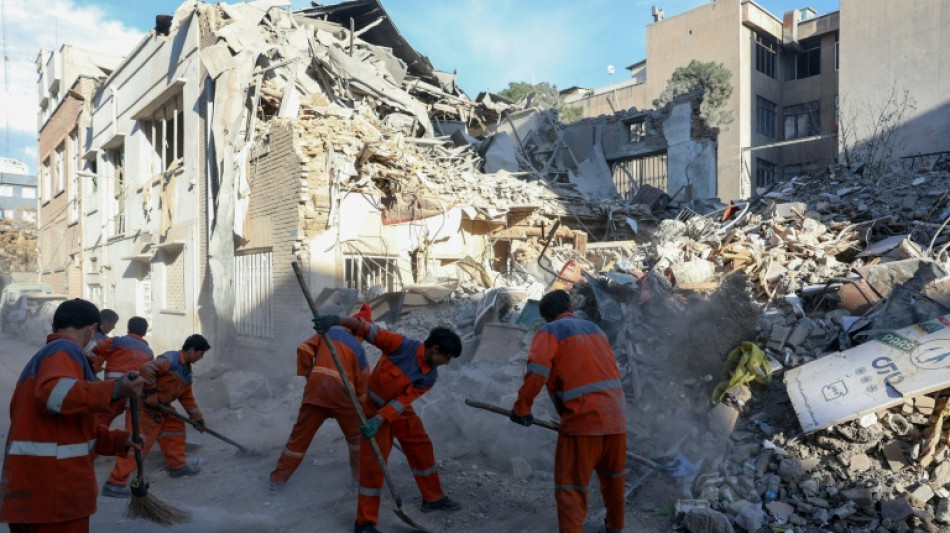
Pakistan makes last-minute bid to avert Trump threat to destroy Iran / Photo: - - AFP
Pakistan made a last-minute proposal Tuesday to avert catastrophic US attacks on Iran, hours ahead of a deadline set by President Donald Trump who warned a "whole civilization will die tonight".
The White House said it was aware and would respond to the proposal by Pakistan, which has sought to mediate after more than five weeks of US and Israeli attacks on Iran.
"Diplomatic efforts for peaceful settlement of the ongoing war in the Middle East are progressing steadily, strongly and powerfully with the potential to lead to substantive results in near future," Pakistani Prime Minister Shehbaz Sharif wrote on X.
He appealed directly to Trump to extend his deadline set for 8:00 PM Washington time (midnight GMT) by two weeks.
In turn, he asked Iran to commit for two weeks to fulfilling Trump's key demand -- reopening the Strait of Hormuz, the vital gateway for global oil which Tehran closed in retaliation for the war.
The latest threats from Trump, shocking even by his own provocative standards, brought disbelief and warnings that he was encouraging genocide -- potentially one day leading to war crimes charges against US servicemembers who comply.
"A whole civilization will die tonight, never to be brought back again. I don't want that to happen, but it probably will," Trump wrote on his Truth Social platform.
The rhetoric was an escalation from a profanity-laden post two days earlier, on Easter Sunday, in which Trump threatened to destroy all bridges and power plants in the country of 90 million -- a war crime unless proven that the sites are mostly for military use.
Pope Leo XIV said that "this threat against all the people of Iran" was "truly unacceptable".
- Threat of new type of attacks -
Speaking in Budapest, Vice President JD Vance said the United States had tools "that we so far haven't decided to use" against Iran, without explaining further.
The White House later denied to AFP that Vance was alluding to nuclear weapons.
The United States and Israel were striking key infrastructure even before Trump's deadline, with Israeli Prime Minister Benjamin Netanyahu confirming attacks on railways and bridges he said were "used by the Revolutionary Guards".
The Israeli military also offered a rare statement of regret after it acknowledged damaging a synagogue in Tehran, saying it had been targeting a senior Iranian commander.
Iran, run by Shia Muslim clerics, is home to around 100 synagogues for its historic Jewish minority.
First Vice President Mohammad Reza Aref said Iran was prepared "for all scenarios" from the United States.
"No threat is beyond our preparedness and intelligence," he added.
Infrastructure attacks reported by Iranian authorities Tuesday included a US-Israeli strike on a bridge outside the city of Qom and another on a rail bridge in central Iran that killed two people.
Regional authorities also said a US-Israeli strike shut down a key highway in northern Iran connecting the city of Tabriz with Tehran.
The Mizan news agency additionally reported a strike on railway tracks in Karaj, outside Tehran.
- Death 'not a joke' -
University student Metanat, whose classmate was killed two weeks ago in an attack, told AFP she felt "terrified and so should everyone else in the country".
The 27-year-old, who declined to give her last name, said as far as Trump's ultimatums were concerned, "some people think they are a joke", but "death is not a joke".
Iranian pensioner Morteza Hamidi said that among many emotions, he felt "gloomy for the future of the country after the war".
The 62-year-old added that he had seen Trump back down too many times to take his words seriously: "We are now numb to his threats".
State media published photos purporting to show groups of Iranians forming human chains to protect power plants as the hours to the deadline ticked down.
The show of patriotism in the face of attacks came several months after Iran's cleric-run government cracked down violently on mass protests, with rights groups reporting thousands of deaths.
As the deadline neared, Israel warned citizens of an increased risk of Iranian inbound attacks.
Kuwait urged its citizens to remain indoors from midnight until 7:00 am, while Bahrain's main port said it would be suspending operations starting early Wednesday.
The United States and Israel said that they attacked Iran to degrade its military capacity. Trump has alleged that Iran was near building an atomic bomb, an assertion not backed by the UN nuclear watchdog and most observers.
Since being attacked on February 28, Iran has responded by taking charge of the Strait of Hormuz, through which a fifth of the world's oil normally flows.
The move has sharply driven up global oil prices and put intense pressure on Trump -- who has made reopening the strait his foremost goal.
At the UN Security Council, Russia and China vetoed a resolution on reopening the Strait of Hormuz, a text already diluted to remove the green light Gulf states had sought to use force to protect the key shipping lane.
- Attack on oil island -
Apart from the infrastructure attacks, strikes were reported on Kharg island, a critical hub for the Iranian oil industry, according to Iran's Mehr news agency, although US media said the attacks were against military targets.
Earlier in the day a series of explosions was heard across Tehran, and Iranian media reported that 18 people, including two children, were killed in strikes in neighbouring Alborz province.
Overnight, attacks on Saudi Arabia hit a petrochemical complex in a sprawling industrial area in the eastern city of Jubail, a witness who requested anonymity told AFP, hours after similar installations in Iran were struck.
Loud explosions were also heard late Tuesday in central Baghdad where the US embassy is located.
Iran has responded to the war by striking Gulf Arab states that host US troops. Israel in turn has launched a major offensive into Lebanon, vowing to control land from which Iranian-linked Hezbollah has fired rockets.
The Israeli invasion into Lebanon has killed more than 1,500 people, according to authorities.
Israel on Tuesday issued a warning to all vessels in the maritime zone off Lebanon's south to head immediately north of the city of Tyre, warning that it would operate in the area.
burs/sct/des
P.Verhoeven--LCdB