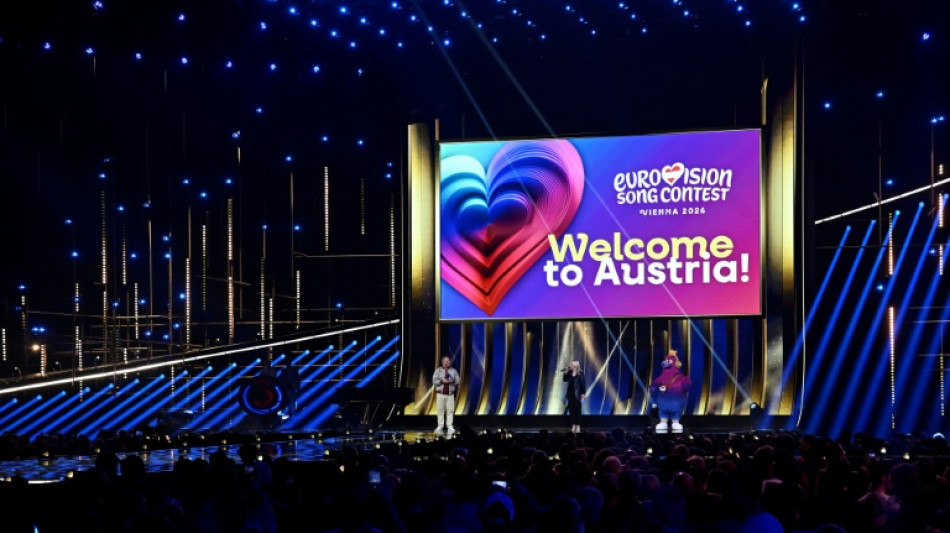
Israel takes the stage in semis of boycotted Eurovision / Photo: Tobias SCHWARZ - AFP
Israel will take to the stage as the Eurovision semi-finals kick off in Vienna on Tuesday, with its very participation triggering the song contest's biggest-ever political boycott.
This year marks the 70th edition of Eurovision, the world's biggest live televised music event which despite the razzmatazz rarely escapes the politics in the background.
Israel's war in the Gaza Strip prompted five countries to withdraw from the glitzy annual extravaganza: Spain, Ireland, Slovenia, the Netherlands and Iceland, with the first three refusing to broadcast this week's contest at all.
Eurovision director Martin Green vowed Monday to do "anything in our power to find a pathway back" for them.
The withdrawals mean 35 countries are taking part this week -- the fewest since entry was expanded in 2004.
The number would have been even lower but for Bulgaria, Romania and Moldova rejoining the fold.
Pro-Palestinian activists are planning to demonstrate on Tuesday by placing coffins in the centre of Vienna.
In a statement, they lamented that "despite its crimes, Israel has the opportunity to be celebrated this week in Vienna as a democratic and peaceful rainbow nation".
The withdrawals were triggered by the Gaza war, but broadcasters also raised suspicions that the public televoting system was being manipulated to boost Israel at Eurovision 2025 in Basel, Switzerland.
Furthermore, some broadcasters voiced concerns about media freedom, with Israel preventing their journalists from accessing Gaza.
Amichai Chikli, Israel's diaspora affairs minister, said a "sharp and coordinated surge in antisemitic and anti-Israel discourse surrounding Eurovision 2026" had been detected.
"This situation is a direct continuation and result of the conduct of European governments and public bodies, which choose, in a hypocritical and weak manner, to boycott the competition."
- Finnish flamethrowers -
Thanks to operatic singer JJ's victory in Basel with "Wasted Love", Austria is hosting for the third time, having staged the 1967 and 2015 contests.
Fifteen acts representing their countries will compete in Tuesday's semi at the Wiener Stadthalle, with 10 going through to Saturday's grand final.
The front-runners to qualify are Finland, Greece, Israel, Sweden and Croatia.
Finland's Linda Lampenius and Pete Parkkonen are the overall Eurovision favourites with "Liekinheitin", or "Flamethrower".
"We are so much into the music and what we are doing in the numbers, so that's what we are actually always going for: the feeling. It has to come from here: from the heart," violinist Lampenius told AFP.
Israel's Noam Bettan will perform "Michelle", a song in Hebrew, French and English.
San Marino, Georgia and Belgium could struggle to go through, according to bookmakers.
"The only stress I put on myself is to want to do things well," Belgium's entrant Essyla told AFP.
Moldova opens the show at 1900 GMT, returning to Eurovision after missing last year's event.
- Coffee house inspiration -
Semi-finals were introduced in 2004 and give acts the chance to establish themselves with viewers before the grand final.
Fifteen more acts compete in Thursday's second semi, with 10 going through.
This year, the semi-finals will be decided by public vote and also by professional juries, back for the first time since Turin 2022, in a bid to assuage fears over televote manipulation.
Alongside Eurovision major financial backers Britain, France, Germany and Italy -- hosts Austria have guaranteed spots in Saturday's 25-country final.
Eurovision 2026 executive producer Michael Kroen said they had drawn on classic Viennese coffee house culture to build the show.
"The creativity and the intellectuality was based in the coffee houses, and very great people lived in Vienna at the same time and created a lot of good stuff for the world," he told reporters on Monday.
"This was our inspiration and we're trying to uphold this story... and present you modern Vienna."
Each competing country has a dedicated coffee house in the city for fans to congregate at.
B.Hendrix--LCdB