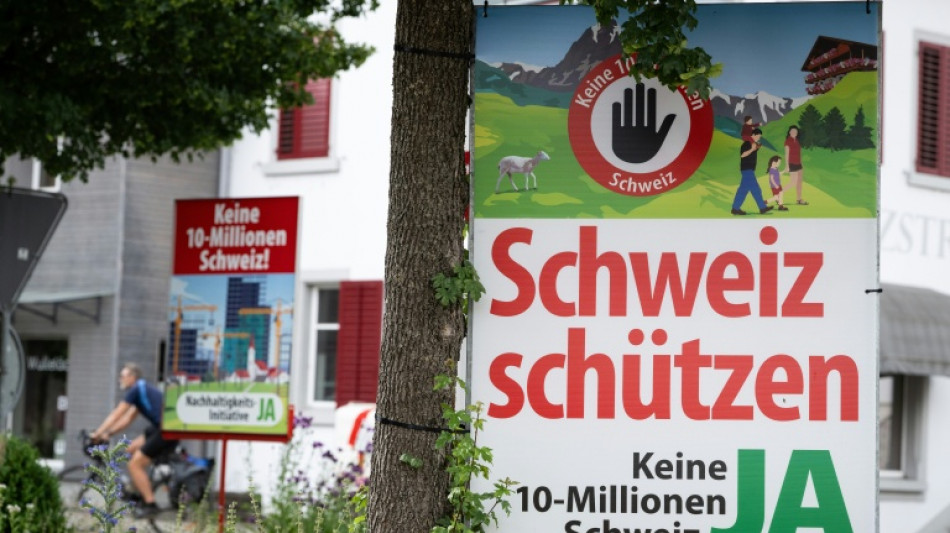
Swiss reject divisive anti-immigration proposal / Photo: SEBASTIEN BOZON - AFP
Swiss authorities and economic players breathed a sigh of relief Sunday after voters narrowly rejected a divisive anti-immigration proposal to cap the country's population, which had sparked warnings of "chaos".
After a tight race, nearly 55 percent of Swiss voters rejected the "No to a Switzerland with 10 million!" initiative, put forward by the hard-right Swiss People's Party (SVP), according to initial projections from the gfs.bern institute.
Swiss Justice Minister Beat Jans welcomed the vote, telling a press conference that the Swiss people "have sent a signal of stability, openness, and reliability".
The rejected proposal called for measures to stop the wealthy Alpine nation's population -- currently 9.1 million -- going above 10 million before 2050.
In a country where foreigners make up more than a quarter of the population, the proposal, if accepted, would have slammed the brakes on immigration.
The SVP, Switzerland's largest party, insisted drastic measures were needed, blaming "mass immigration" for a host of problems, from housing shortages and rising rents to overcrowded trains and traffic jams.
The initiative faced broad opposition from the government, parliament and multiple sectors of the economy.
Prior to the vote, opponents had warned the proposal risked crippling swathes of the economy and Switzerland's relations with the European Union, its main trading partner.
Jans had warned it could provoke the Swiss equivalent of Brexit.
- High stakes -
Swiss employers and unions alike welcomed the result.
"We are very relieved and happy. This is an important result for our country and for our relations with the EU," Monika Ruhl, director of the employers' organisation economiesuisse, told public broadcaster RTS.
The Swiss Trade Union Federation agreed, saying in a statement that "by rejecting the SVP initiative, the Swiss people have said no to isolationism and xenophobia".
SVP meanwhile said voters had missed an opportunity to address the "colossal challenges" posed by "mass immigration".
"It's a disappointing Sunday for us, but also for all of Switzerland," Marcel Dettling told reporters, while noting that voters in rural areas had overwhelmingly supported the initiative.
Turnout for the vote reached nearly 59 percent -- far higher than the average of 49 percent for popular votes in Switzerland in recent years.
He said it was "not astonishing", given that "beyond the question of immigration policy, Switzerland's European policy was also partly at stake."
While SVP had suffered a defeat, Sciarini stressed that it was "a minor one", pointing out that the party, which garners around 30 percent of the vote in parliament, had won over 45 percent of voters with its proposal.
SVP parliamentarian Thomas Aeschi agreed, insisting to AFP that Sunday's result sent "a very strong message".
He said it showed that a "very large portion of the Swiss population does not want that this immigration as we've seen it today continues".
While welcoming the rejection of the SVP initiative, economiesuisse acknowledged that it was "clear that immigration is a concern for the population".
"The people have given politicians a yellow card," it said.
- Conscientious objection -
Under Switzerland's direct democracy system, voters on Sunday also voted on and approved a new law aiming to limit access to civil national service in favour of military service.
The war in Ukraine and other geopolitical tensions are pushing European countries to bolster army numbers.
That referendum passed with 52.5 percent of voters in favour, the final results showed.
It was the political left in the militarily neutral country that called the referendum. They said the bill was dangerous and could ultimately lead to the alternative to military service being scrapped altogether.
Switzerland has compulsory military service for men. They serve in a unique militia system in which army conscripts do at least four months' service before being called up repeatedly over a decade for weeks-long refresher sessions.
People who conscientiously oppose military service have since 1996 been permitted to perform civilian service instead.
Since access to civilian service was simplified in 2009, the numbers choosing that option have steadily climbed -- a trend the government warned had become "problematic".
R.Michiels--LCdB